
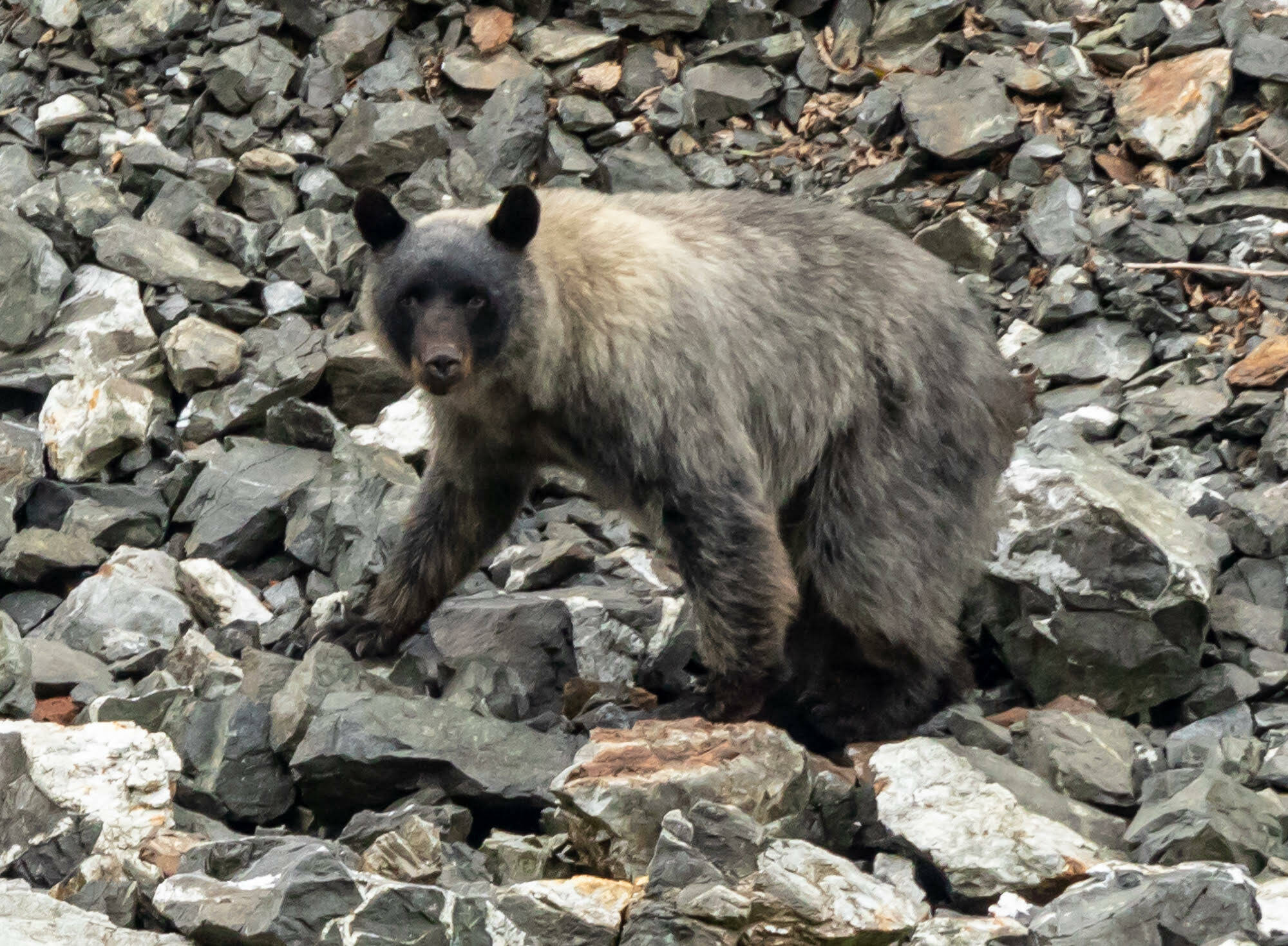
Until recently, not much was known about the grayish bears sometimes spotted in Southeast Alaska, said Tania Lewis, a wildlife biologist for the National Park Service at Glacier Bay National Park and Preserve.
The bears — known as “glacier bears” in English and sik noon ”bear that disappears” in Lingít — are unique to Southeast Alaska with a genetic history influenced by the region’s glaciation, according to Lewis.
A better understanding of the bears has emerged thanks to research spanning over a decade and including samples from hundreds of bears. During a virtual installation in the U.S. Forest Service’s popular Fireside Lecture series, Lewis shared insights researchers gleaned, theories about why the bears have their captivating coloration and how a better understanding of the rare bears started with nuisance animals in Juneau.
Tania Lewis, a wildlife biologist for the National Park Service at Glacier Bay National Park and Preserve, spoke about glacier bears during a virtual Fireside Lecture on Friday. The lectures, a popular series held by the U.S. Forest Service, are free and scheduled for Friday evenings through March. (Courtesy Photo / Tania Lewis)
A bear of a different color
Despite their name, black bears aren’t always black, Lewis said, although that is the most common color.
Glacier bears are one color variation. Others include the relatively common cinnamon-colored black bears and the white kermode bears, also known as “spirit bears,” found on the coast of British Columbia.
Even within glacier bears, there are color variations, Lewis said.
“They’re mostly gray, but they can be almost white or even black with just white tips,” Lewis said.
Colorful theories
There are multiple theories about why the bears have their unusual color.
Since the known population of bears are near ice fields, Lewis said it is thought the color may offer a camouflage advantage.
“Maybe there’s an association or potentially a selective advantage between coloration and ice-covered areas,” Lewis said.
Additionally, Lewis said studies done on similarly colored kermode bears, found the lighter color is advantageous when catching salmon as it allows the bears to better blend in with the sky.
Lewis said as is the case with spirit bears, the coat color seems to come from a recessive gene that came about during isolation during an ice age.
Since the gene is recessive, it must be present in both parents for offspring to present it, and a bear can carry the gene while looking like an otherwise typical black bear.
That means a normal-colored bear can potentially have glacier bear cubs.
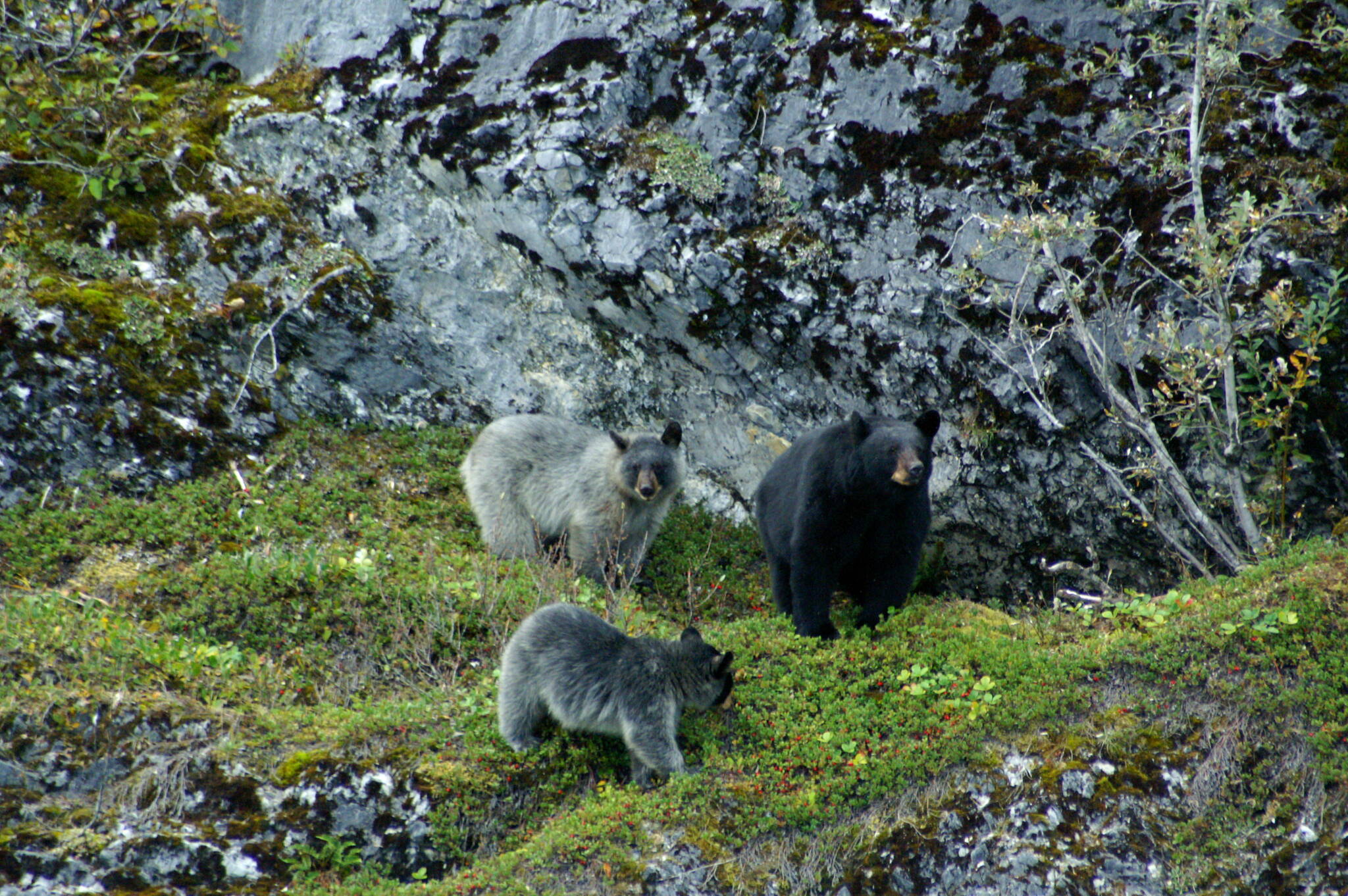
Black bears with more typical coloration can produce offspring with grayish coats. Bears with with the coloring are known as glacier bears. There are multiple theories for why the bears have their unusual coloration. They include a potential camouflage advantage in icy terrain and possibly an advantage when catching salmon. (Courtesy Photo / Cody Edwards)
Same size as other black bears
It was long thought that glacier bears are typically smaller than black bears.
However, harvest records show no size difference between glacier bears, cinnamon-colored black bears and black-colored black bears.
“There’s probably no difference from any other black bear other than their coat color,” Lewis said.
Why did the size discrepancy rumor persist?
Lewis said she has no hard evidence, but she thinks it may stem from trophy hunting.
Typically, she said, trophy hunters would want to take an especially large bear. However, glacier bears may have been sought regardless of their size because of their atypical color.
That could have created a false impression that glacier bears were smaller than black- or cinnamon-colored bears.
Rare bears
While Lewis said it was difficult to get a hard count on the number of glacier bears in the area, she said for many seeing one would be a once-in-a-lifetime event.
About one glacier bear is harvested every year in the portion of Southeast Alaska from Juneau to Haines, Lewis said, and about 1-4 are harvested every year near Yakutat.
That accounts for .4% of black bears harvested in Southeast Alaska, Lewis said.
Lewis said sightings and harvests have stayed relatively steady over the years, and the numbers are too small to allow for an estimate of how many glacier bears reside in Southeast Alaska.
With an apparent link between the bears and ice fields, Lewis said how climate change will affect glacier bears is an open question.
“Deglaciation of this region started a long time ago, but it is being greatly accelerated by human activity,” Lewis said.
She said that includes some positives, such as potential range expansion fueled by an increase in habitat and an increase in berries and flowers in warmer weather.
“But there are some bad sides, too,” Lewis said.
These include the loss of alpine habitat, weather inhospitable to salmon and ocean acidification. Additionally, populations kept separate by melting glaciers could come into contact, and glacier bear genetics could be diluted.
“There is some potential threats from climate change, specifically for glacier bears,” Lewis said.
She said bear conservation, including not allowing bears access to human food, and fighting climate change are good for both glacier bears and their more typically colored counterparts.
Capital city connection
A research project that included tissue and hair samples from hundreds of black bears was jump-started by a glacier bear in Juneau.
In the early ’00s, multiple nuisance glacier bears in Juneau were relocated out of town and a few died after being struck by vehicles on Egan Drive, Lewis said.
She said it’s likely the bears were related to each other.
While Lewis said people at the time seemed unaware of the rarity of the bears, Alaska Department of Fish and Game Biologist Neil Barten recognized the unlikely opportunity. Barten took samples from the dead bears.
“Those were the first samples that we got,” Lewis said.
Over a decade and hundreds of hair and tissue samples later, research revealed 10 distinct populations of black bears around Southeast Alaska —generally separated by fjords and ice.
Of those populations, four were found to have glacier bears, including populations located near Yakutat, the western area of Glacier Bay, Haines and Skagway and Juneau.
It notably did not include a population of bears located on the Chilkat Peninsula that reside in between two populations known to include glacier bears, Lewis said.
“The Chilkat, while it does have some glaciers high in the mountains, it’s not a big ice area, it’s more just snow-covered mountains, so that suggests there’s either an unsampled population of black bears with glacier bears connected these, ” Lewis said, adding a northern corridor could be a possible location. “Or maybe there’s an association or possibly selective advantage for glacier bears with large ice fields.”
Watch the full Fireside Lecture below
• Contact Ben Hohenstatt at (907)308-4895 or bhohenstatt@juneauempire.com. Follow him on Twitter at @BenHohenstatt.
