
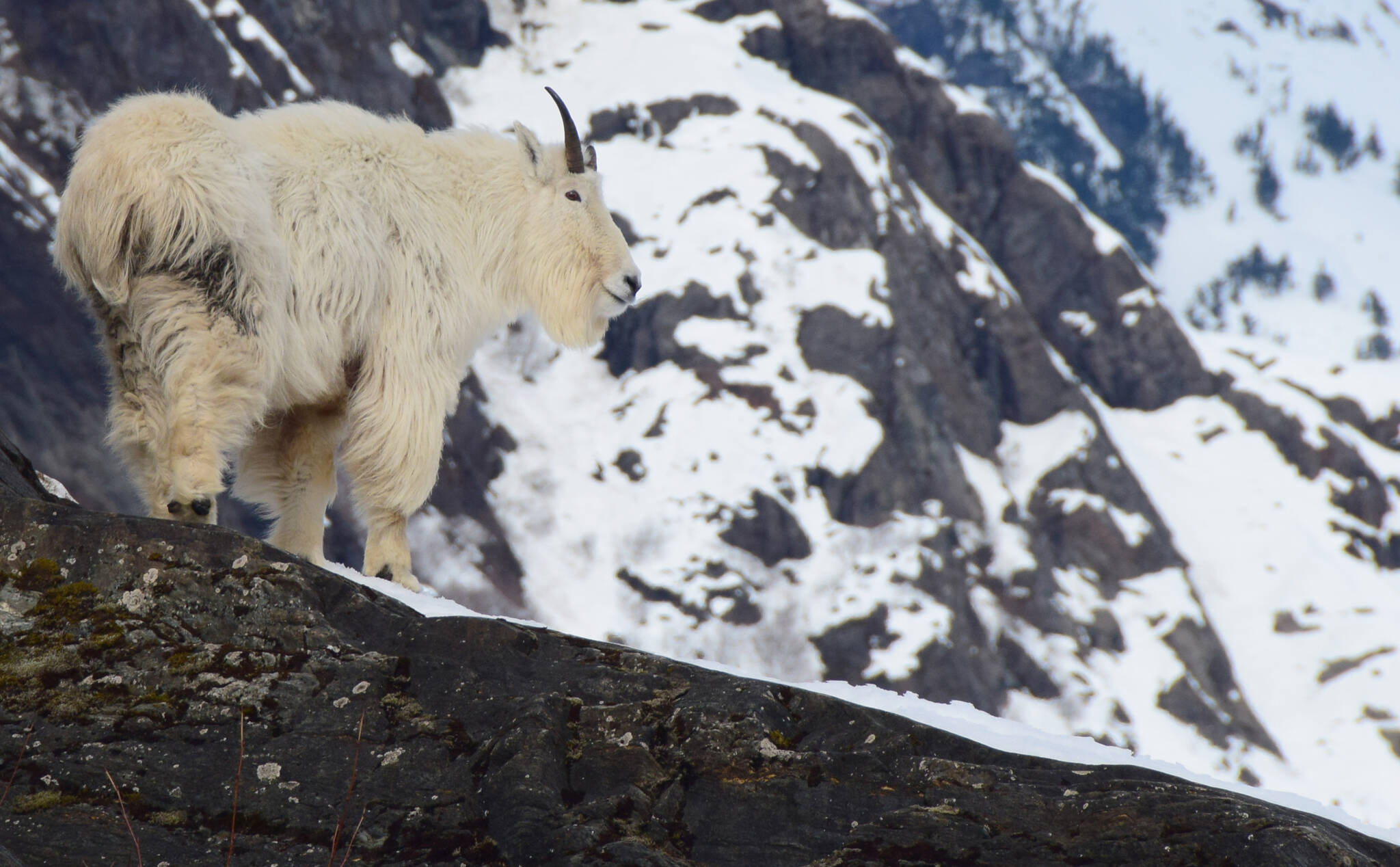
There is little trial and error when it comes to navigating avalanches. Especially if you’re a mountain goat, without access to an Intro to Backcountry course or avalanche airbags.
Kevin White presented “Living on the Edge: The Ecology of Mountain Goats and Avalanches” before a crowd of over 100 at Egan Library on Oct. 25. The lecture marked the third installment of this fall’s Evening at Egan lecture series.
The mountain goat is a “sentinel species of alpine climates,” White said, offering important insight into how these ecosystems are changing.
White and his team of researchers drew on field data from tracking 600 GPS collared mountain goats over a 17 year period across Klukwan, Lynn Canal, Baranof Island and the Cleveland Peninsula.
They found that 36% of mountain goat mortalities — 7% of the total population — were caused by avalanches, averaging data from across the four regions studied. In a single season, avalanches can elicit population declines that take 11 years — about one and a half mountain goat generations — to recover from.
“One bad avalanche event can set a population back for a generation or more,” White said. “So that’s pretty significant, and that provides us with some important insights about how snow and subsequent avalanches can impact mountain goat populations.”
Still, avalanches aren’t all bad for mountain goats. They can expose ground and vegetation, facilitating earlier growth of food sources. The nimble creatures are better equipped to navigate steep mountainsides than most other animals, making avalanche-prone terrain a refuge from predators.
But crossing a snowy slope, whether to find food or escape predation, presents the risk of death.
White and his team, in effect, act as mountain goat coroners in studying and documenting the causes of mountain goat deaths. In one photo in White’s presentation, a black bear waits patiently for a brown bear to finish scavenging a mountain goat carcass. White said the risks carnivores will take to scavenge them demonstrates the mountain goats’ valuable place in the food chain.
White’s team also studied the future of the region by running general circulation models, which simulate change to climate systems. Their findings suggest that mountain goat populations are not likely to fare well against avalanche conditions in coastal Alaska in the future.
Avalanche dynamics, White explained, depend heavily on snowpack stability. Even a relatively stable layer of snowpack will fail under the weight of a huge amount of snow. But it doesn’t take much snow to trigger a slide on a weak base layer.
“Those are important sort of fundamental mechanisms to understand and in order to kind of think about how climate change might influence avalanche occurrence and frequency and distribution across the landscape,” White said.
White concluded the lecture by opening up the floor for questions.
The audience’s youngest member, Hali, age 7, asked, “How high do mountain goats climb?”
Mount Sinclair, one of the highest peaks in the Lynn Canal study area between Juneau and Haines, stands at 6,800 feet. White said GPS collars tracked goats roaming near its summit, the highest elevation his team had recorded.
“Will you tell the story about the mysterious goat collar that came back to life?” another audience member asked.
Around 20 years ago, White said, the team tracked a collared mountain goat southeast of Haines. The goat had died and was buried deep under the snowpack. When they returned the following spring, they found the site, scattered with goat hair and bones, but no collar.
They signed it off as a mystery, but White kept that collar’s frequency in the receiver.
“[I] would check on it, like, ‘Who knows, maybe it’s going to come back to life or something.’ And sure enough, it did, except it was three miles away from the original site,” White said.
They eventually tracked the collar to a forest of thick alders, and were circling the area when they spotted a black bear with a collar on.
“Sure enough, it turned out to be the black bear came across this mountain goat that died at the end of winter, scavenged on it, and then, because bears are so curious, it managed to clip the collar on, collared itself, and was walking around for a year and a half,” White said.
The collars have a mechanism to automatically release before the battery dies. When the collar eventually popped off, they located and retrieved it from a salmonberry patch.
“That’s one of the more remarkable things that we’ve observed over the course of these studies,” White said.
White’s work focuses on the Rocky Mountain goat, one of 32 species of alpine ungulates across the world. As he noted in closing, habitats with both alpine ugulates and avalanches cover about 6% of Earth’s land area, spanning seven continents.
For scientists like White, that means plenty more opportunities to study life on the edge.
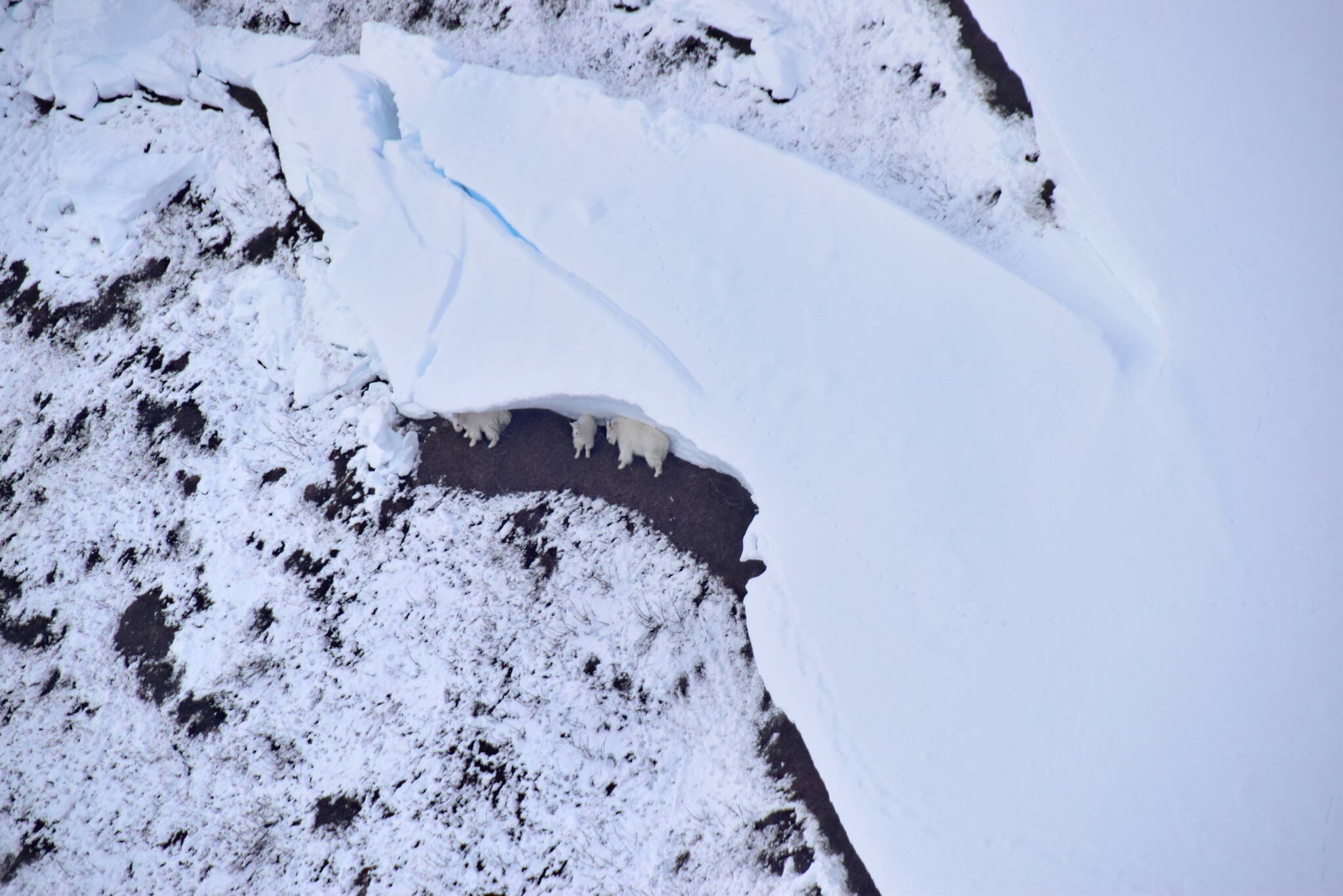
Mountain goats sheltering beneath the fracture line of a mid-winter glide avalanche, Summit Creek, Klukwan, Alaska. (Photo by Kevin White)
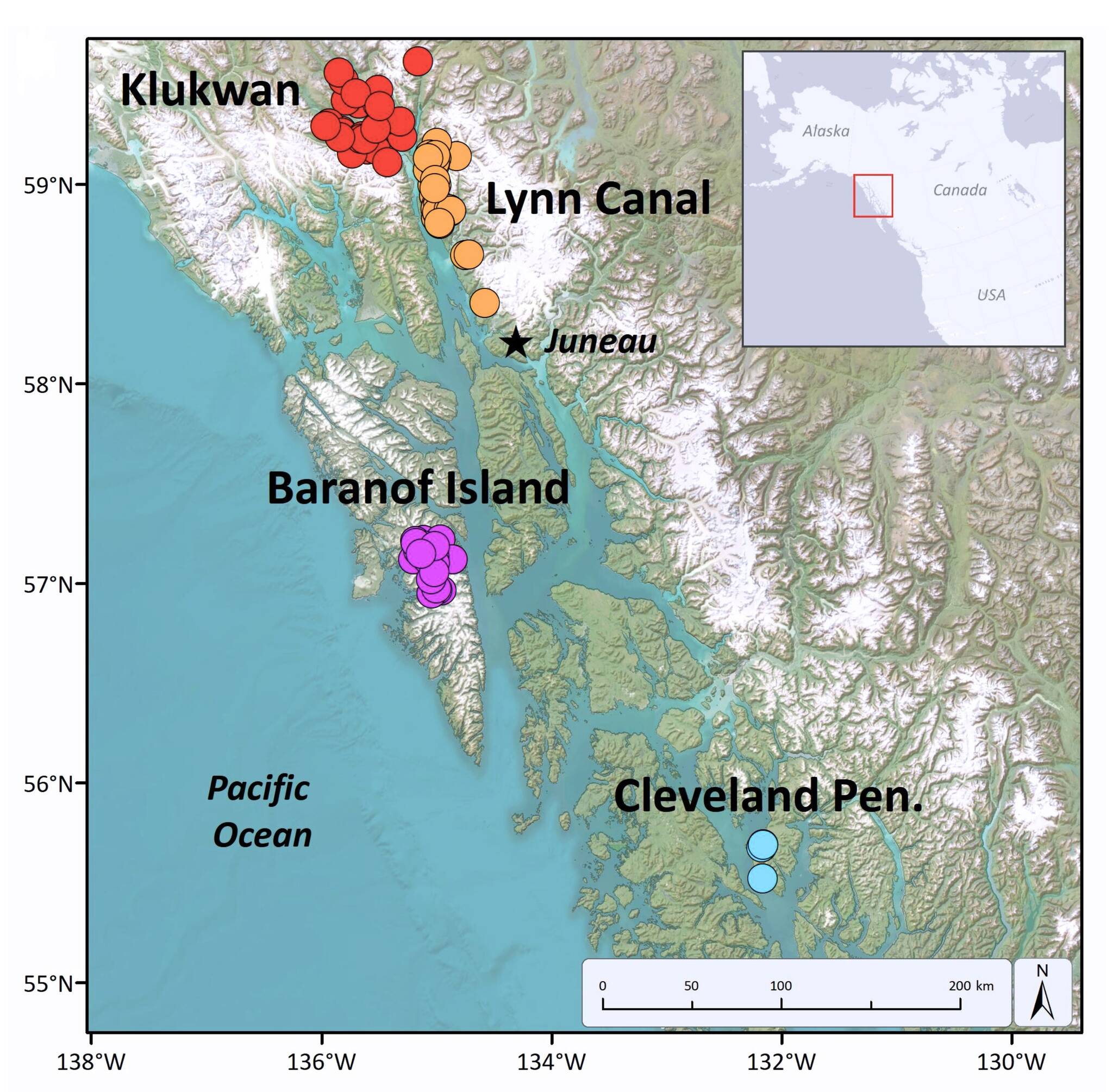
Map depicting the four study areas and locations where radio-marked mountain goats were studied and died in avalanches during 2005 – 2021 in coastal Alaska. (image by Kevin White)
