
Old languages need new words.
The Tlingit language is still spoken today, which means speakers of the Alaska Native language need words for technologies and ideas that would not have been known to their ancestors.
In that way, the Tlingit language lexicon is still changing and growing as new words are coined and ripple out to the few but growing chorus of speakers.
“It takes a while (for new words) to catch on,” said Florence Marks Sheakley, who was one of the dozens of fluent speakers at Centennial Hall for Day 2 of the Voices of Our Ancestors language summit. “You have to go to all these speakers.”
There is not yet a body that officially mints new words, so the invented ones do need to be spread and catch on to become widely used.
“We don’t have a formal process, but we’re trying to develop it,” said X’unei Lance Twitchell, Associate Professor of Alaska Native Languages Arts and Sciences at the University of Alaska Southeast and frequent speaker at the three-day language summit.
Sheakley and Ruth (Jackson-Wilson) Demmert, who were seated near each other at the summit, said they would like elders to gather to come up with something official.
As it stands now, fluent speakers told the Capital City Weekly words are forged in a few different ways for different reasons.
[Photos from the language summit]
Descriptive words
“This is new,” Demmert said and pointed to her cellphone.
One commonly used work for cellphone is galtú a tóonáx yoo xadul.átgi át, which literally translates to pocket thing through which someone talks.
“There’s a lot of us that come up with words that we think will fit,” said Sheakley, who was seated next to Demmert. “When we name it, we think of a description of what it does.”
That’s why a word for bicycle, a kát sh kadultsext át, translates literally to the thing you kick yourself around on, Twitchell said.
“A lot of times, in Tlingit, you try to describe what a thing does in as few words as possible,” said John Buller, President of the Yakutat Tlingit Tribe.
Sometimes that concept extends to animals not native to Alaska.
Twitchell said it often comes up when trying to translate children’s books.
“As we formulate new words, sometimes we’ll look at something like, animals and say, ‘Is there something like that here?” Twitchell said. “We have cow, pig and sheep translated, and those are kind of the rock stars of children’s books.”
Physical descriptions are also an option if there isn’t an obvious local relative.
Twitchell said a Tlingit word for elephant that literally means limp nose.
“That’s a newer word for elephant,” said Hans Chester, a Harborview Elementary teacher at the conference, who has coined many words inside and outside the classroom. “There’s one elders taught me in that means really long nose.”
Chester said speakers would understand each other regardless of the word used for elephant.
Borrowed words
Tlingit language also includes cognates, or sound alike words and words borrowed from other languages.
Buller said chai, the Russian word for tea, is similar to the Tlingit word cháayu, and there are other Alaska Native words that share a similar post-contact origin.
The Tlingit word for car is káa, and Twitchell said it is similar across Tlingit, Tsimshian and Haida languages.
There is influence from other Native languages, Twitchell said, and words from Alaska’s interior and the Chinook language also have a presence in the Tlingit dictionary.
New cognates are also still coming into being, too.
When Chester’s niece, Helen John, now 13, was 4, she asked Chester what the word was for penguin, and upon finding out there was no word, John came up with the soundalike gwengwen.
Chester said the word is now commonly used among fluent speakers.
Occasionally, words don’t need to be translated and can be used as they are.
Twitchell said he was talking with a young person who was discussing video games.
“I said, ‘Let’s just use PlayStation 4, we don’t need to translate brand names,” Twitchell said.
Fun with words
Necessity is often what leads to the creation of new words.
In a school setting, Chester has come up with words for the daily schedule, recess, reading and more.
“I think about other words I know and how it’s related to words I know,” Chester said.
He also comes up with phrases that are formed in spontaneity and fun.
While Chester was talking about Tlingit words, someone’s cellphone rang and played “Diamonds” by Rihanna.
Chester sang it back using Tlingit words.
“I try to translate pop songs into Tlingit,” Chester said. “Sometimes there aren’t words for the music I like to listen to.”
Similar impulses led Chester to confirm whether a word he invented for “cray cray” made sense.
“It’s shkaháaháa, which comes from shkahaaadí, which means crazy,” Chester said. “I said it to my teacher, and she laughed, and I said, ‘OK, this works.’”
What the words mean
Twitchell said the words that do and don’t yet exist can offer a glimpse into a culture.
“You’ll notice everyone just says government,” Twitchell said. “There’s no word for government. There’s not a real word for freedom. That’s a very American thing. Sometimes these things reveal a value system.”
That’s partly way Chester said one of his pet peeves is when new words are coined that don’t fit in with the Tlingit world view.
As an example of that worldview, Twitchell recalled a moment of clarity he had when he realized that the word for generous literally translates to not stingy.
“It was just assumed you would be generous,” Twitchell said.
• Contact arts and culture reporter Ben Hohenstatt at (907)523-2243 or bhohenstatt@juneauempire.com.

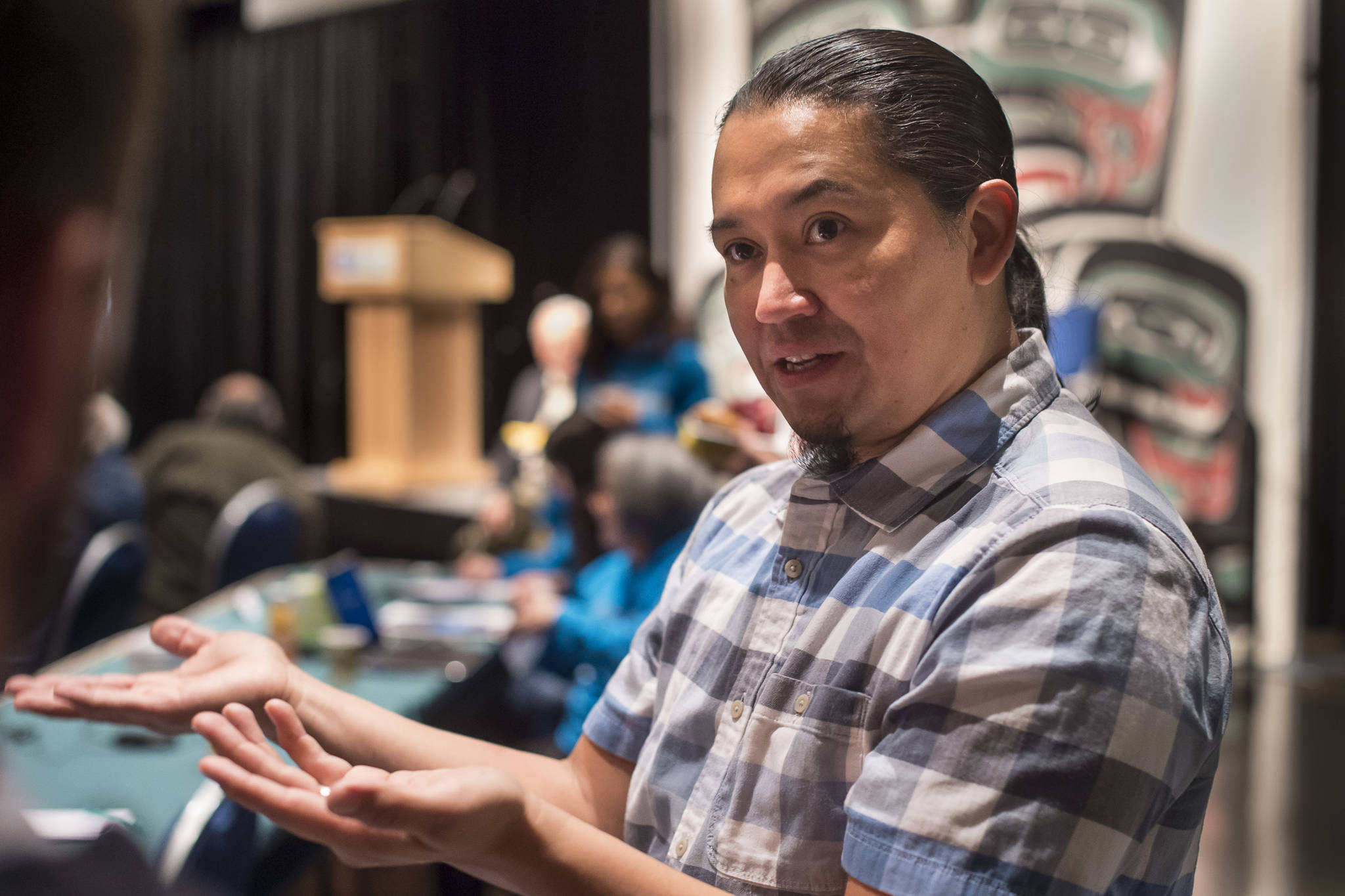
Hans Chester, a teacher in the Tlingit Culture, Language and Literacy program at Harborview Elementary School, talks about how new words are created in Native languages at the Voices of Our Ancestors Language Summit at Centennial Hall on Wednesday, Nov. 14, 2018. (Michael Penn | Juneau Empire)
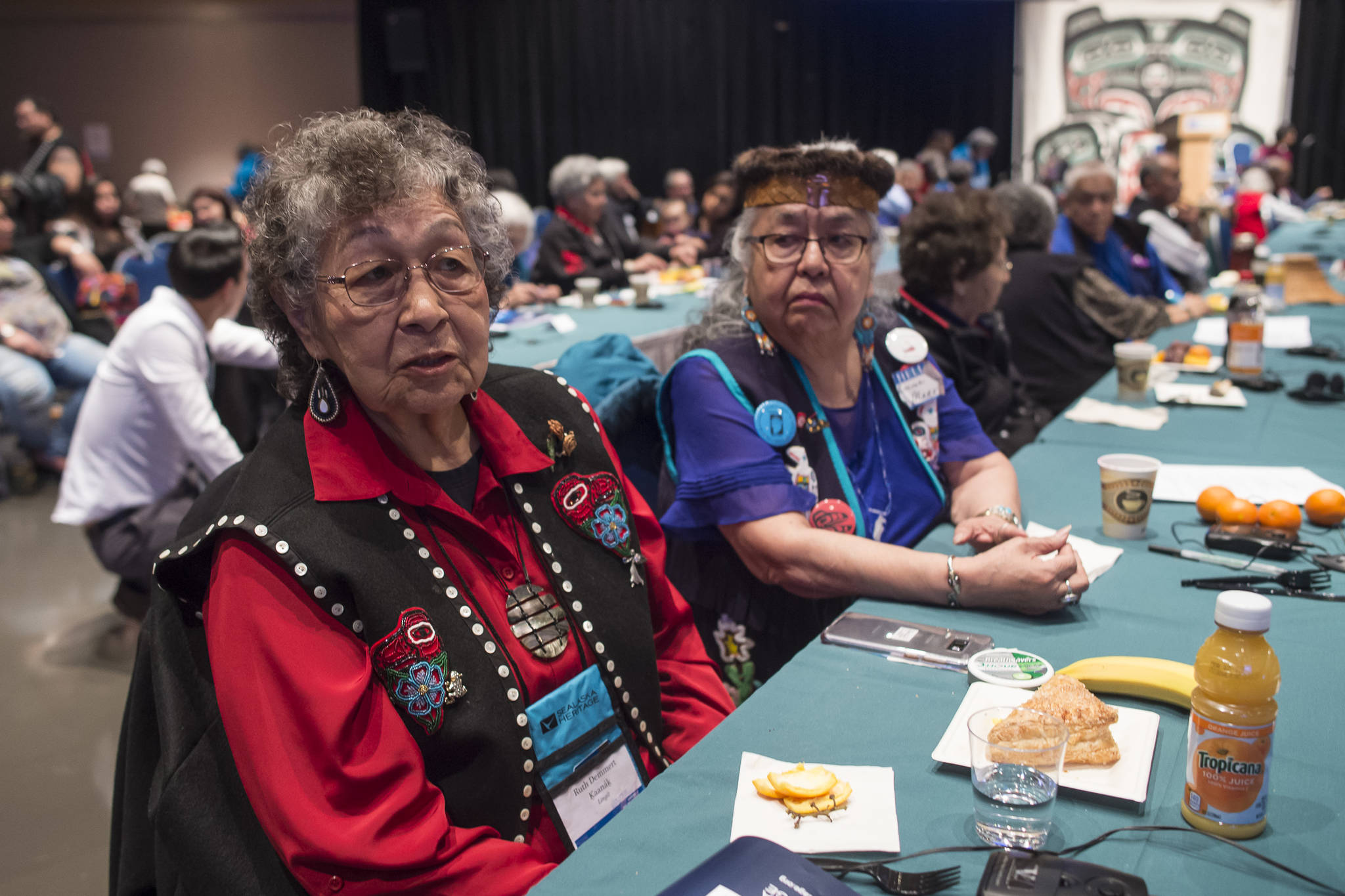
Ruth Demmert, left, and Florence Sheakley talk about how new words are created in Native languages at the Voices of Our Ancestors Language Summit at Centennial Hall on Wednesday, Nov. 14, 2018. (Michael Penn | Juneau Empire)
