
Sputnik 1 orbits Earth in this artist’s rendition by Gregory Todd. (Creative Commons)

Sputnik 1 orbits Earth in this artist’s rendition by Gregory Todd. (Creative Commons)

Alaska Science Forum: The first satellite’s Alaska connection

The first satellite’s Alaska connection

On any clear, dark night you can see them, gliding through the sky and reflecting sunlight from the other side of the world. Manmade satellites now orbit our planet by the thousands, and it’s hard to stargaze without seeing one.

The inky black upper atmosphere was less busy 68 years ago, when a few young scientists stepped out of a trailer near Fairbanks to look up into the cold October sky. Gazing upward, they saw the moving dot that started it all, the Russian-launched Sputnik 1.

Those Alaskans, working for the Geophysical Institute at the University of Alaska Fairbanks, were the first North American scientists to see the satellite, which was the size and shape of a basketball, and, at 180 pounds, weighed about as much as a point guard.

The Alaska researchers studied radio astronomy at the campus in Fairbanks. They had their own tracking station in a clearing in the forest near Ballaine Lake on the northern portion of university land. This station, set up to study the aurora and other features of the upper atmosphere, enabled the scientists to be ready when a reporter called the institute with news of the Russians’ secret launch of the world’s first manmade satellite.
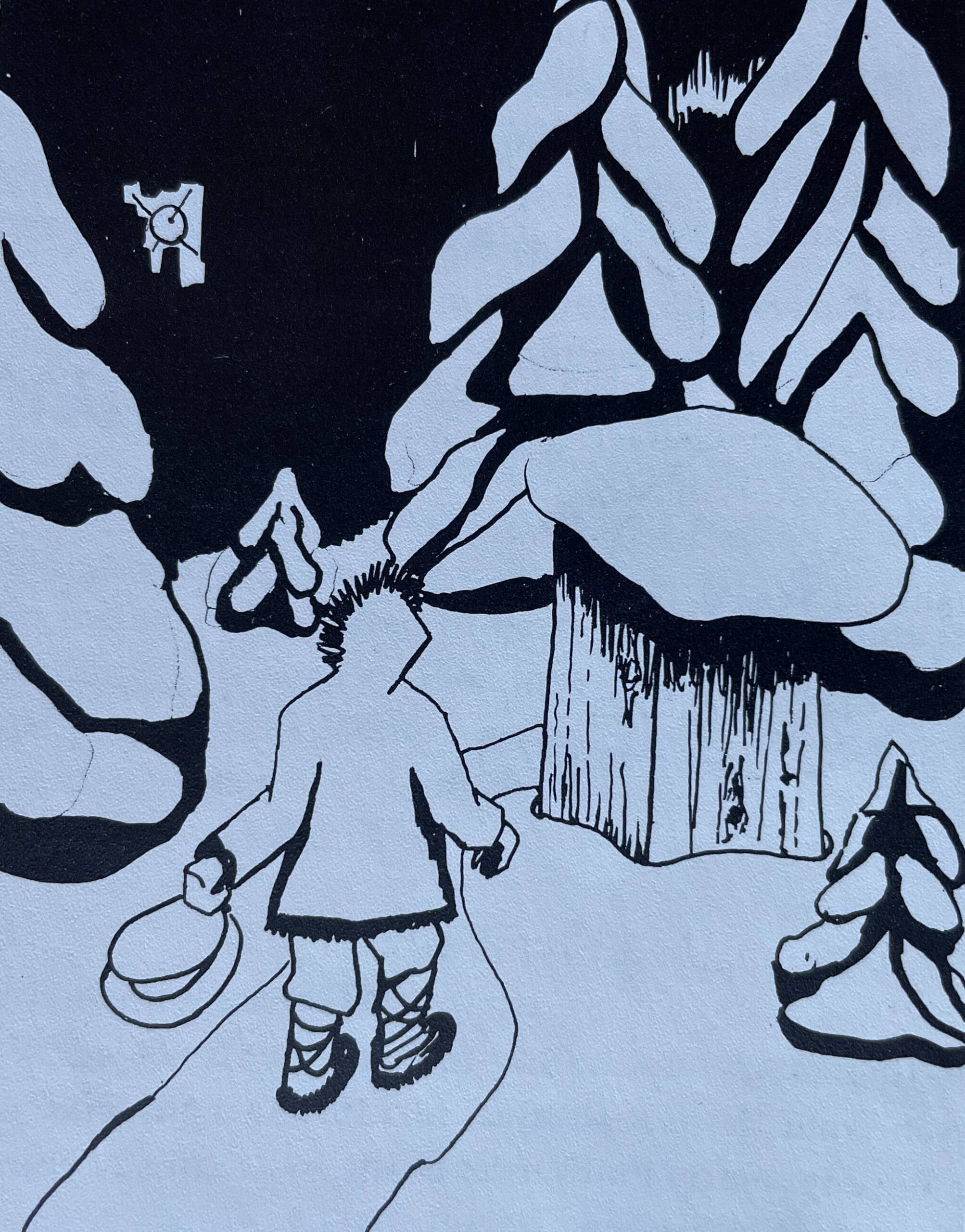
Charles Deehr, an emeritus professor at UAF’s Geophysical Institute, created this image of Dexter Stegemeyer, perhaps the first man in North America to see the Sputnik 1 satellite in October 1957. From the book “Alaska Science Nuggets” by T. Neil Davis.

Charles Deehr, an emeritus professor at UAF’s Geophysical Institute, created this image of Dexter Stegemeyer, perhaps the first man in North America to see the Sputnik 1 satellite in October 1957. From the book “Alaska Science Nuggets” by T. Neil Davis.

Within a half hour of that call, an official with the Naval Research Laboratory in Washington D.C. called Geophysical Institute Deputy Director C. Gordon Little with radio frequencies that Sputnik emitted.

“The scientists at the Institute poured out of their offices like stirred-up bees,” wrote a reporter for the “Farthest North Collegian,” the UAF campus newspaper.

Crowded into a trailer full of equipment about a mile north of their offices, the scientists received the radio beep-beep-beep from Sputnik and were able to calculate its orbit. They figured it would be visible in the northwestern sky at about 5 a.m. the next day.

On that morning, three of them—Joe Pope, Bob Leonard, and Gian Carlo Rumi—stepped outside the trailer to see what Little described as “a bright star-like object moving in a slow, graceful curve across the sky like a very slow shooting star.”

For the record, scientists may not have been the first Alaskans to see Sputnik. In a 1977 article, the founder of this column T. Neil Davis described how his neighbor, Dexter Stegemeyer, said he had seen “a strange moving star come up out of the west” as he was sitting in his outhouse. Though Stegemeyer didn’t know what he saw until he spoke with Davis, his sighting was a bit earlier than the scientists’.

In October 1957, researchers from the Geophysical Institute track the Sputnik 1 satellite In the Ballaine Lake Tracking Station on the UAF campus. From left are Bob Merritt, Joe Pope, Pete Michelow, Gordon Little, Glen Stanley and Ernest Stiltner. (Photo courtesy Geophysical Institute)

In October 1957, researchers from the Geophysical Institute track the Sputnik 1 satellite In the Ballaine Lake Tracking Station on the UAF campus. From left are Bob Merritt, Joe Pope, Pete Michelow, Gordon Little, Glen Stanley and Ernest Stiltner. (Photo courtesy Geophysical Institute)

The New York Times’ Oct. 7, 1957 edition included a front-page headline of “SATELLITE SEEN IN ALASKA,” and Sputnik caused a big fuss all over the country. People wondered about the implications of the Soviet object looping over America every 98 minutes, and whether it meant the Russians also had the smarts to produce ballistic missiles that could carry nuclear warheads from Europe to the United States. Within a year, Congress voted to create NASA.

Fears about Sputnik evaporated as three months later the U.S. launched its own satellite, Explorer 1, and eventually took the lead in the race for space.

Almost 70 later, satellites are a part of everyday life. The next time you see a satellite streaking through the night sky, remember the first scientist on this continent to see one was standing right here in Alaska. And the first non-scientist to see a satellite in North America was sitting right here in Alaska.

• Since the late 1970s, the University of Alaska Fairbanks’ Geophysical Institute has provided this column free in cooperation with the UAF research community. Ned Rozell ned.rozell@alaska.edu is a science writer for the Geophysical Institute. A version of this story appeared in 2007.

More in Sports

The Juneau-Douglas High School: Yadaa.at Kalé Crimson Bears won fourth place during the Division II Hockey State championships in Palmer last weekend. Photo courtesy of Rapi Sotoa
Juneau takes home fourth place during high school state hockey tournament

The Crimson Bears also received the Sportsmanship Award last weekend.

Senior Juneau-Douglas High School: Yadaa.at Kalé hockey players were recognized at the Treadwell Arena on Friday, Jan. 23, 2026 before the Crimson Bears faced the Homer High School Mariners. Head coach Matt Boline and assistant coaches Mike Bovitz, Luke Adams, Jason Kohlase and Dave Kovach honored 11 seniors. (Chloe Anderson / Juneau Empire)
JDHS celebrates hockey team’s senior night with sweeping victory over Homer

The Crimson Bears saw an 8-2 victory over the Mariners Friday night.

Photo by Ned Rozell
Golds and greens of aspens and birches adorn a hillside above the Angel Creek drainage east of Fairbanks.
Alaska Science Forum: The season of senescence is upon us

Trees and other plants are simply shedding what no longer suits them

Things you won’t find camping in Southeast Alaska. (Jeff Lund/Juneau Empire)
I Went to the Woods: Sodium and serenity

The terrain of interior Alaska is captivating in a way that Southeast isn’t

An albacore tuna is hooked on a bait pole on Oct. 9, 2012, in waters off Oregon. Tuna are normally found along the U.S. West Coast but occasionally stray into Alaska waters if temperatures are high enough. Sport anglers catch them with gear similar to that used to hook salmon. (Photo provided by the National Oceanic and Atmospheric Administration/West Coast Fisheries Management and Marine Life Protection)
Brief tuna bounty in Southeast Alaska spurs excitement about new fishing opportunity

Waters off Sitka were warm enough to lure fish from the south, and local anglers took advantage of conditions to harvest species that make rare appearances in Alaska

Isaac Updike breaks the tape at the Portland Track Festival. (Photo by Amanda Gehrich/pdxtrack)
Updike concludes historic season in steeplechase heats at World Championships

Representing Team USA, the 33-year-old from Ketchikan raced commendably in his second world championships

A whale breaches near Point Retreat on July 19. (Chloe Anderson/Juneau Empire)
Weekly Wonder: The whys of whale breaching

Why whales do the things they do remain largely a mystery to us land-bound mammals

Renee Boozer, Carlos Boozer Jr. and Carlos Boozer Sr. attend the enshrinement ceremony at the Naismith Basketball Hall of Fame in Sprinfield, Massachusetts, on Saturday, Sept. 6, 2025. As a member of the 2008 U.S. men's Olympic team, Boozer Jr. is a member of the 2025 class. (Photo provided by Carlos Boozer Sr.)
Boozer Jr. inducted into Naismith Hall of Fame with ‘Redeem Team’

Boozer Jr. is a 1999 graduate of Juneau-Douglas: Yadaa.at Kale

Photo by Martin Truffer
The 18,008-foot Mount St. Elias rises above Malaspina Glacier and Sitkagi Lagoon (water body center left) in 2021.
Alaska Science Forum: The long fade of Alaska’s largest glacier

SITKAGI BLUFFS — While paddling a glacial lake complete with icebergs and… Continue reading

Photo by Jeff Lund/Juneau Empire
The point of fishing is to catch fish, but there are other things to see and do while out on a trip.
I Went to the Woods: Fish of the summer

I was amped to be out on the polished ocean and was game for the necessary work of jigging

A female brown bear and her cub are pictured near Pack Creek on Admiralty Island on July 19, 2024. (Chloe Anderson for the Juneau Empire)
Bears: Beloved fuzzy Juneau residents — Part 2

Humor me for a moment and picture yourself next to a brown bear

Isaac Updike of Ketchikan finished 16th at the World Championships track and field meet in Budapest, Hungary, on Tuesday. (Alaska Sports Report)
Ketchikan steeplechaser makes Team USA for worlds

Worlds are from Sept. 13 to 21, with steeplechase prelims starting on the first day