
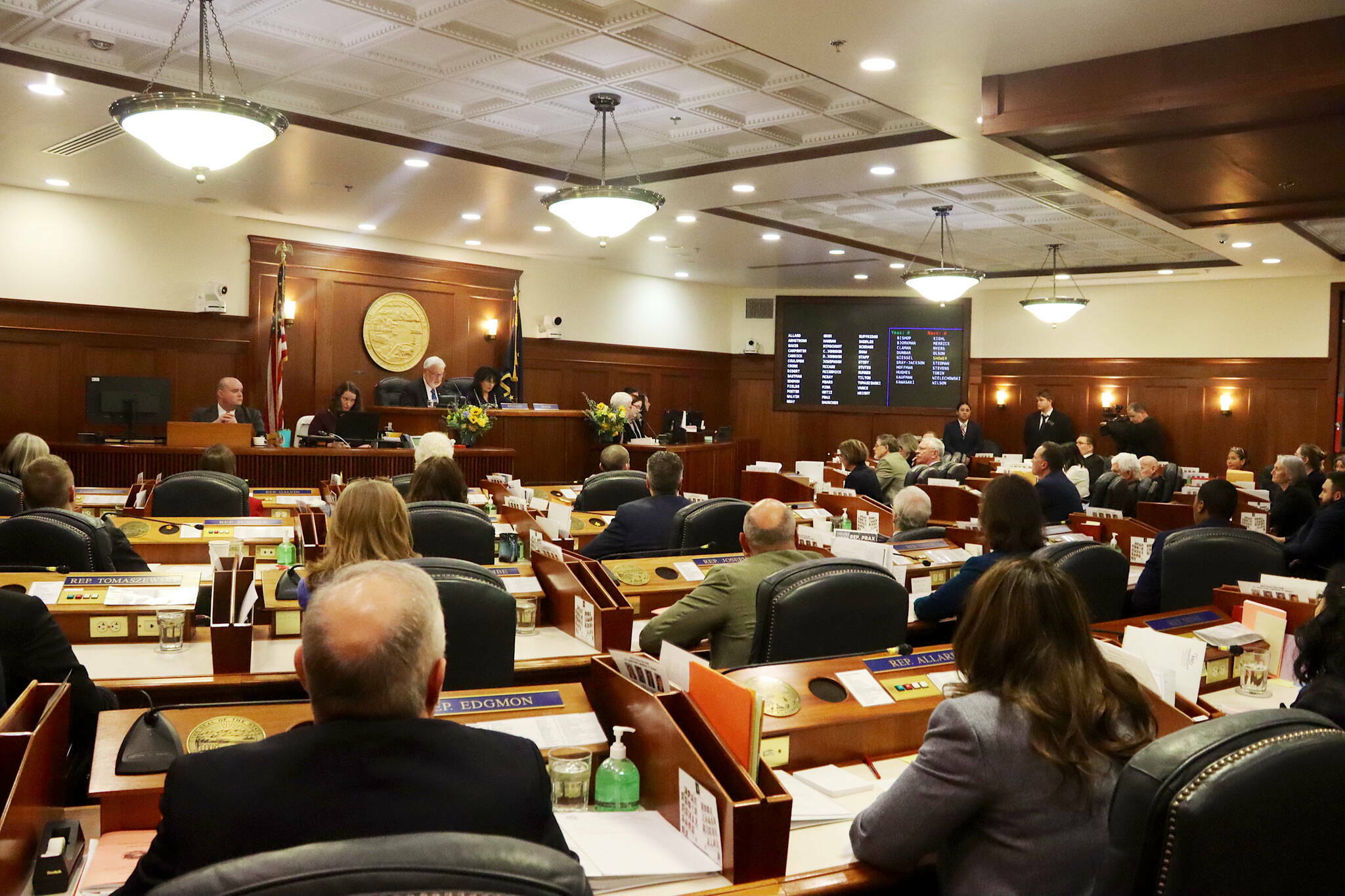
To make it a little easier for the legislature to override a governor’s veto of revenue or appropriation bills, Sen. Matt Claman (D-Anchorage) is sponsoring a resolution to amend the state constitution. If two-thirds of both the Senate and House vote to pass it, then a simple majority of voters could ratify it.
Gov. Mike Dunleavy may not like the proposed amendment or the fact that the Constitution gives him no veto power to prevent it from being ratified. But he could effectively kill it by appealing to the many Republican legislators who put personal or partisan loyalty ahead of their constitutional responsibility to serve as a check on his power.
Alaska is the only state that requires three-quarters of the Legislature to override any kind of veto. If the amendment is adopted, it’ll take only two-thirds — as is the case with non-revenue bills. That’s five fewer legislators.
As a member of the House in 2019, Claman co-sponsored an identical resolution introduced by then-Rep. Jonathan Kreiss-Tomkins (D-Sitka). But even if the Legislature had passed that, it wouldn’t have been put on a ballot until after Dunleavy vetoed $444 million from the budget approved by the Legislature that year.
Kreiss-Tomkins believed that prior to that veto, no Alaska governor had ever “exercised their constitutional powers to full, unrestrained, destructive effect.” He argues that changed after Dunleavy took office, with the ultimate proof being his massive budget veto.
Even at the lower threshold of the proposed amendment, it’s doubtful the Legislature would have been able to override any part of it. Dunleavy did partially reverse a few items. And he never repeated that act. But instead of getting a strong rebuke by elected representatives of the people, it was delivered directly to him via an outpouring of public anger.
Last year, he vetoed half of a one-time funding boost for education. Support for its inclusion in the budget crossed party lines. But the 41-15 margin of its passage meant it wasn’t veto-proof. And even at the lower threshold, only two Republican defectors could have doomed any attempt to override it.
Two weeks ago, we saw 17 of them vote to uphold a veto of an education bill that all but three legislators supported. Since it wasn’t strictly an appropriation bill, a legislative override required just 40 votes. They came up one short.
As Gordon Harrison wrote in “Alaska’s Constitution – A Citizen’s Guide,” the veto was intended to be “an important check on the legislative branch.” It gives the governor the power “to block, or at a minimum to force reconsideration of, legislation that he believes to be hasty, unwise, ill-considered, poorly written, or illegal.”
With that last veto, Dunleavy mainly objected to what wasn’t in the legislation.
“While I support the basic idea of education funding reform, this bill fails to address the innovations necessary to allow Alaskan students to excel,” he argued. Specifically, it lacked “sufficient changes in how charter schools are chartered in order to allow more students and families charter school possibilities.”
Every Republican who supported the bill knew that wasn’t included. But instead of defending their work, far too many of them bestowed on Dunleavy the power to undo a major legislative accomplishment.
A similar thing happened with Alaska Marine Highway Operations Board. It was created by the Legislature in 2021. The Senate President and House Speaker were each given the authority to appoint two board members. A few months ago, Dunleavy issued an executive order that gave him total control of the board. It only took a simple majority to reject it. But despite the original bill having been passed unanimously, only 33 legislators stood up to deny him that power grab.
“Few state constitutions grant as much authority to the governor as does Alaska’s,” the Citizen’s Guide states, because most of the others “were written with a history of tyrannical or corrupt executives in mind.”
If they could have foreseen Dunleavy’s unrestrained actions, constitution convention delegates might not have given the governor so much power. But because checks and balances of power are so central to our system of government, they still wouldn’t have anticipated that so many legislators would voluntarily cede additional power to the governor. And no constitutional amendment can solve that problem.
• Rich Moniak is a Juneau resident and retired civil engineer with more than 25 years of experience working in the public sector. Columns, My Turns and Letters to the Editor represent the view of the author, not the view of the Juneau Empire. Have something to say? Here’s how to submit a My Turn or letter.
