
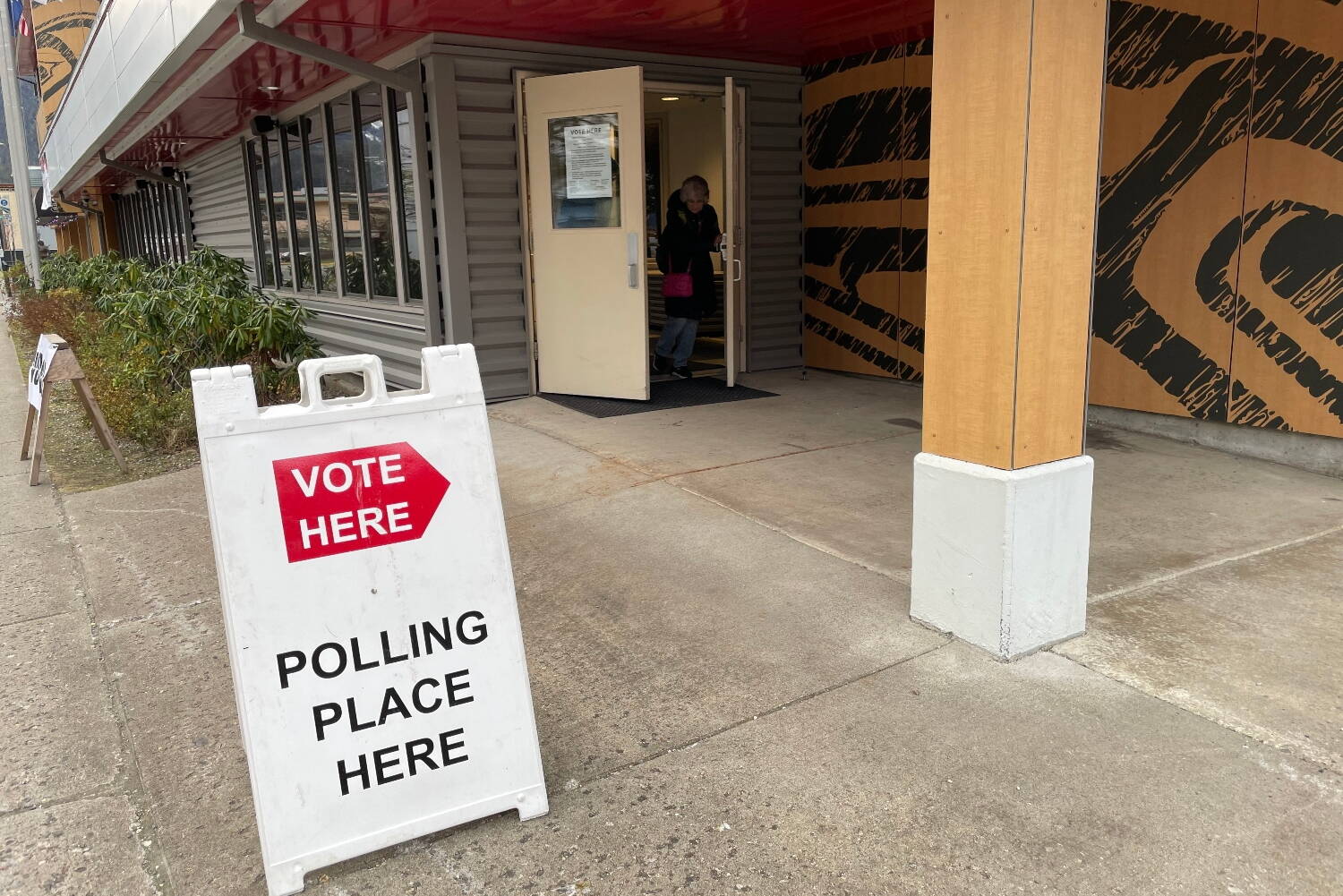
Voters in Juneau come out of the Elizabeth Peratrovich Hall voting location on Nov. 8, 2022. (Lisa Phu/Alaska Beacon)

Voters in Juneau come out of the Elizabeth Peratrovich Hall voting location on Nov. 8, 2022. (Lisa Phu/Alaska Beacon)

Opinion: Open primaries, ranked choice voting offer advantages to Alaskans

Ranked choice voting elections have been advancing and retreating since first developed in Denmark in the 1850s. The method was explored in Australia, Ireland, and, in the early 20th century, the U.S. After waxing and waning here during the ‘30s and ‘40s, since the 1960s, the ranked voting process has slowly spread. As reported by Fairvote.org tracking, ranked choice voting in the U.S. occurs in “2 states, 3 counties, and 45 cities.” Now, according to rankedvote.co, a software company, the method is on the 2024 ballot in Colorado, Idaho, Nevada, Oregon, and Washington, D.C.

In Alaska, the state’s open primary and ranked choice system will also be on the ballot—for repeal, unless a Supreme Court appeal prevents it.

One argument Republicans make for repeal is that their party cannot field its own candidates. This is not exactly true as nothing prevents a party from sponsoring or endorsing candidates. What Republicans want in general is a return to the party-controlled, closed system of voting that helped it dominate Alaska election outcomes.

Under the former election process, the Republican Party, Alaska’s largest, controlled a single Republican candidate for each elective office, usually against a Democrat from Alaska’s second largest party. Other parties could field candidates, but with the vote usually trapped between candidates from the two largest parties, elections generally went to Republicans. This was despite being a sizeable minority among Alaska voters overall.

The Alaska Department of Elections, according to its most recent listings, reports 605,892 registered voters and counts them in 17 registered groups.

Republicans account for 144,363 registrations, one-quarter of the total, while Democrats with 73,963 members account for one-eighth. These two largest parties with their 218,326 registered voters make up one-third of Alaska’s electorate. The majority two-thirds comprise 387,566 registrations, outnumbering Democrats and Republicans by 169,240 Alaska voters.

In 2020, open primaries and ranked choice voting narrowly passed. It probably did so with considerable help from members of Alaska’s 15 other registered voter groups. In 2022, open primaries and ranked choice elections showed these groups that the new system increased their electoral influence. If members of these groups want to keep this gain, they should vote to reject a repeal.

Alaska voters are loyal to independent political thinking. Some of the 15 groups beyond Republicans and Democrats are small like the Owl and the Clowns parties with 103 and 215 members respectively. Larger parties like the Alaskan Independence Party, with 18,853 members, field candidates but are not usually competitive in general elections. The case is the same for the Green and Progressive parties with their 1,521 and 260 members.

Nonpartisans, the group I’m in, number 84,333, but the largest group by far is Undeclared. It numbers 272,530, or 44.98% of Alaska’s voters.

Open primaries tend to shape the positions, preferences, and values of candidates as determined by the whole electorate, not the largest parties. When voters in 2020 chose open primaries and ranked choice voting, they changed the rules of participation on the electoral field of play. Instead of 75% of voters having little to no chance of their values and positions being heard and represented, the new system increased the need for candidates to pay attention to all of Alaska’s diverse electorate.

If repeal appears on the ballot, Alaska’s voters will have the chance to reaffirm their 2020 choice. A “no” vote on repeal will keep electoral power where it belongs, with the diverse majority of Alaska voters.

• Art Petersen is a 49-year resident of Juneau and a retired professor of English from the University of Alaska Southeast. This article originally appeared online at alaskabeacon.com. Alaska Beacon, an affiliate of States Newsroom, is an independent, nonpartisan news organization focused on connecting Alaskans to their state government.

More in Opinion

Web
Have something to say?

Here’s how to add your voice to the conversation.

David Guttenfelder/The New York Times
FILE — Federal agents arrest a protester during an active immigration enforcement operation in a Minneapolis neighborhood, Jan. 13, 2026. The chief federal judge in Minnesota excoriated Immigration and Customs Enforcement on Wednesday, Jan. 28, saying it had violated nearly 100 court orders stemming from its aggressive crackdown in the state and had disobeyed more judicial directives in January alone than “some federal agencies have violated in their entire existence.”
OPINION: When silence signals consent

Masked ICE enforcement and the failure of Alaska’s congressional leadership.

Northern sea ice, such as this surrounding the community of Kivalina, has declined dramatically in area and thickness over the last few decades. Photo courtesy Ned Rozell
20 years of Arctic report cards

Twenty years have passed since scientists released the first version of the… Continue reading

Dr. Karissa Niehoff
OPINION: Protecting the purpose

Why funding schools must include student activities.

A sign reading, "Help Save These Historic Homes" is posted in front of a residence on Telephone Hill on Friday Nov. 21, 2025. (Mari Kanagy / Juneau Empire)
OPINION: The Telephone Hill cost is staggering

The Assembly approved $5.5 million to raze Telephone Hill as part of… Continue reading

Win Gruening (courtesy)
OPINION: Eaglecrest’s opportunity to achieve financial independence, if the city allows it

It’s a well-known saying that “timing is everything.” Certainly, this applies to… Continue reading

Gov. Mike Dunleavy gestures during his State of the State address on Jan. 22, 2026. (Photo by Corinne Smith/Alaska Beacon)
OPINION: It’s time to end Alaska’s fiscal experiment

For decades, Alaska has operated under a fiscal and budgeting system unlike… Continue reading

Atticus Hempel stands in a row of his shared garden. (photo by Ari Romberg)
My Turn: What’s your burger worth?

Atticus Hempel reflects on gardening, fishing, hunting, and foraging for food for in Gustavus.

At the Elvey Building, home of UAF’s Geophysical Institute, Carl Benson, far right, and Val Scullion of the GI business office attend a 2014 retirement party with Glenn Shaw. Photo by Ned Rozell
Alaska Science Forum: Carl Benson embodied the far North

Carl Benson’s last winter on Earth featured 32 consecutive days during which… Continue reading

Van Abbott is a long-time resident of Alaska and California. He has held financial management positions in government and private organizations, and is now a full-time opinion writer. He served in the late nineteen-sixties in the Peace Corps as a teacher. (Contributed)
When lying becomes the only qualification

How truth lost its place in the Trump administration.

Jamie Kelter Davis/The New York Times
Masked federal agents arrive to help immigration agents detain immigrants and control protesters in Chicago, June 4, 2025. With the passage of President Trump’s domestic policy law, the Department of Homeland Security is poised to hire thousands of new Immigration and Customs Enforcement (ICE) agents, and double detention space.
OPINION: $85 billion and no answers

How ICE’s expansion threatens law, liberty, and accountability.

Yereth Rosen/Alaska Beacon
The entrance to the Alaska Gasline Development Corp.’s Anchorage office is seen on Aug. 11, 2023. The state-owned AGDC is pushing for a massive project that would ship natural gas south from the North Slope, liquefy it and send it on tankers from Cook Inlet to Asian markets. The AGDC proposal is among many that have been raised since the 1970s to try commercialize the North Slope’s stranded natural gas.
My Turn: Alaskans must proceed with caution on gasline legislation

Alaskans have watched a parade of natural gas pipeline proposals come and… Continue reading