
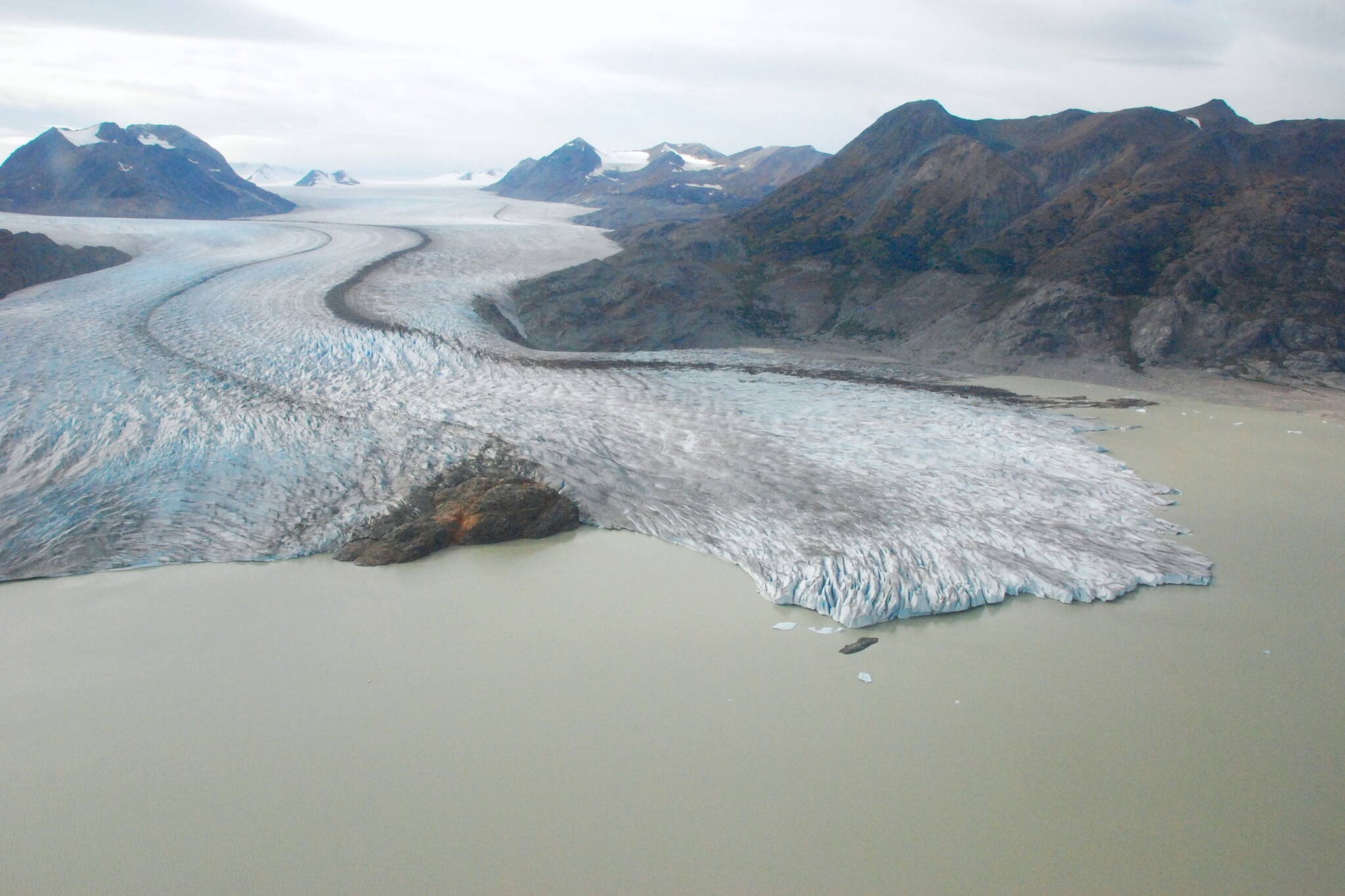
Beneath the glaciers of northwestern British Columbia and Southeast Alaska is wild salmon habitat in the making. Atop those glaciers, however, are ice roads, mining claims and active drills.
As the climate changes and glaciers at the headwaters of Alaskan rivers melt, they’re creating hundreds of miles of new salmon habitat. Now a new scientific analysis reveals to just what extent that glacial melt, and new salmon habitat, overlaps with prolific gold mine staking, operation and exploration just over the Alaska border.
“I really hope this paper helps elevate the conversation,” said lead author Jonathan Moore, a professor of Biological Sciences and Resource and Environmental Management at British Columbia’s Simon Fraser University. “Imagine you’re at a glacier’s edge. It’s literally the leading edge of climate change. And it’s retreating fast with climate change and creating new ecosystems. We need to ask ourselves — what are we doing with these nascent ecosystems? Are we mining them for gold? Or are we stewarding them for salmon futures?”
The study builds on previous work led by Dr. Kara Pitman, with Moore and collaborators, which mapped out where and when glacial retreat in the region will create new salmon rivers.
The paper found 114 “subwatersheds” expected to have new salmon habitat as glaciers retreat. A total of 25 of those systems had 50% of future habitat within five kilometers, or 3.1 miles, of mining claims. Another 17 had more than 90% of their future salmon habitat within that distance. Of all of the total future salmon habitat in the region, 6% has mining claims staked directly on top of it.
The rivers flowing from B.C. into Southeast Alaska are a hotspot for this kind of conflict, as they’re home to big glaciers in low valleys — prime future salmon habitat — and because they are located in what the mining industry calls “The Golden Triangle” — the location of British Columbia’s modern-day gold rush.
The study outlines three key policy opportunities. First, Moore highlights that “different Indigenous groups are advancing Indigenous Protected and Conserved Areas and Indigenous-led land use planning.” The Gitanyow and Taku River Tlingit are two First Nations in B.C. that have declared expanded Indigenous Protected and Conserved Areas that would protect emerging and future salmon habitats.
The second opportunity the paper highlights is reforming the Mineral Tenure Act in B.C., the colonial 19th-century law still guiding mining in the province that “undermines the ability for forward-looking land use planning” and gives companies the rights to minerals with zero consideration of Indigenous rights. The Supreme Court of British Columbia in September 2023 ruled that this practice breaches the province’s “duty to consult” — but the court also allowed mining corporations to continue staking without the need to consult with Indigenous nations for 18 months, resulting in a flurry of new claims in the region, complicating future land use planning and exacerbating the problem. The Gitxaała Nation, which brought the lawsuit, has partially appealed that ruling, partly in hope of “immediately halt[ing] unconstitutional automatic grants of mineral claims in our Territories,” Gitxaała Sm’ooygit Nees Hiwaas (Matthew Hill) said.
“These changes can’t come soon enough,” added Tara Marsden, who is both with the Gitanyow Hereditary Chiefs and a co-author of this new study about glacial, salmon habitat, and mining claims overlap. “The Mineral Tenure Act not only violates Indigenous rights but also undermines stewardship of ecosystems for future generations.”
The third opportunity the paper highlights, Moore said, is “the need for thinking about climate change in environmental laws.”
“I think a really important question needs to be raised as to how these laws can protect the habitats of tomorrow, not just the habitats of today,” Moore said. “Should those environmental laws mandate climate change forecasts? Should those environmental laws mandate incorporating data such as this, so that industry is not degrading the habitats of tomorrow?”
“This is a globally relevant opportunity to get a lot right — Indigenous rights, meaningful protection of biodiversity and ecosystems, and climate resilience,” Marsden added.
• Mary Catharine Martin is the communications director of SalmonState, which works to keep Alaska a place where wild salmon and the people whose lives are intertwined with them continue to thrive.
