
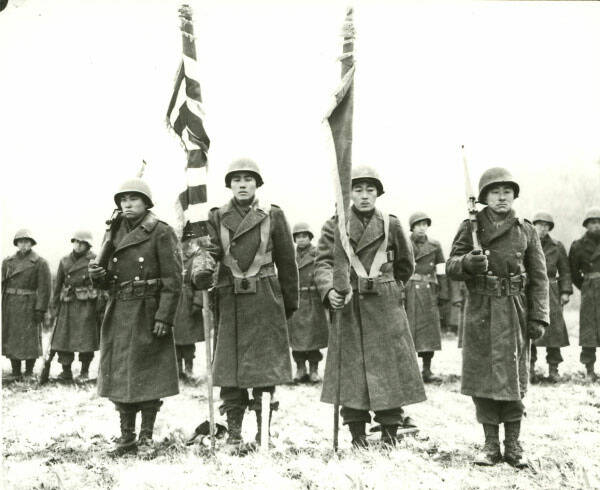
The Japanese-American Citizens League’s Alaska Chapter will honor the 442nd Regimental Combat Team on Feb. 19 as part of an annual event recognizing the hardships of Japanese-Americans during World War II.
Every year, the JACL holds an event to honor the date, said Dennis Arashiro, executive board president of the Alaska Chapter.
This year’s event will be a lecture about the all-Japanese-American unit recognized as the most decorated unit of the war, to be held at St. John Methodist Church in Anchorage on Feb. 19 at 4 p.m.
[Organizations unite to celebrate legacy of Elizabeth Peratrovich]
“Feb. 19 is the Day of Remembrance,” Arashiro said in a phone interview. “It’ll be 80 years since that date since President Roosevelt gave Order 9066, which led to the Japanese internment and the Aleut internment in Alaska.”
That order saw more than 120,000 Japanese-Americans interned without due process over racially driven fears that they might be collaborating with the Japanese military against the United States.
“We don’t want to see this again. The word ‘Nisei’ means second-generation Japanese-American immigrants. They were born and raised in the U.S. They were actually American citizens. They were denied due process. They were behind barbed wire without having done anything to justify what took place,” Arashiro said. “This was a blanket — you’re Japanese, you’re out of here. It was strictly race-based.”
Juneau has a special connection for the JACL, Arashiro said, with stories like the “Empty Chair” in the city’s history. The annual event focuses on Japanese-Americans in Alaska, and issues that surround them.
“Last year we focused on the Aleut evacuation. It’s not just about us Japanese-Americans,” Arashiro said. “We believe that as a human rights story it was in line with our values.”
The 442nd RCT and 100th Infantry Battalion
The 442nd Regimental Combat Team was formed in 1943, Arashiro said, as an all-Nisei Army unit assembled from volunteers, but led by white officers. It would follow in the footsteps of the 100th Infantry Battalion, a Nisei Hawaii Army National Guard unit.
The 100th, which would precede the 442nd into Italy and France and was eventually folded into the 442nd RCT, would become known as the Purple Heart Battalion for taking part in shattering actions in which hundreds of men were killed, particularly at the Battle of Monte Cassino, said Stuart Hirai, who will present from his research about the regiment on Saturday.
“They basically were asked to enlist and serve and possibly sacrifice their lives for the country when many of their families were interned,” Arashiro said. “The fact that they chose to serve and serve with extraordinary courage… the 442nd is the most decorated unit in our military’s history – not one of, the.”
Prejudice and the shape of the war conspired to keep the 442nd sidelined until 1944, Hirai said, until they entered action in the Italian campaign, fighting north toward central Europe. Hirai said he was inspired to research the history of the unit by figures in his life who had served in the military as Nisei, including his father as well as his scoutmaster.
The 100th Infantry Battalion was integrated into the larger 442nd RCT after the breakout from Anzio and the fall of Rome, Hirai said. The newly combined unit would fight north, into northern Italy and southern France. The 442nd became famous for its rescue of the “Lost Battalion,” the 141st Infantry Regiment, which had been cut off. Entire companies, hundreds of men, were killed, but the attempt was successful, Hirai said.
“The 442nd was sent to rescue them and suffered tremendous casualties in the rescue, but saved that unit from actual annihilation,” Arashiro said. “There was obvious recognition on the battlefield at that particular time. At the time there was some obvious reserve and suspicion about this military unit.”
The unit would go on to win more commendations than any other unit of a comparable size over a similar time period, including 21 Medals of Honor, according to the Go For Broke National Education Center, a nonprofit organization dedicated to teaching about their sacrifice during the war.
Nisei didn’t serve exclusively in these units; many worked in intelligence and counterintelligence units in the Pacific, Arashiro said.
“There was a large contingent of Japanese who served in a military intelligence capacity. They were instrumental for our success in the South Pacific,” Arashiro said. “They acted as translators for units in the South Pacific. They were in danger of being killed by their fellow soldiers. The service… it’s extraordinary what these men did; the decisions they made and the actions they took. Way above the call of duty in many cases.”
For Arashiro, the story of the 442nd is one that highlights the injustice of the internment camps; by remembering the story, he said he hopes we can prevent things like it from occurring again.
“The story of these Nisei WWII veterans were proof positive that these actions were clearly unjustified,” Arashiro said. “We’re losing them because of the passing of generations. We want to make sure they get the honor they deserve.”
Know and Go
What: JACL’s Day of Remembrance: honoring the 442nd RCT
When: Saturday, Feb. 19, 4 p.m. to 6:30 p.m.
Where: St. John Methodist Church
Admission: n/a, mitigation measures will be in place
• Contact reporter Michael S. Lockett at 757-621-1197 or mlockett@juneauempire.com.
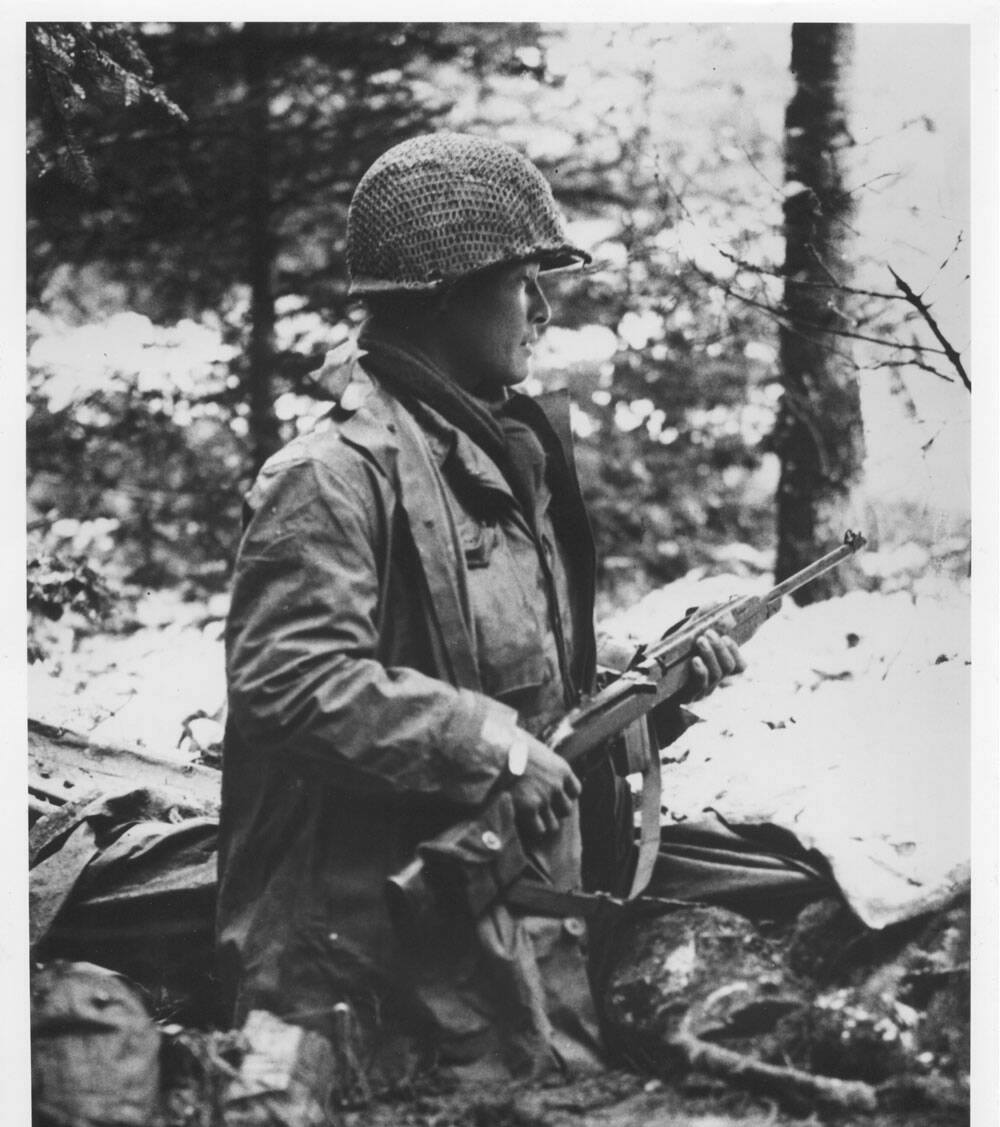
Courtesy photo / National Archives and Records Administration Goichi Suehiro, Co F, 2nd Battalion, 442nd RCT, looks for German movements in the Vosges Forest.
