
Every winter I notice that blueberry twigs have turned red. That got me thinking about colors and that color in particular. We see reds in other plants — lots of berries, dwarf dogwood leaves, columbine flowers and so on.
Red and reddish colors can be produced in many ways, by a variety of pigment molecules. In many cases, the degree of reddishness is determined by the chemistry (e.g., acidity) of the cellular fluid around the pigment molecules, so sometimes the color (as we see it) is orange or pinkish-red or purplish-red. And often the pigments are present without contributing to color, as they have many other functions.
Here are some pigments that can produce red color:
Animals carry a red pigment called hemoglobin, which (in vertebrates) ferries oxygen around the body, and a similar one called myoglobin in red muscles. The redness of blood under the skin accounts for blushes, the red faces of some monkeys, and the red marks on the face of mandrill apes. There is turnover in the population of hemoglobin molecules, new ones replacing old ones, and as the old ones break down, they form another pigment, a ‘bilin’ called bilirubin, yielding the yellow color of urine and jaundice.
Bilirubin also occurs in some taxonomically diverse plants. However, it seems that this pigment only contributes to color in the genus Strelitzia, native to southern Africa. These so-called bird-of-paradise plants have seeds bearing nutrient-rich appendages called arils, which are bright orange, attracting seed-dispersing birds.
Animals also have pigments called melanin. One type of melanin (eumelanin) produces browns and blacks; in vertebrates, they color hair and skin and protect skin from UV rays, while in insects they have many other roles. But another one, phaeomelanin, produces red and yellows; in combination with a brown eumelanin, it accounts for the color of red fox fur and for red hair in humans.
Other pigments called betalains produce colors grading from red to yellow or red to violet. Betalains take their name from the Latin name of beets (Beta). They occur in plants of most taxonomic families of the order Caryophyllales and in some fungi. Examples include not only beets, but amaranths, cacti, and sundews. Apparently, betalains function as antioxidants and disarm free radicals (unstable atoms or molecules with an unpaired electron that can link up in some unexpected places, causing damage, although at low concentrations they also have proper metabolic functions).
Anthocyanins produce red color in acidic conditions (but blue in alkaline ones). They act as a sort of sun-screen in plants, protecting the photosynthetic machinery from excessively strong light, scavenging free radicals and reactive forms of oxygen, protecting photo-sensitive defense compounds, and helping the plants tolerate stress. They sometimes appear in very young leaves of some trees, where they may protect from strong light or even deter herbivory in some way. We see them in the showy fall color of some maple leaves, the flowers of wild columbine, and red cabbage.
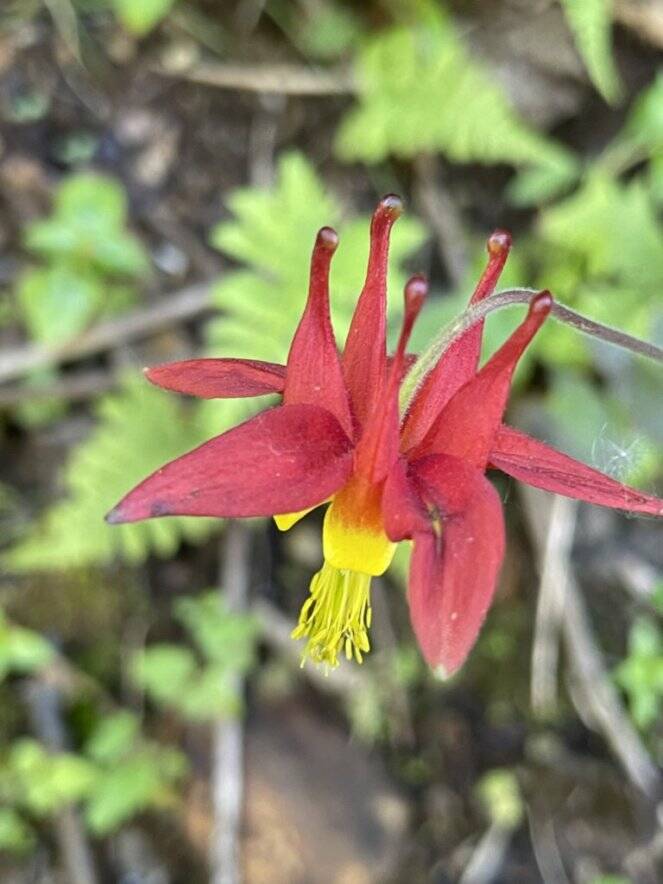
The red flowers of the native columbine are caused by anthocyanins. (Courtesy Photo / Deana Barajas)
Carotenoids are widely distributed in plants, where they help transfer light energy to chlorophyll for photosynthesis. They are also antioxidants and scavenge free radicals. They contribute colors ranging from yellow to red in autumn leaves and many flowers, the orange of carrots, and the red of ripe tomatoes. Animals can’t synthesize these pigments and must obtain them from food. They function there as antioxidants and controllers of excess free radicals, as precursors to vitamin A, and enhance immunity; they also function in mate choice and rivalries. The bright red of male red-winged blackbird epaulets and of male cardinals is produced by carotenoids, as is the red bill on zebra finches, the brightness depending on the availability of the pigments in the diet, and females prefer bright males. They contribute to color in fishes, amphibians, and reptiles, and even in certain bats that have yellow skin on ears, nose, and wings.
Pterins produce colors ranging from yellow to red, but unlike carotenoids, they can be synthesized by animals. They participate in many fundamental physiological processes. They also modify UV reflectance in males of some butterflies, producing sexual signals contributing to mate choice. They often interact with carotenoids, for instance producing the orange spots that male guppies use to court females.
Unique to parrots are special kinds of red-orange-yellow pigments that are synthesized by the birds, not obtained from the diet. The turacos of Africa have some red feathers produced by a pigment known to occur almost nowhere else.
That’s just a sample of pigments producing reddish color; they are clearly diverse and widespread. But blue, green, and white pigments seem to be far less common. Here is a sample of those:
Pterins can produce white pigments, which absorb so much UV that they appear white to us; this occurs in the wings of cabbage white butterflies. In general, however, white colors are usually due to the absence of colored pigments.
Blue is usually made structurally; the blue of bluebird and bluejay feathers, for instance, is created by air pockets and molecules that reflect blue light. The showy blue of morpho butterflies comes from overlapping, ridged scales that reflect light. Anthocyanins can look blue or purple (e.g., blue gentians, wild iris, blueberries) if in nonacidic cellular fluid. But conversely, Hydrangea flowers turn from pink to blue when grown in acidic soils with aluminum ions. I found one blue pigment, a ‘bilin’, that is synthesized by olive-wing butterflies and found in some swallowtails too.
Greens are produced in several ways. Turacos also have a unique green pigment, but most green or greenish feathers (e.g., on the backs of many warblers) are produced by blue structural colors overlying yellow pigment. The plant world offers several chlorophylls, involved in photosynthesis. Some ‘bilins’ produce green (the green huntsman spider) or the green bones of garfish.
So now the usual question: Why are red-making pigments apparently more diverse and common than other pigments?
• Mary F. Willson is a retired professor of ecology. “On The Trails” is a weekly column that appears every Wednesday.
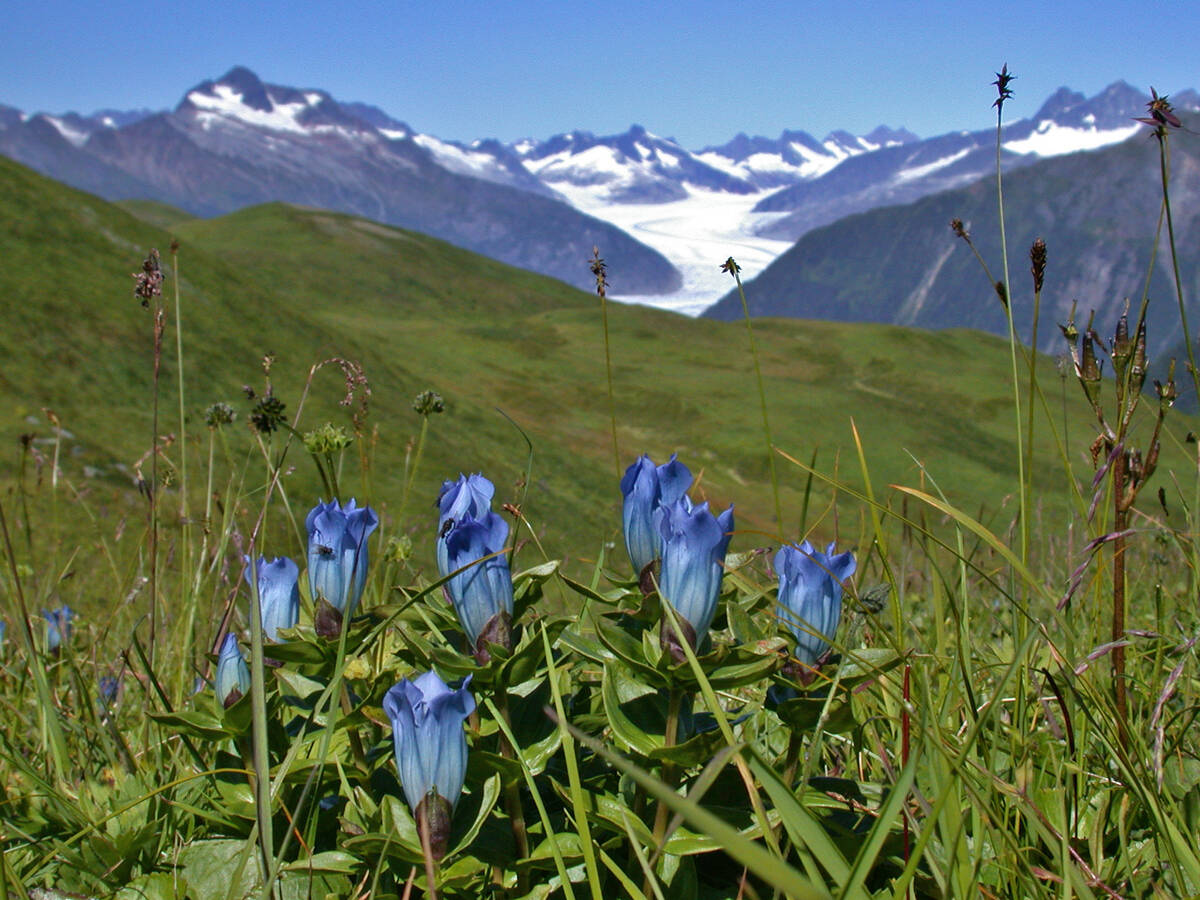
Anthocyanins in the petals of blue gentian have been modified to produce blue colors by the non-acid fluid of the cells. (Courtesy Photo / Bob Armstrong)
