
When biologists look at trees in the forests, they are likely to think about such matters as growth rates, insect pests, fungal infections, nesting birds, seed dispersal and seedling recruitment, and so on. All those interesting and sometimes complicated interactions and processes among the living precede the beginning of a long and complex saga of what happens when a tree dies. Some scientists have called this the afterlife of trees.
A tree may die after a long life or succumb to wind, flood, landslide, beavers, lightning, fungi, insects or whatnot, well short of its potential lifespan. Whatever the cause of death, a tree is then embarked on its afterlife, which may last for hundreds or even thousands of years and have myriad essential, ramifying roles in the ecosystem. Some of these ecological roles are readily observed and well-known to many of us, but I’ll mention them anyway in their places in the afterlife.
Dead trees that are still standing are commonly used by woodpeckers, which excavate nesting cavities for themselves; the cavities are often used in subsequent years by chickadees, nuthatches, bluebirds, certain flycatchers and swallows, small owls and falcons, flying squirrels, and others. A stand of dead trees in a swamp may support a heron rookery. All those critters feed on other inhabitants of the system and may become prey themselves. Carpenter ants may move in, even before the tree falls, as well as numerous other insects and fungi.
When a tree falls and takes others with it, a light gap forms — letting light reach the understory. The increase of light allows many kinds of formerly shaded plants to grow better — in some cases these may be of the same species as the fallen one but often other species will fill the gap, increasing the diversity of the stand. The branches of the crown of a living tree that falls may make a tangle of brush that provides a temporary refuge for wrens, juncos, sparrows, squirrels, and other small animals that feel a need to hide. If the treefall included the root mass, newly exposed soil may be colonized by pioneer plants and the up-turned rootwad will be colonized by ferns, mosses and understory herbs (until the roots themselves decay and collapse).
The trunks of fallen trees serve as walkways for small animals and feeding platforms for rodents and some birds. The surface of the log may accumulate feces, along with discarded leaves, and become a landing place for spores of mosses and fungi. That makes a rich substrate for wind-borne or animal-dropped seeds, which can germinate and grow. We sometimes see a tidy row of conifer seedlings and saplings lined up along a so-called nurse log or a crowd of young shrubs on an old stump—the fallen tree gives new trees and shrubs a good start.
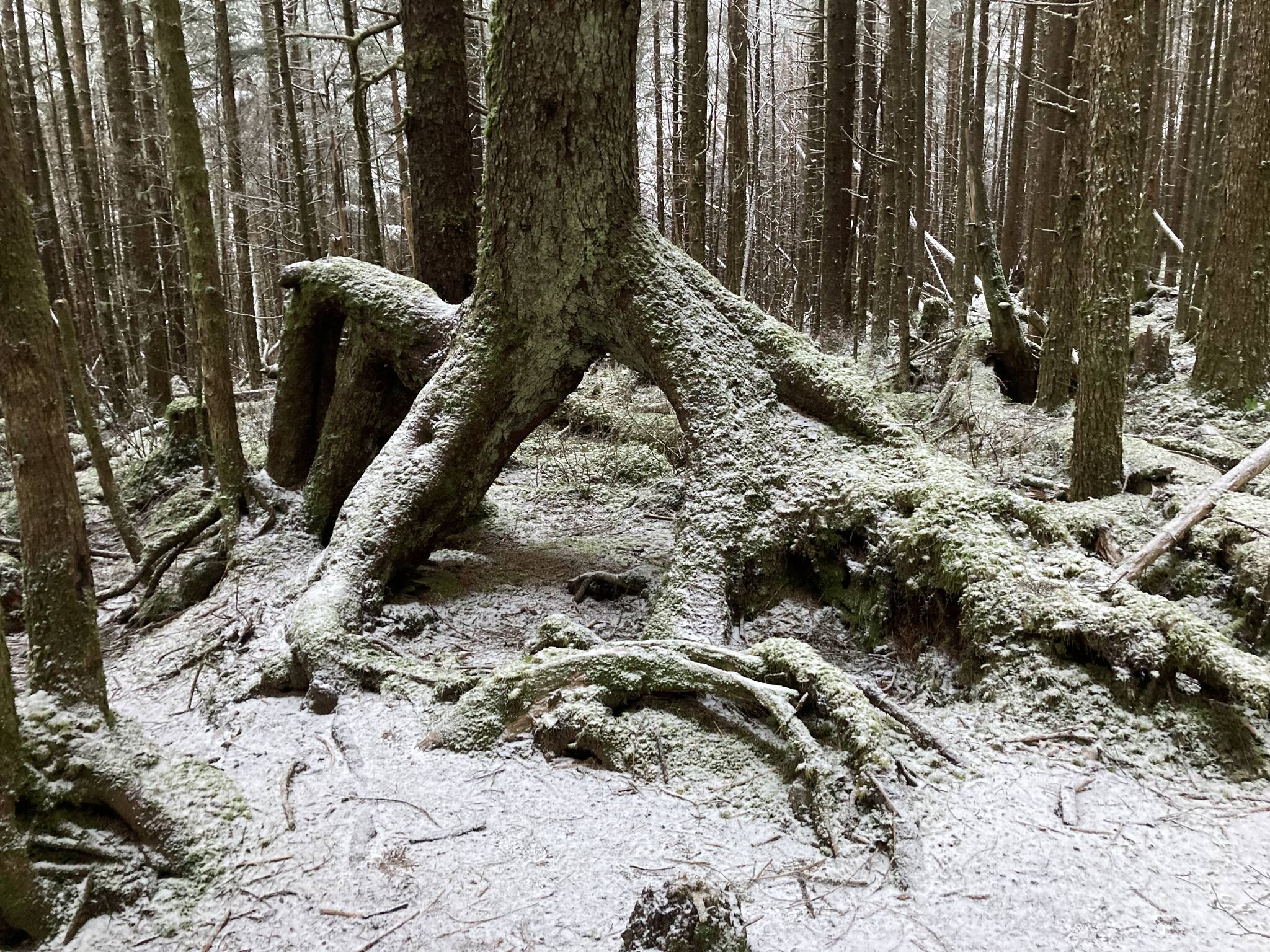
A mature spruce tree grows on stilt roots, its nurse log long gone into the soil. (Mary F. Willson / For the Juneau Empire)
The young trees can send roots down to reach the soil and thus continue growing for years, as the log or stump slowly decays. The grown-up tree then stands well above the ground on stilt-like roots. We see fine examples of this along some of our trails.
The logs that support those new seedlings and saplings are invaded by beetles, ants, and other insects that burrow into the wood, creating entry ports for microbes and fungi, which proliferate. A bear may tear open the log in search of larvae. Springtails and mites come to graze on the microbial and fungal mats, and they are followed by predatory insects and spiders, millipedes, worms that bring in still more fungi and microbes. Over many decades, the log is reduced to a low mound, eventually indistinguishable from the rest of the forest floor and part of the soil.
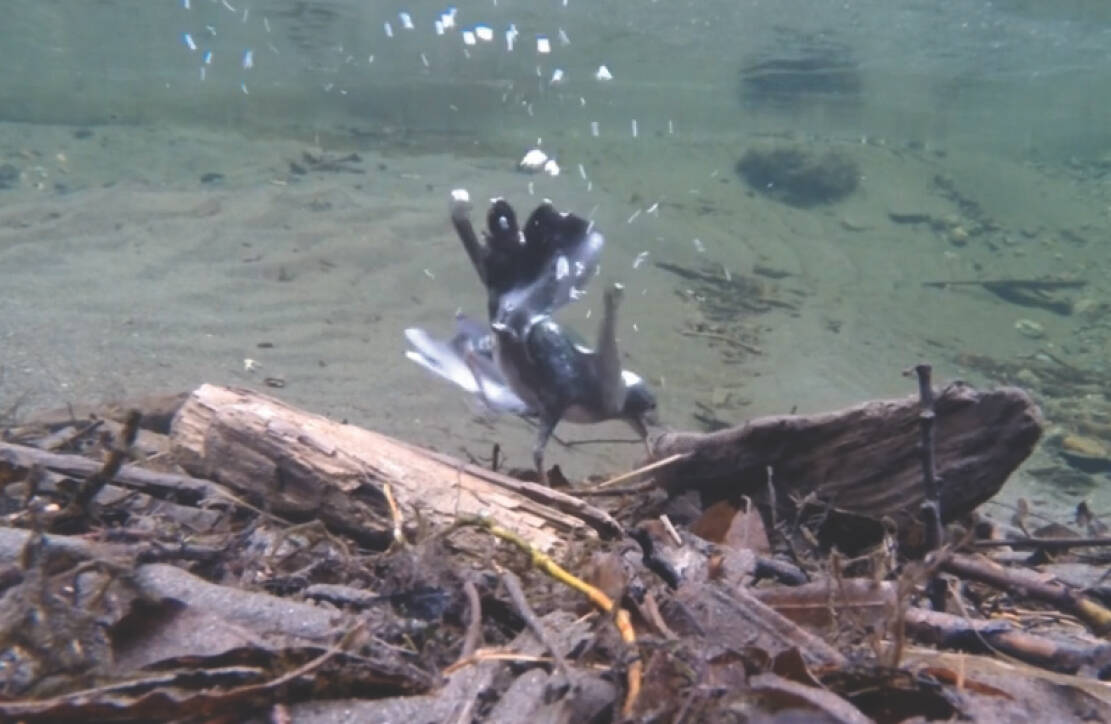
If a tree falls into a stream, however, the trajectory of the afterlife can be quite different. Logs get caught on rocks or gravel bars or projections from the banks and begin to change the patterns of water flow. They trap other vegetative materials and sediment coming from upstream, making more blockage of flow, sometimes creating pools where incoming salmon and char can rest on their way upstream and juveniles can take refuge. The accumulated wood and other vegetation make a substrate for bacteria and algae, which provide food for aquatic invertebrates, which in turn provide food for young fish, stream-nesting ducks, and dippers (vimeo.com/121113407). If enough sediment builds up, a new gravel bar may form, potentially a place for willows or cottonwoods to establish.
The Value of Woody Debris in Streams from Bob Armstrong on Vimeo.
In large rivers, periodic floods can move logs downstream, sometimes for miles. After a few years, perhaps, some of those logs, banged up by collisions with rocks and other logs, and still carrying microbes, fungi, and insects, may reach the sea and pile up as driftwood on a beach. Another ecological community of fungi, microbes, and insects can develop there, and even some plants in trapped sediments. Amphipods and other invertebrates may come to feed on smaller things. And a few of those logs might even wash out into open water and eventually sink to the sea-floor, where they provide new habitat and a food source for benthic micro-organisms and various invertebrates, which then become food for bottom-feeding fishes. A far-reaching afterlife!
In short, dead wood is an important basis for many new uses and different ecological communities. Much remains to be learned about all the intricacies of the many interactions that involve dead wood.
Thanks to Bob Armstrong for the underwater video.
• Mary F. Willson is a retired professor of ecology. “On the Trails” appears every Wednesday in the Juneau Empire.
