
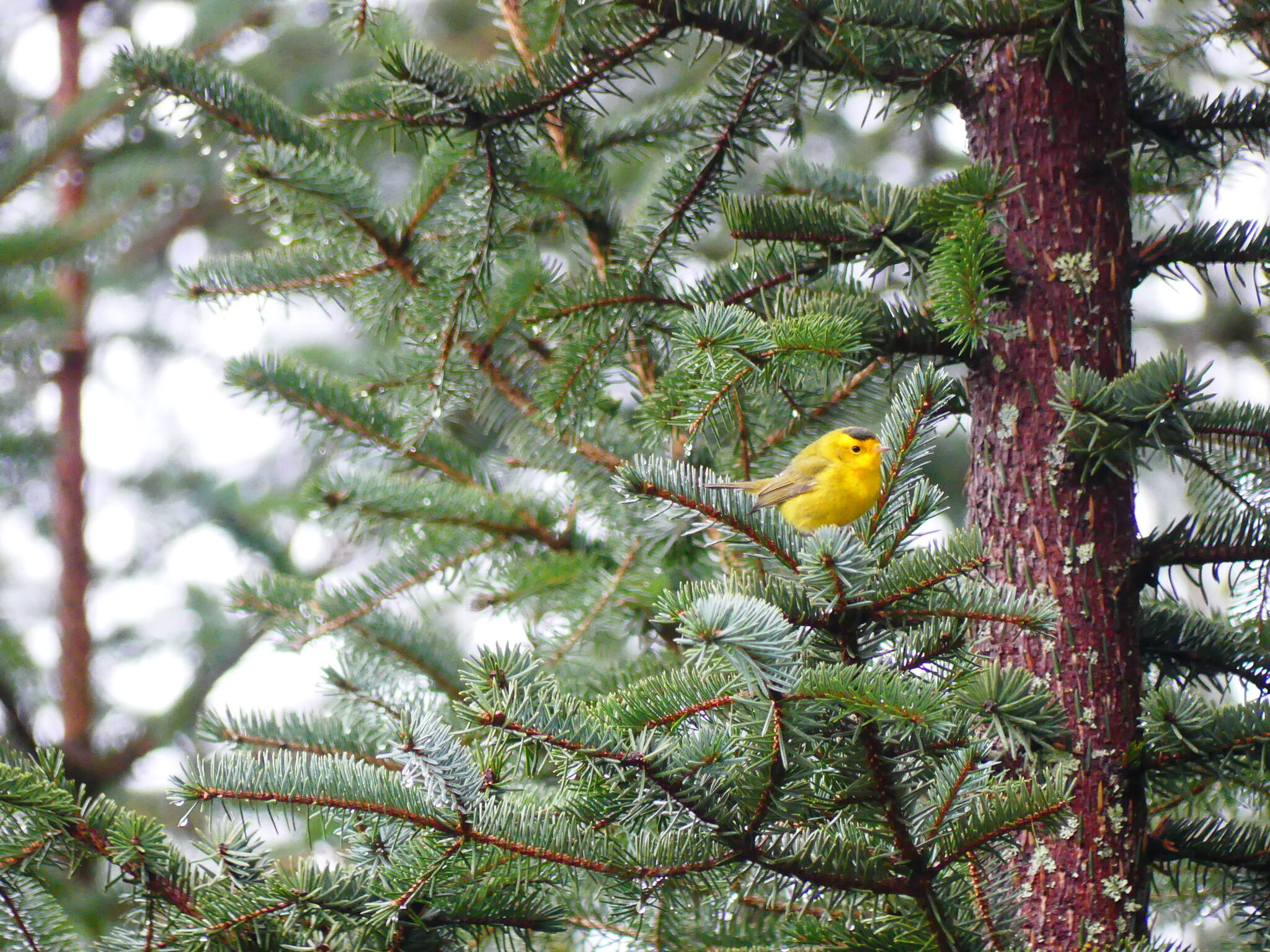
On the last day of November, on the way to the end of the dike trail, I saw a warbler fossicking about on a mossy area near the spruce trees. It was probably finding small moribund insects and spiders. I got a good look at it: a male Wilson’s warbler. That was a surprise! I didn’t expect to see any warbler at that time of year, especially since we were having a series of cold nights with temperatures in the teens. I could only hope that he would find enough food to fuel a flight to somewhat warmer places.
I began to wonder if this sighting was unusual. So I explored the information recorded in ebird.com a little and found that, over the years, this warbler has been spotted in northern Southeast Alaska uncommonly in November and December and even, but very rarely, in the depths of winter. Then I wanted to learn what other warblers (of those that commonly breed around here) are seen at this time of year. In particular, I thought of orange-crowned warblers and yellow-rumped warblers, which I often see in early spring (March-April), so they seemed like candidates for appearing in early winter too. Although yellow-rumps are recorded quite frequently in November-December and rarely in deep winter, orange-crowns are rare in northern Southeast in November-December. Then, I found out that early arrival is not necessarily a good predictor of late fall sightings; Townsend’s warbler comes early but is seldom seen in late fall.
Do the warblers that sometimes stay into late fall have anything in common that might explain their presence? All our warblers feed chiefly on arthropods. Wilson’s, orange-crowns, and yellow-rumps are also known to eat berries and other small fruits at times, but so do some other warblers (but perhaps less often). And, in any case, our region does not offer many small fruits suitable for small birds. Maybe those three just strayed from a relatively nearby wintering ground? But that could not be the case for Wilson’s, which winters in Mexico and the Gulf coast. So neither what we know of diet nor proximity to wintering grounds goes very far to accounting for the three late-stayers. Perhaps they just misread a cue or get delayed by some unknown matter.
Other small birds characteristically spend the winter in Alaska: Pacific wrens, black-capped chickadees in the Interior and the closely related chestnut — backed species here, red-breasted nuthatches, and brown creepers. All of these species usually weigh about the same as the warblers discussed above: in the range of 8-12 grams (YRWA at the top of the range). Being small means that they cannot store large quantities of fat to sustain themselves overnight or for several days— their metabolism is quite high and they are so small that there is no place to store a lot of fat on the body as large animals (such as bears and beavers) can do. And they don’t hibernate—they stay active all winter. Some of them (chickadees, nuthatches, occasionally creepers) include seeds in the diet, which are available in winter and which the warblers don’t eat. Chickadees, creepers, and nuthatches often cache their food — in effect, storing their energy outside the body, and black-capped chickadees (possibly also the others) have a temporary increase in brain size, with increased spatial memory during winter.
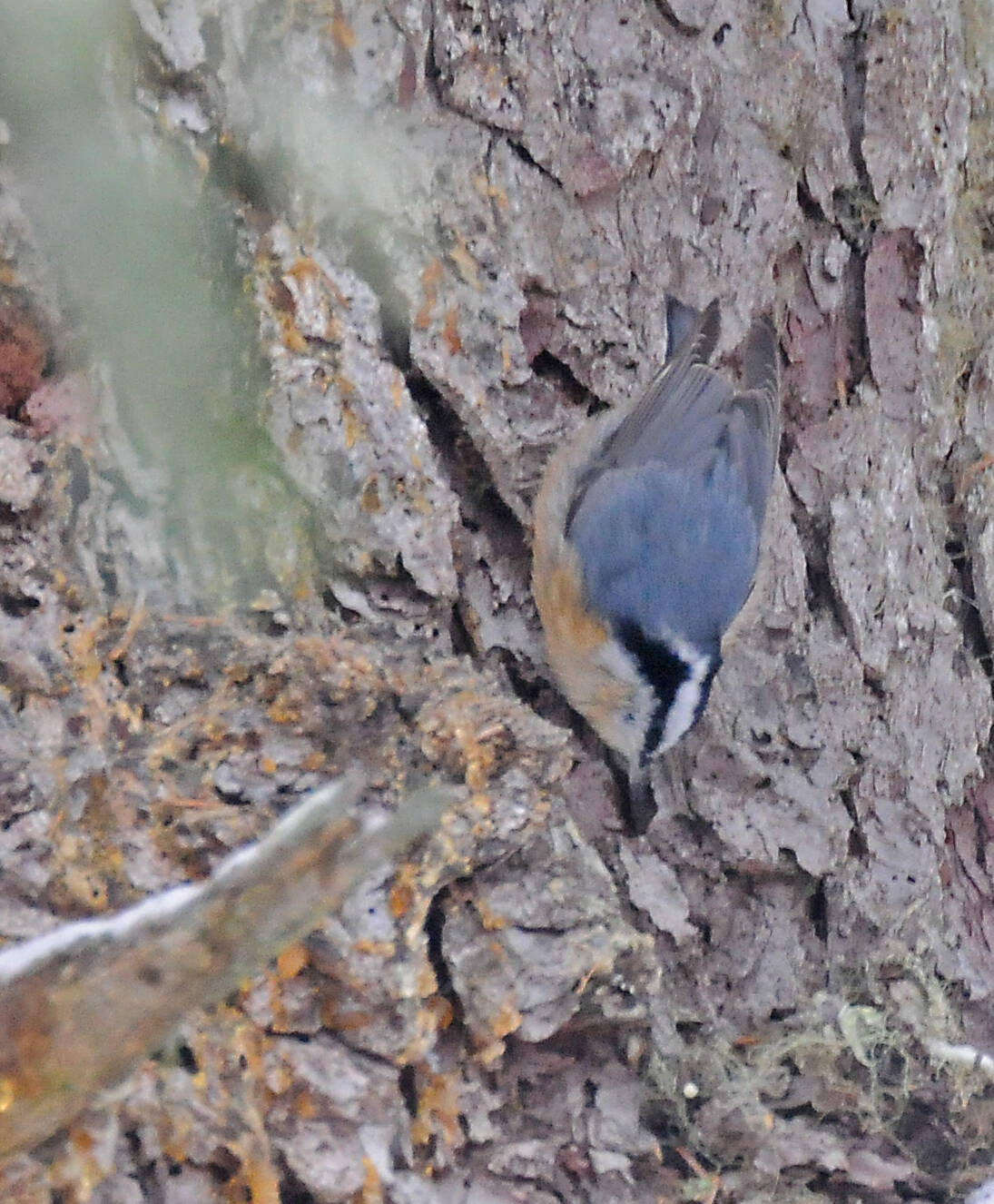
Red-breasted nuthatches stay active all winter, often caching seeds (Courtesy Photo / Bob Armstrong)
In addition, chickadees (the black-capped species has been studied, but other species may do this also) can reduce their metabolism at night and let body temperature decrease; this saves energy, although in extremely cold conditions, it may be impractical, because body temperatures can’t drop too far (being ‘warm-blooded’). The over-wintering species have several tricks that are apparently not used by the warblers. Roosting in cavities, away from the winds, can increase the effective temperature by 25% or more, saving energy, and any sheltered site would be helpful to some degree. Moreover, roosting with companions would also help save energy. Both sheltering and companionship are used by these four species upon occasion. Wrens sometimes roost in cavities, sometimes communally. Chickadees sometimes roost in pairs, sometimes in cavities but more usually in dense foliage. Creepers sometimes roost in small groups, often in sheltered spots. Red-breasted nuthatches may sometimes use cavities, and if seed crops fail, they travel southward in search of better foraging. Apparently none of these methods (except for travelling south) is used by the late-staying warblers (as far as is known).
I can’t resist adding one more bird species: the common redpoll, which is slightly larger than those birds already mentioned, averaging about 13 to 14 grams. They eat lots of seeds, especially in winter. And they have the intriguing habit of using snow blankets, dropping down to the snow and making a tunnel with a chamber at the end, 6-11 centimeters below the snow surface.
Shrews are very small, short-lived mammals that stay active during the winter. They can’t store sufficient body fat, so they have to keep eating every day—twice or three times their body weight in bugs, worms, and other inverts, to maintain their high metabolic rate. European common shrews (Sorex araneus) , weighing less than 12 grams, undergo a marked autumnal reduction in body size, including spine, internal organs, skull, and (!!) brain, as they enter their first winter. Home ranges are smaller and cognitive function related to spatial explorations seems to be diminished in winter. But they regain body mass and re-grow these parts in spring, almost to the original size, ready for the mating season. Researchers suggest that those winter reductions may be a way for saving energy. I have not found comparable information about Sorex species in Alaska, but similar seasonal changes might occur. I wonder what the Alaska tiny shrew does, living in the Interior and weighing less that 2 grams. Interestingly, the pygmy shrew (in a different genus) does not show these seasonal patterns, leaving open a number of intriguing questions.
European studies of least weasels and stoats (or ermine) have also revealed seasonal changes in depth of the braincase. (Both stoats and least weasels are considerably larger than shrews: stoats weigh up to about 330 grams (esp. males), and the weasels weigh up to about 190 grams, especially males. However, the long, narrow body shape means heat conservation is difficult, and the metabolic rates are high). Again, brain size reduction may be a way of saving energy. Juveniles decrease braincase depth during their first winter but regain it the next summer. Adults also lose braincase volume in winter and regain it the following summer, but males regain more than females (perhaps related to female’s energy expenditure on rearing offspring and less need to range widely).
Thanks to Gus van Vliet for helpful consultation.
• Mary F. Willson is a retired professor of ecology. “On the Trails” appears every Wednesday in the Juneau Empire.
