
Winter came late this year—the good snows and cold temperatures didn’t arrive until after the new year began. One last observation from the winter: the creeks in the Dredge Lake area were frozen, and their icy surfaces held mini-forests of feathery ice crystals. A shrew had ventured out among those feathery tufts, mowing down a channel through them, leaving a trail rather like a big caterpillar.
The vernal equinox has just passed and the now-dirty and rotten snow still lies over much of the ground. I looked out my front window at all that snow and my ice-covered pond a few days ago and was swept by a wave of nostalgia for the deciduous forests of the Midwest, with their wonderful array of flowering woodland ephemerals that bloom in early spring before the trees leaf out. When I was little, an elderly neighbor lady took me for walks, just to look at them. Years later, I learned to appreciate them in a different way, when my grad students and I studied the pollination biology of seven species of white-flowered ephemerals in Illinois woodlots. Other species soon flowered too, all taking advantage of the sunlight reaching the forest floor before the canopy closed. Never-mind that March is a tad early, even for those early-flowerers—I must be very ready for spring events here.
Trail-walkers comment on their impatience for the arrival of spring, and I’m just as eager as they are for the exuberant burst of spring that’s still in the offing. Meanwhile, signs of spring are appearing slowly, almost one by one. A couple of deer along the highway still had their thick, dark winter fur coats. But we hear juncos singing in many places, varied thrushes and wrens are tuning up, and robins forage in beach grasses. A dipper is singing at Steep Creek. The serious declines in bird populations here and elsewhere make each sighting or hearing more valuable than ever. Mountain goats are seen quite regularly near Nugget Falls, as they rest in the infrequent sunshine and look for edible lichens. Squirrels have done their mating chases. Elderberry buds are fat and almost ready to open; new shoots of devil’s club are becoming visible at the tips of the prickly stems.
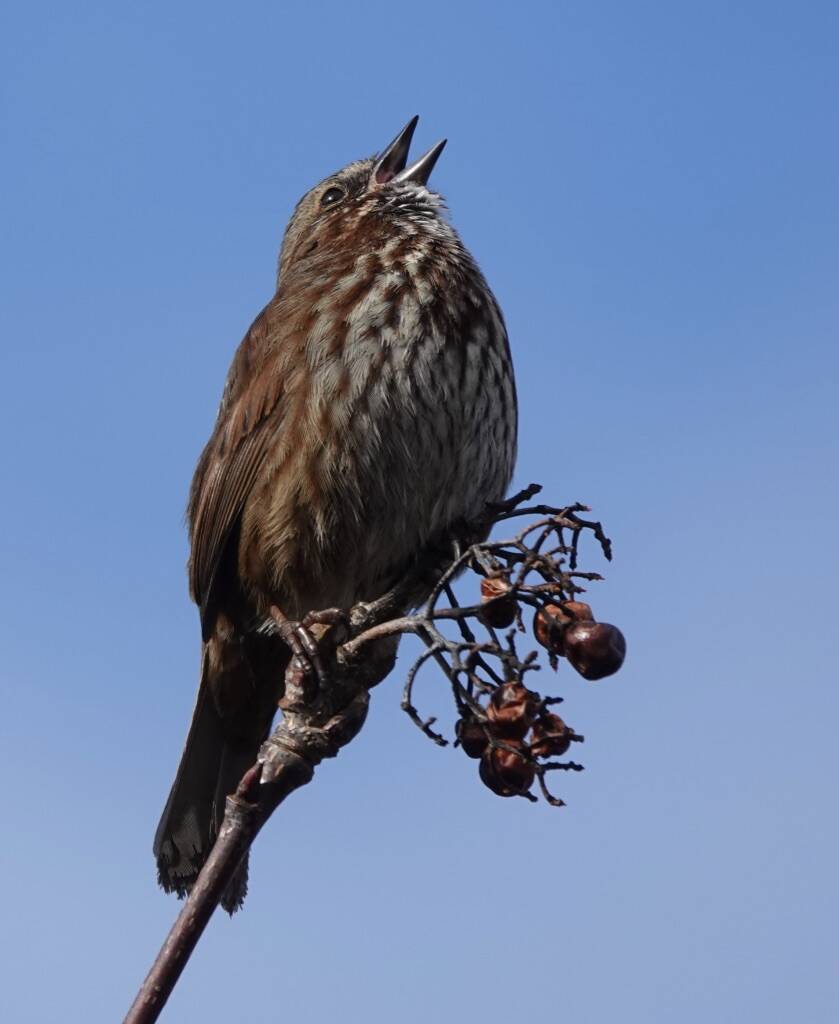
A male song sparrow near the wetlands sings on the Equinox (Courtesy Photo / Helen Unruh)
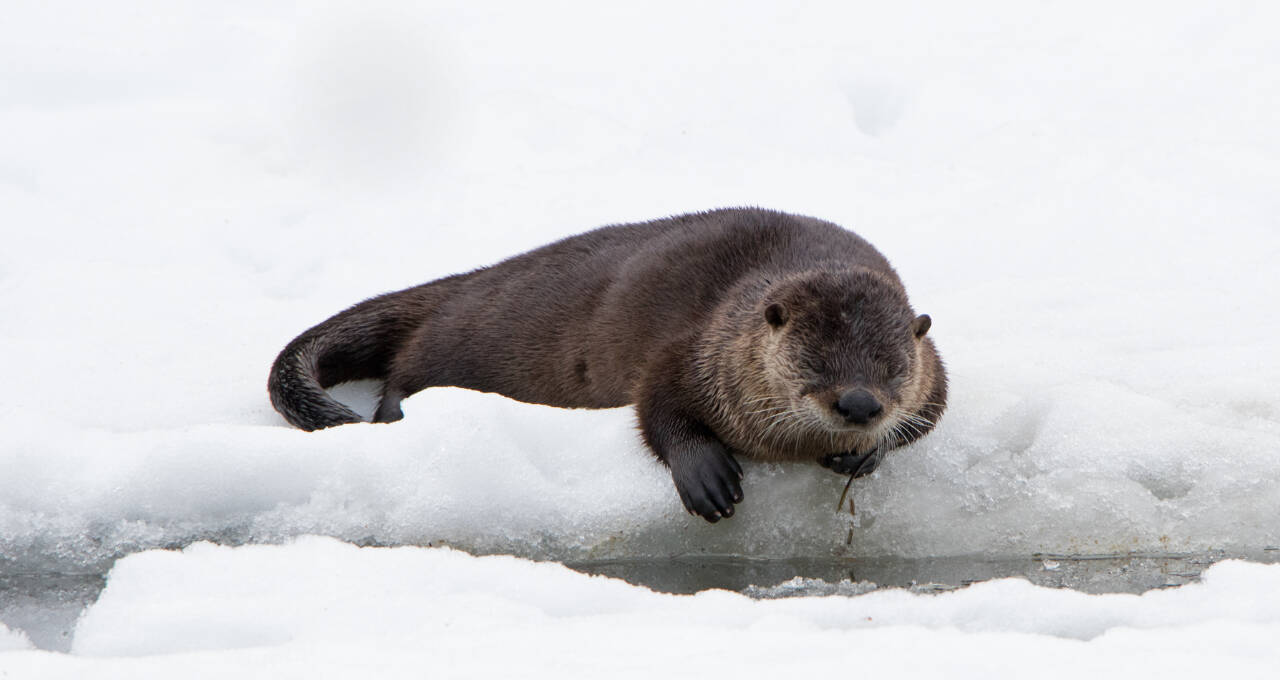
As I await more and bigger signs of spring, there have been good things to see along the trails. One day at Fish Creek, a rotund otter rested at the edge of the ice that still covered most of the pond. After a few minutes, it dove and came back up in a crack a little farther offshore. There it dove repeatedly, but if it caught anything at all, the prey was very small.
Lots of elderberry bushes grow at the edge of the woods on the ‘island’ at the end of the berm. A friend and I were curious about bud development, so we inspected the branches. Yes, the buds were growing but, more interestingly, almost all the twigs at the branch ends were missing, chewed or torn off, although a few of the tallest branches had escaped mutilation. I have seen porcupines demolishing elderberry twigs and deer are known to browse woody vegetation in winter, especially when snow is deep, so there are two likely perpetrators—if they ever wander out to that ‘island.’
Out on the wetlands, an anomalous spindle-shaped form caught my eye, and binoculars revealed it to be the back view of a heron, standing sleek and still. It turned a little bit, and I had a beautiful view of its light-colored chest feathers, all fluffed out and fluttering in the breeze. I’d never seen such a huge ‘chest beard’ on a heron. No other herons were visible; maybe it was merely drying out its plumage (?).
Near Shaman Island, a harbor seal floated placidly, sometimes making short dives but mostly just looking round. A flotilla of red-breasted mergansers cruised by, two males and four females. The males had their long, green crests erected and occasionally thrashed the water with their wings; there may have been tension between them, but most of their cruise looked peaceable. One of the females drifted away and went foraging, but the others kept on sailing.
Red-breasted mergansers often over-winter in salt water bays and estuaries and move inland to nest near big lakes and rivers. This merganser regularly nests on the ground, unlike our two other species of merganser. Their name derives from Latin words meaning ‘diving goose’, but they bear almost no resemblance to geese. The diet is mainly small fish, with some additions from invertebrates, snapped up by that narrow bill.
My eagerness for full-blown spring will not hurry it along, so I’d best settle down and patiently(?) enjoy whatever I can observe as the days go by.
• Mary F. Willson is a retired professor of ecology. “On The Trails”appears every Wednesday in the Juneau Empire.
