

By Mary F. Willson
Although some range maps show American robins occurring in Southeast Alaska all winter, we don’t usually see them then. For many of us, robins are one of the harbingers of spring and therefore a pleasure to behold. This year, I saw my first one toward the end of March; a few days later, I found a small flock of them (mostly males), foraging in the leaf litter. In very early April, I heard them singing, albeit wheezily. That early in the season, they may be seen in a variety of habitats, including beaches; eventually they’ll settle for nesting along forest edges, in open woods, and shrubby areas, often near open grassy places. They are sometimes quite common, and when the novelty of their arrival wears off, we sometimes dismiss them as ordinary, not worthy of attention. And then we probably miss some interesting behaviors.
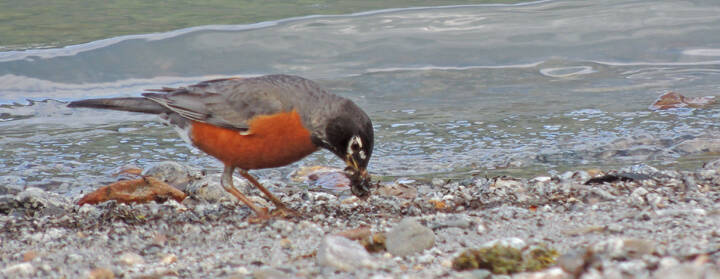
An American robin feeds on flies. (Courtesy Photo / Bob Armstrong)
Robins got their name from English colonists who saw some similarity to the European robin, commonly called robin redbreast. Indeed, both birds have reddish breast feathers, but there the similarity ends. American robins are much larger than European robins, weighing three to four times more. They are not closely related, being classified in different taxonomic families: the European robin is currently classified with chats and nightingales in a subfamily of the family Musicapidae (which includes the Old World flycatchers), while the American robin is a thrush, classified with bluebirds, solitaires, hermit thrushes, varied thrushes, and so on (family Turdidae; formerly a subfamily of the Musicapidae, but now separated). (Although I suspect the European species sings in springtime, as does our species, I’m told that they also help celebrate Christmas in Britain, often appearing on British Christmas cards.)
Both species forage on invertebrates and fruits; the European species also eats seeds, carrion, and small vertebrates. The European species is noted for following gardeners or other animals that disturb the soil, exposing edible invertebrates. American robins may do so too, but they also make their own disturbances, tossing leaf litter aside and tearing up moss. They are famous for hunting earthworms — detecting the prey by listening and watching, then pulling the worms out of the soil, sometimes with difficulty. When foraging on the ground, the American robin commonly runs, but the European robin usually hops.
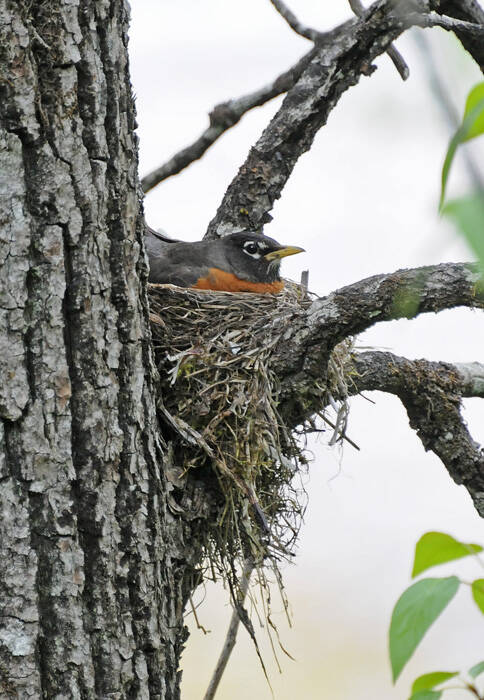
An American robin sits on a nest. (Courtesy Photo / Bob Armstrong)
As fruit-eaters, both species can disperse seeds (and sometimes associated mutualistic mycorrhizal fungi). American robins disgorge large seeds and defecate smaller ones; they can store fruit overnight in an extensible esophagus (like a crop, but somewhat different). They are not efficient at digesting fruits, which pass through the gut quickly; furthermore, this species lacks the necessary enzyme for digesting sucrose (common sugar, a disaccharide), although other sugars (monosaccharides such as fructose and glucose) are digestible. I have not found such information for the European robin.
Their nesting habits are quite different. The American species makes a bulky, open-cup nest of grasses and small twigs held together with mud; it is placed on a branch, or building, or stump, or occasionally on the ground, often with some protection such as thick foliage overhead. The European robin commonly nests in tree cavities, holes in stone walls, under tussocks or roots, making the nest of moss, grass, and twigs, placed on a mat of dead leaves.
Both species are socially monogamous, but there can be variations on that theme: As many song birds do, the American robin indulges in frequent extra-pair copulations, so that a brood of nestlings often has two or more fathers. This practice is known in the European species, but I found no information on how commonly.
Incidentally, the name ‘robin’ has been applied to many other birds in other places, including the Central American rufous-collared thrush (or rufous-collared robin; family Turdidae), the robin-chats of Africa (Musicapidae), the Australian robins (in an altogether different taxonomic family, Petroicidae), and — by early settlers in Australia — the Australian rufous whistler (‘robin redbreast’, in yet a different family, Pachycephalidae), among others. Most of these have reddish feathers on the chest.
Common names in English can be very confusing.
• Mary F. Willson is a retired professor of ecology. “On the Trails” appears every Wednesday in the Juneau Empire.
