
Nitrogen is essential for growth and development of living things. It’s involved with almost all aspects of life: in amino acids that constitute protein, in DNA and RNA that control genetic inheritance, in ATP molecules that provide energy for cellular metabolism involved in muscle contraction and nerve impulse propagation, in lots of enzymes that control physiological processes, and in some vitamins (e.g., B complex), and so on. It’s abundant in Earth’s atmosphere, comprising almost eighty percent of all atmospheric gases. But it’s not in a form usable by many organisms, including all the ones we can actually see without a microscope.
This essential element is provided in small quantities by lightning bolts, which separate nitrogen atoms from each other and lets them bond with oxygen in the air, to be picked up by water droplets and dropped as nitrates to the earth in rain. However, most of the nitrogen used by living things is retrieved from the atmosphere by bacteria, many species of them. They have the machinery to “fix’ nitrogen into forms usable by other organisms by oxidizing it to nitrates (nitrogen with three oxygen atoms).) These so-useful bacteria live in all kinds of places: in the soil and decomposing litter, in root nodules of legumes (e.g., lupine, beans) and alders, inside conifer needles, certain ferns, fungi, and lichens, in water, on leaf surfaces in the crowns of trees and shrubs, on tree bark and many other places.
Nitrates are water-soluble, so they can leach out of bacterial cells, fall with rain from leaves to the ground, ooze in and out of root nodules and roots, get picked up by fungal networks and so transferred to plants. Plants are the basis of most food chains, providing food for herbivores that are food for carnivores. Soils differ in nitrogen content and nitrogen is often a limiting factor for plant growth (witness the use of commercial fertilizers).
Vertebrae muscle tissues usually have about 15-30% protein, by wet (raw) weight. Insects seem to have more protein, on average (but it’s highly variable), although some of that protein is in chitin (e.g., in the exoskeleton of insects), and apparently only some birds and mammals can digest chitin well. So, with some exceptions, animals that eat other animals seldom have problems with nitrogen supplies; the nitrogen in animal tissues is generally in a form usable by consumers.
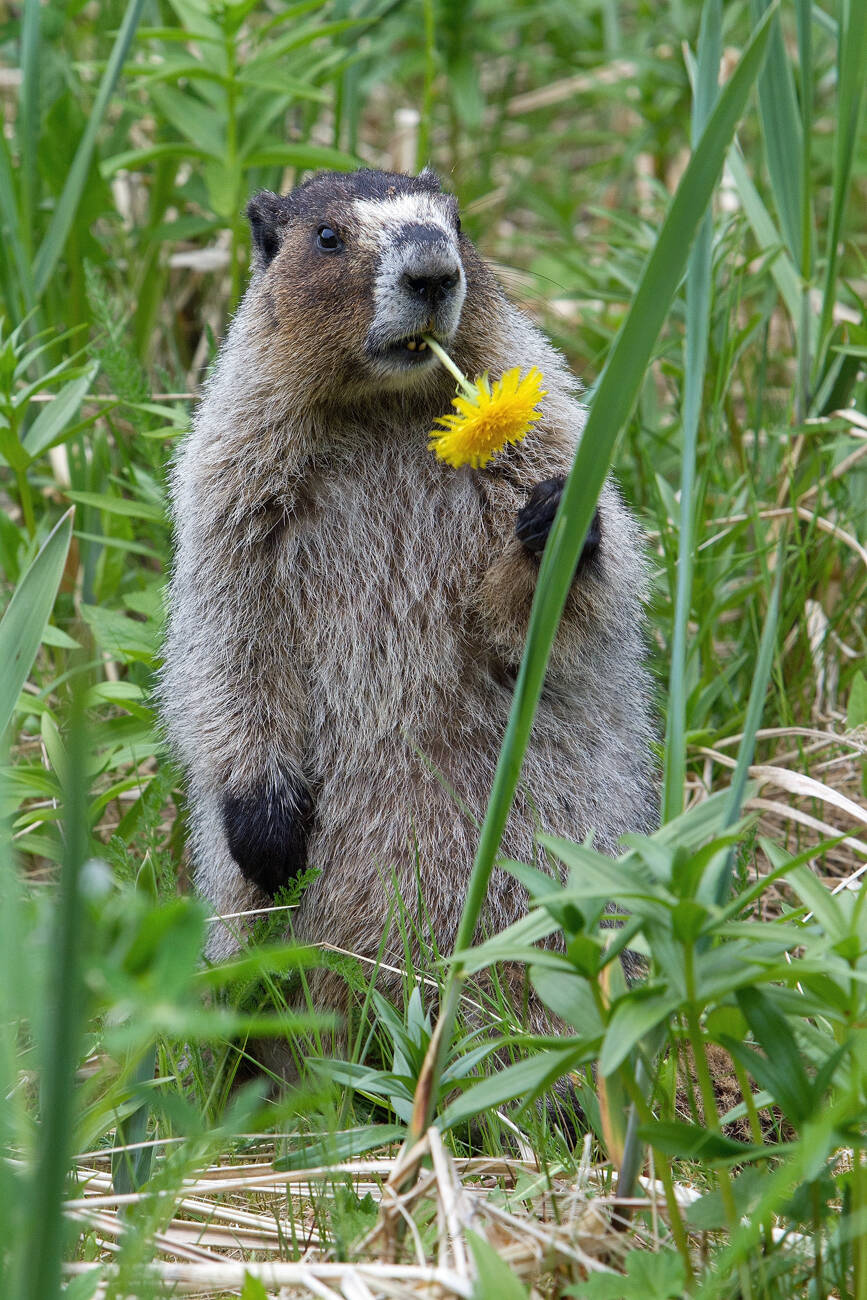
A hoary marmot nibbles a dandelion (Courtesy Photo / Jos Bakker)
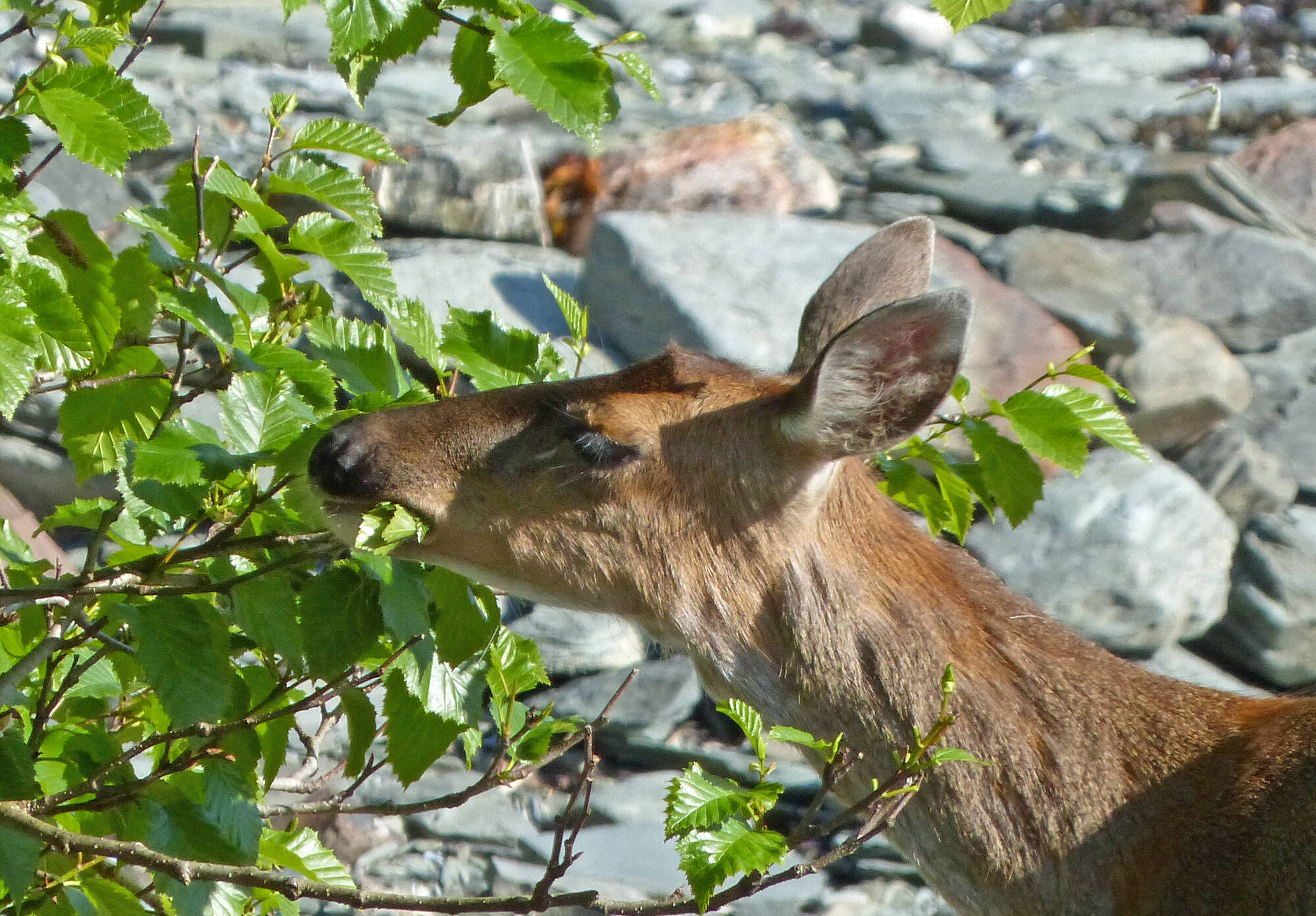
However, in general, plant tissues have lower levels of protein (usually less than twenty percent by dry weight, often much less). Plant-eating animals (herbivores) consume fresh green plant material and the wet weight varies with the water content, which is highly variable, depending on growing conditions, among other things. For comparison purposes, try fifty percent water, giving less than ten percent protein in plants. Plants and plant parts differ a lot in nitrogen content, availability, and digestibility; for instance, young needles of spruces have more than twice as much protein as old needles—but still a relatively low value. Pollen and seeds tend to have more protein than the green parts.
Herbivores feed on green vegetation that often has relatively little nitrogen, so how do they obtain enough nitrogen? Some forage selectively; for example, the giant panda eats mostly bamboo but it favors young bamboo shoots, which have more nitrogen than older shoots. Another way is to eat large volumes of vegetation, which is most possible for large animals with large guts (elephants, horses, cows). Or an herbivore may pass small volumes of vegetation through the guts rapidly (panda); aphids and other sap-sucking insects ingest lots of fluid in order to get enough nitrogen, excreting the excess water and sugar as honeydew.
Herbivores have a variety of specializations of the digestive tract. But fundamentally, all vertebrates (and invertebrates too) depend on vast populations of microbes to process food. Some plant-eaters do a lot of food-breakdown in the stomach, which is generally divided into compartments; examples are camels, kangaroos, hippos, sloths, and the ‘ruminants’ (deer, cows, sheep),which can burp up a meal from the stomach to be reprocessed by the mouth. The first stomach compartment (the rumen) holds populations of microbes that do the work of digestion. Other herbivorous mammals (horse, elephant, manatees, gorillas) have enlarged colons for microbial digestion. There are billions of these microbes, which have many digestive uses, but they have very short individual lives. When they die, their multitudinous bodies can be digested by still other microbes, which produce amino acids usable by the herbivore.
Many herbivores have special physiological adaptations that allow them to recycle urea (a metabolic product of nitrogen digestion, which humans excrete in urine) back into the digestive tract where it is used by gut microbes. Herbivorous birds such as grouse and ptarmigan can reflux urine and digestive material back ‘upstream’ from the cloaca where it is collected into the large intestine to be reprocessed.
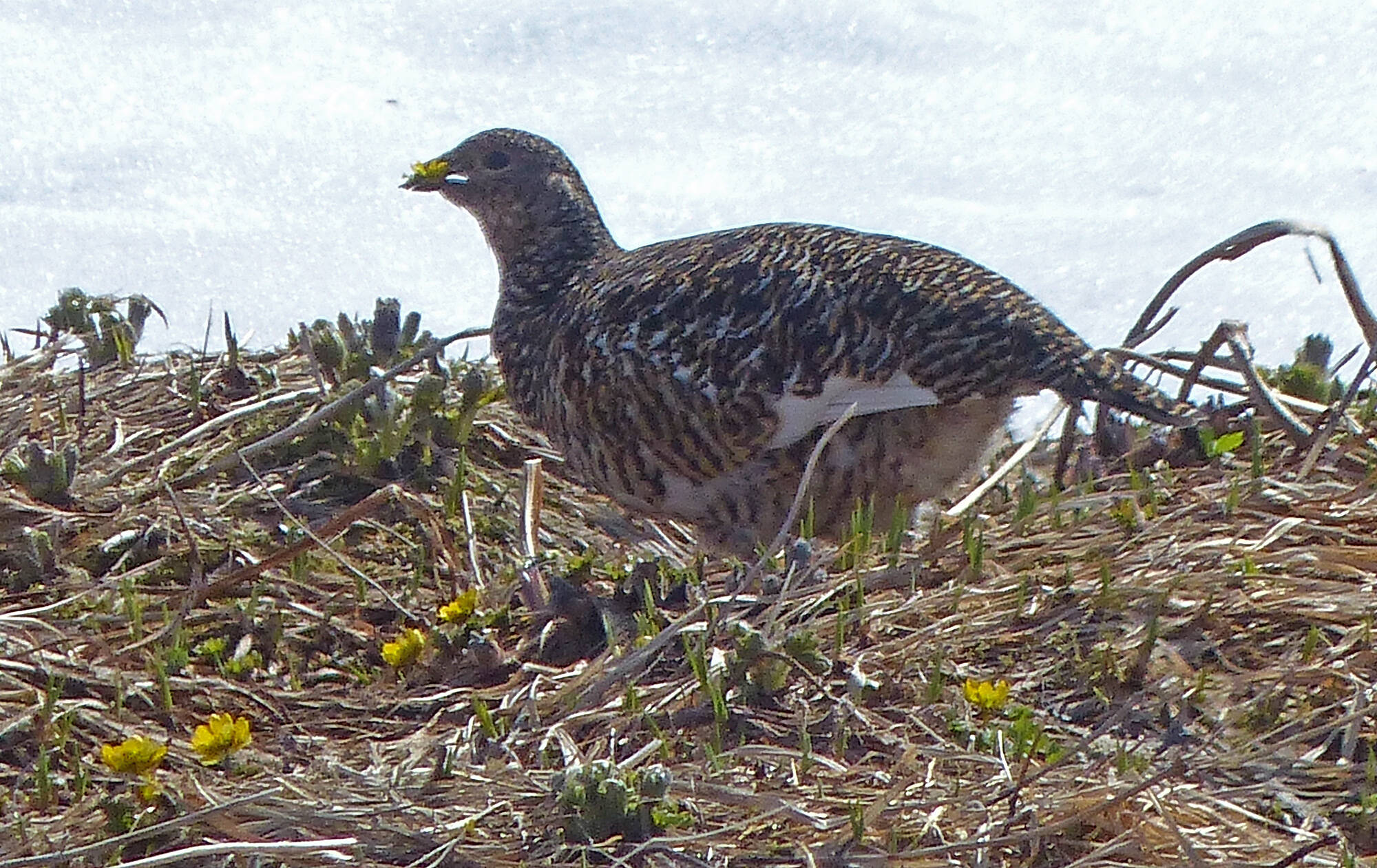
A female rock ptarmigan eats Cooley’s buttercups. (Courtesy Photo / Bob Armstrong)
Or those things can be refluxed into ceca (sacs attached to the intestine in which further microbial digestion occurs). Lots of small mammals and some birds have ceca, which can retain fluids and small particles that can be digested more easily than large particles in a second round of processing.
Still another means of recycling is ingestion of feces (coprophagy). Many small mammals (lemmings, rabbits) with ceca produce two kinds of feces: ordinary ones that have only passed through the intestine and cecal ones that have been reprocessed by the ceca before being excreted. Cecal feces, reprocessed, have higher nitrogen content than ordinary feces, and are consumed by these herbivores. Much of that nitrogen results from microbial activity.
Vertebrate herbivores have solved the problem of nitrogen acquisition in many ways! I’ve emphasized vertebrates here, in hopes of keeping this subject tractable and within my usual space limitations.
• Mary F. Willson is a retired professor of ecology. “On the Trails” appears every Wednesday in the Juneau Empire.
