
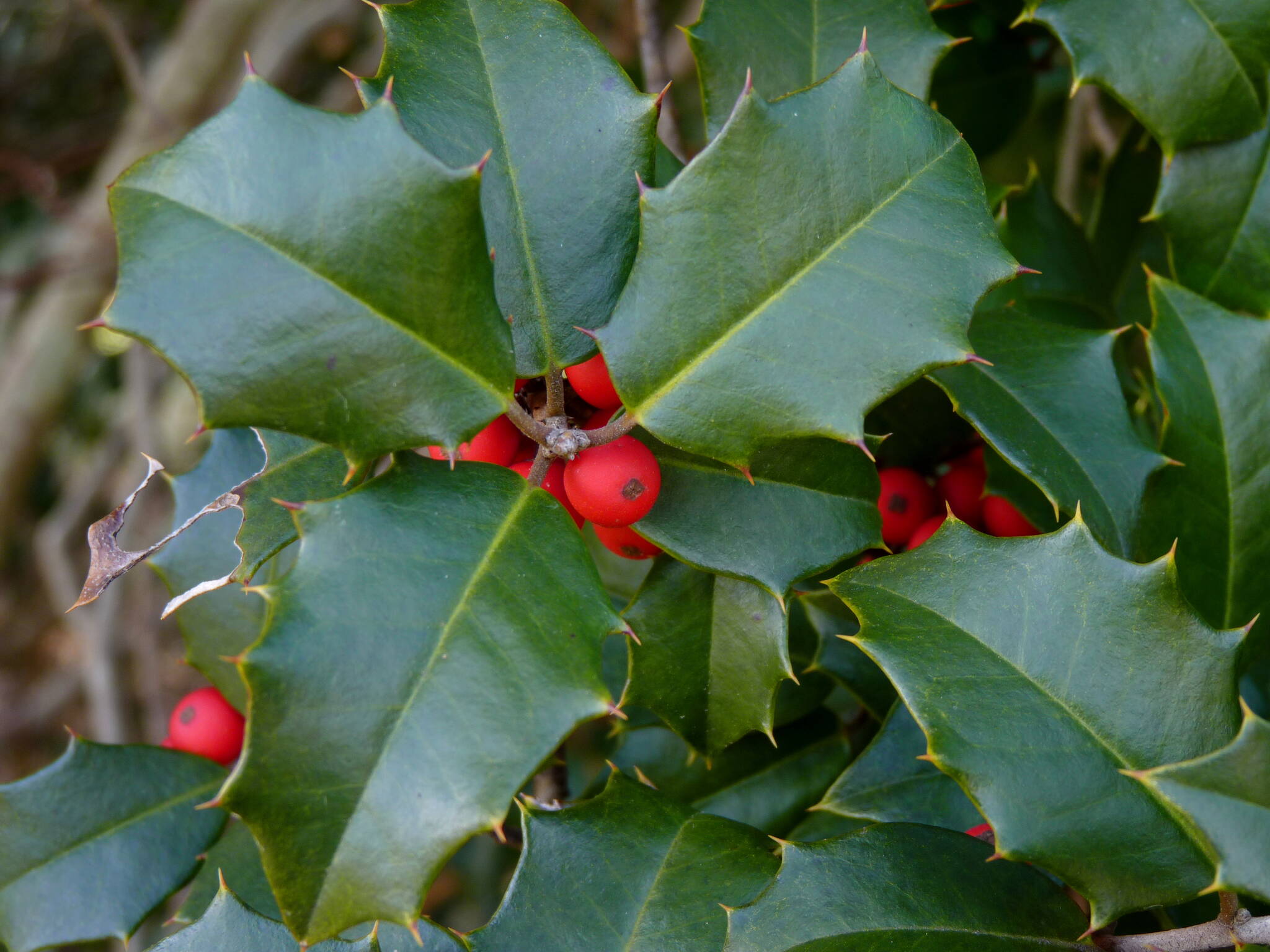
Some Juneau friends planted holly bushes in their front yard a few years ago. Those bushes grew well, producing dark green leaves with smooth edges. However, during a few winters of heavy snow, deer foraged on the smooth leaves, as far up the bushes as they could reach. Juneau folks often note deer (or porcupines) browsing on garden plants. A common response of gardeners is to build a fence.
But the holly bushes built their own “fence.” The leaves produced after the deer browsing have spines on their edges, which dissuades deer from further munching. Somehow, the deer foraging induced a change in the leaf morphology. How does that happen?
To approach an answer to that question, we have to provide some background (and that leads to a more general issue of inheritance).
The suite of features that comprise the structure and function of an organism is called the phenotype. An individual’s phenotype typically determines (along with sheer luck, too) if it can survive and reproduce successfully. Holly phenotype includes the flexibility to produce different types of leaves. In their native habitats, that flexibility probably enhances the ability of holly plants to survive and reproduce successfully. Thus, some phenotypes do better than others: they have higher evolutionary fitness—that’s natural selection. Much of a phenotype is determined by genes, so differential survival and reproduction of phenotypes generally means that some genes become more frequent in a population, while others become less frequent—that’s evolution, which sometimes leads to new species.
The physical basis of inheritance lies in DNA, which occurs in cell nuclei and in mitochondria (which run metabolic machinery) in the cell cytoplasm. Genes typically are segments of a long DNA molecule; we identify them as units of inheritance by observing what they produce and then by detailed molecular analysis. The information contained in a gene is expressed in the building of proteins and other molecules essential for life. Some genes determine a structure or an enzyme or a process, while others modify expression of other genes or repair DNA damage (some do nothing we can detect). Genes can change, through a process called mutation. Although many mutations are repaired before they are expressed, some persist, altering the organism’s phenotype — so they are a basic source of variation among individuals. Some mutations are beneficial, favored by natural selection and that phenotype succeeds, while other mutations are detrimental and that phenotype does poorly.
In addition, for centuries, it has often been thought that some traits acquired during the lifetime of an individual can also be passed on to the next generations. Such phenotypic traits are not based on the genes of DNA. For example, it might be suggested that if a giraffe made her neck longer by continually stretching out for more leaves to eat, she could end up making offspring with longer necks. That particular example does not work. But the contrast between this idea and gene-based inheritance fueled arguments for many years. As we learn more about the intricacies of inheritance, it turns out that certain types of acquired characteristics actually can be transmitted from one generation to the next.
We are not talking here about direct external impacts — if the tails of mice are cut off (changing the apparent phenotype), the offspring of the artificially tail-less mice have normal tails. A body-builder who has spent a long time developing big muscles doesn’t pass on those big muscles to his kids.
Instead, some internal, intracellular change brings with it a change in the expressed phenotype. It happens without any change to the basic physical structure of DNA (and is reversible in some cases). It alters gene expression, generally by blocking access to a functional part of the DNA but not changing the genes themselves. For example, sometimes a chemical group called methyl is stuck onto the DNA, usually turning off gene expression for that piece of DNA. Or the normal twist in a DNA molecule is changed, such that a functional part of DNA cannot access the material it normally works on. These changes of gene expression are called epigenetic, the prefix epi- means on top of or over.
Many of these epigenetic effects are normal, controlling development and changing with age. And some environmentally induced epigenetic effects may modify the expressed phenotype of individuals without changing the next generations. A study of European holly in Spain showed that leaf browsing by mammals induces an increase of prickliness of the leaves, and this was accompanied by methylation of the DNA, which is presumably what happened to the hollies in Juneau. But the possible heritability of the prickly phenotype itself is still unknown, apparently.
However, environmentally induced phenotypic alterations can sometimes be passed on to the next generations and have been reported for many organisms, from worms and insects to plants and humans. Marked temperature changes, air pollution, diet composition, exposure to heavy metals, viral infections, stress, various medicines, exercise… the list of agents that can lead to heritable epigenetic effects is very long. There may be heritable environmentally induced epigenetic effects on flower shape, longevity, leaf hairiness, eye color, fur color, body size, susceptibility to disease, and many other phenotypic traits. To provide one example, in a much-cited case for humans, severe malnutrition during pregnancy, associated with methylation at various DNA sites, resulted in offspring that were smaller than usual, and that also had more disease, poorer cognitive function and shorter lives. Some of those effects also appeared in the grandchildren of the starved mothers.
The bottom line is this: Inheritance of acquired characteristics is a real phenomenon, in certain cases of environmentally induced epigenetic changes of phenotype. There has been a lot of research on environmental epigenetics, primarily on the molecular mechanisms and the associated phenotypes. Although it is widely recognized that such phenotypic changes can increase or decrease survival and reproductive success, it seems that there is still much to be learned about precisely how and when such phenotypic changes are adaptive or detrimental and thus potentially have an effect on the course of evolution.
• Mary F. Willson is a retired professor of ecology. “On The Trails” appears every Wednesday in the Juneau Empire.
