
By Mary F. Willson
For the Juneau Empire
On a fine, sunny day in February (yes, there were a few of those!), a friend and I decided to snowshoe on the Lower Loop at Eaglecrest. The snow was very deep, after those heavy snowfalls earlier, but now it was packed so firmly that we could walk around anywhere, on or off the trail. We didn’t really need those ‘shoes.
Wandering around, at first I thought the hard snow would mean that small critters wouldn’t leave tracks, but there was just enough dusting on the surface that tracking was possible: voles and squirrels, as usual, and a very narrow groove ending in a tiny hole that was surely a shrew.
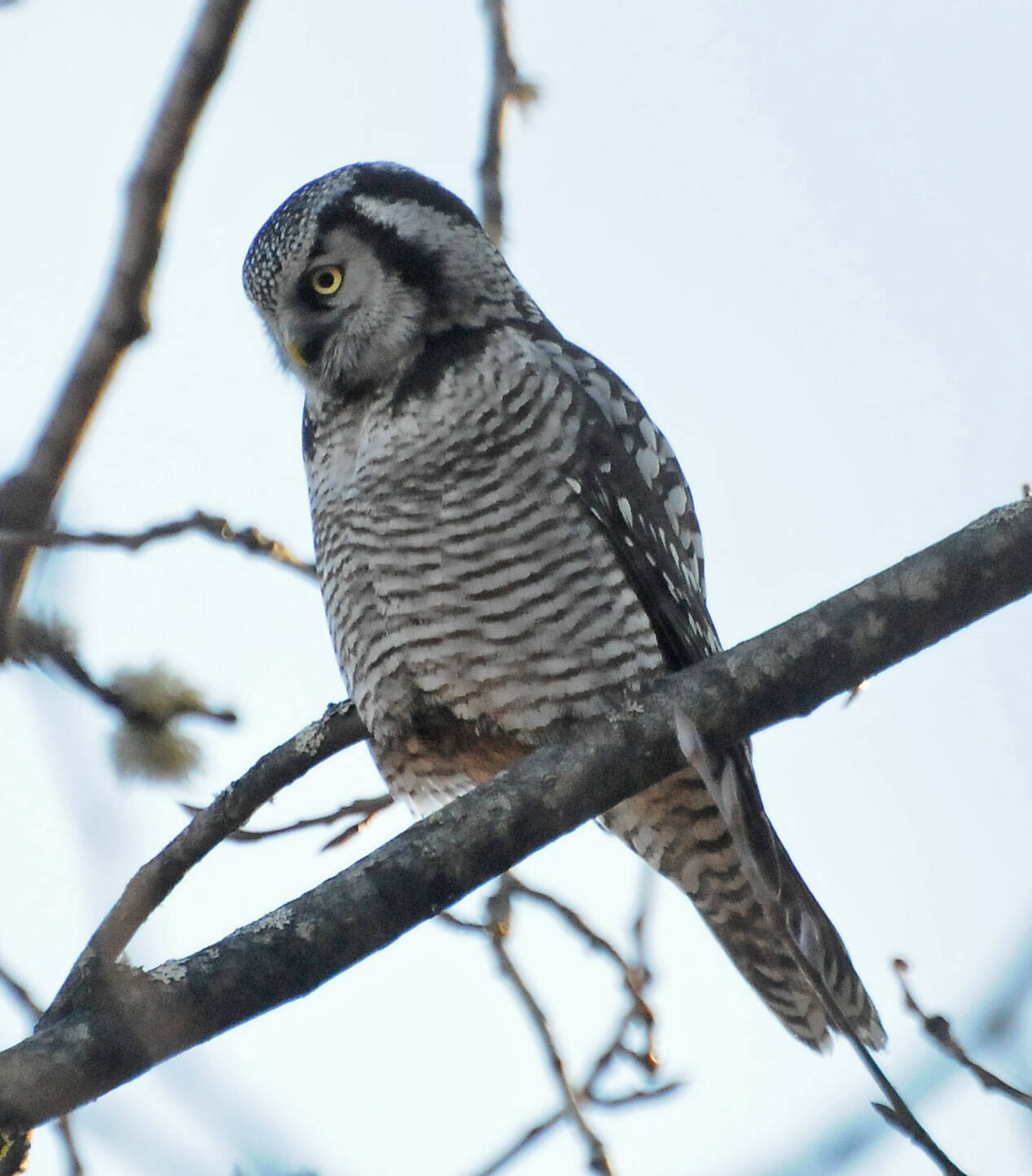
A pair of Real Birders kindly drew our attention to a bird that was perched high in a dead tree. Hawk owl, they said. None of us had binoculars. All I could see, at first, was a dark lump. As I started to ask how they knew that lump was a hawk owl, it changed its position a bit and I saw its long tail. Ha! That made naming it easier. Then, as it turned its head this way and that, I could just barely make out the white spots on the side of the head.
Female hawk owls are generally a little bigger than males (by body mass), but there is overlap in the range of body sizes. That is unlike most other owls, in which females are considerably heavier than males. This raise the everlasting question of why this is so…
Northern hawk owls hunt mostly during the day. The facial disc of feathers, which helps focus sounds, is smaller than on owls that hunt at night. The ears differ in size and shape of the opening, but they are placed symmetrically on the sides of the head (again, unlike the very nocturnal owls, in which they are placed differently on right and left sides). Hawk owls can locate and capture prey by sound (e.g., under snow), but much of their hunting is done by sight. They love to sit on a high perch, surveying the surroundings for prey—and that’s what ‘our’ owl was probably doing that day.
Hawk owls prey on rodents, hares, songbirds and sometimes even birds as large as grouse or ducks. When they spot a tasty prey animal, they swoop down and pounce; occasionally they catch a prey in flight or hover, but seldom pursue prey on foot. Small prey are swallowed whole, but large items are commonly beheaded and then eviscerated; the head is swallowed but the guts are often discarded, before the carcass is torn and eaten. Although they nest in the circumpolar boreal region, in years when vole and hare population cycles are peaking, some of them venture south to nest in other areas.
They like to nest in tree cavities and broken-tops of snags. Usually monogamous, occasional males have more than one female. Then the male’s territory encompasses the territories of both his females. There are usually six to ten eggs, but when prey populations are high, there may be a dozen eggs in a nest. The female incubates for about four weeks; the male delivers food to her. Chicks leave their nest when they are three to five weeks old. They can’t fly right away, so they move about by climbing and jumping around on branches. Juveniles become independent of their parents when they are about three months old. They reach adult size when they’re a year old, but the age at which they begin to breed is uncertain.
This is a species that has not received much research attention, compared to some other owls. So there is still a lot to be learned.
As February turned to March, there were a few other little things that were fun along the way, too:
— By the North Douglas boat ramp, a tightly packed pod of young sea lions, agitating the waters near shore. A kingfisher watched closely from its tree lookout just at the water edge.
— A raven flying overhead, carrying a substantial twig, no doubt for a nest somewhere. Lengthening daylight told it that the time had arrived to get ready for spring.
— A sharp-shinned hawk, sitting in a cottonwood along the airport dike trail. We’ve noticed very few small birds along that trail this winter, so the hunter may have gone hungry.
• Mary F. Willson is a retired professor of ecology. “On the Trails” appears every Wednesday in the Juneau Empire.
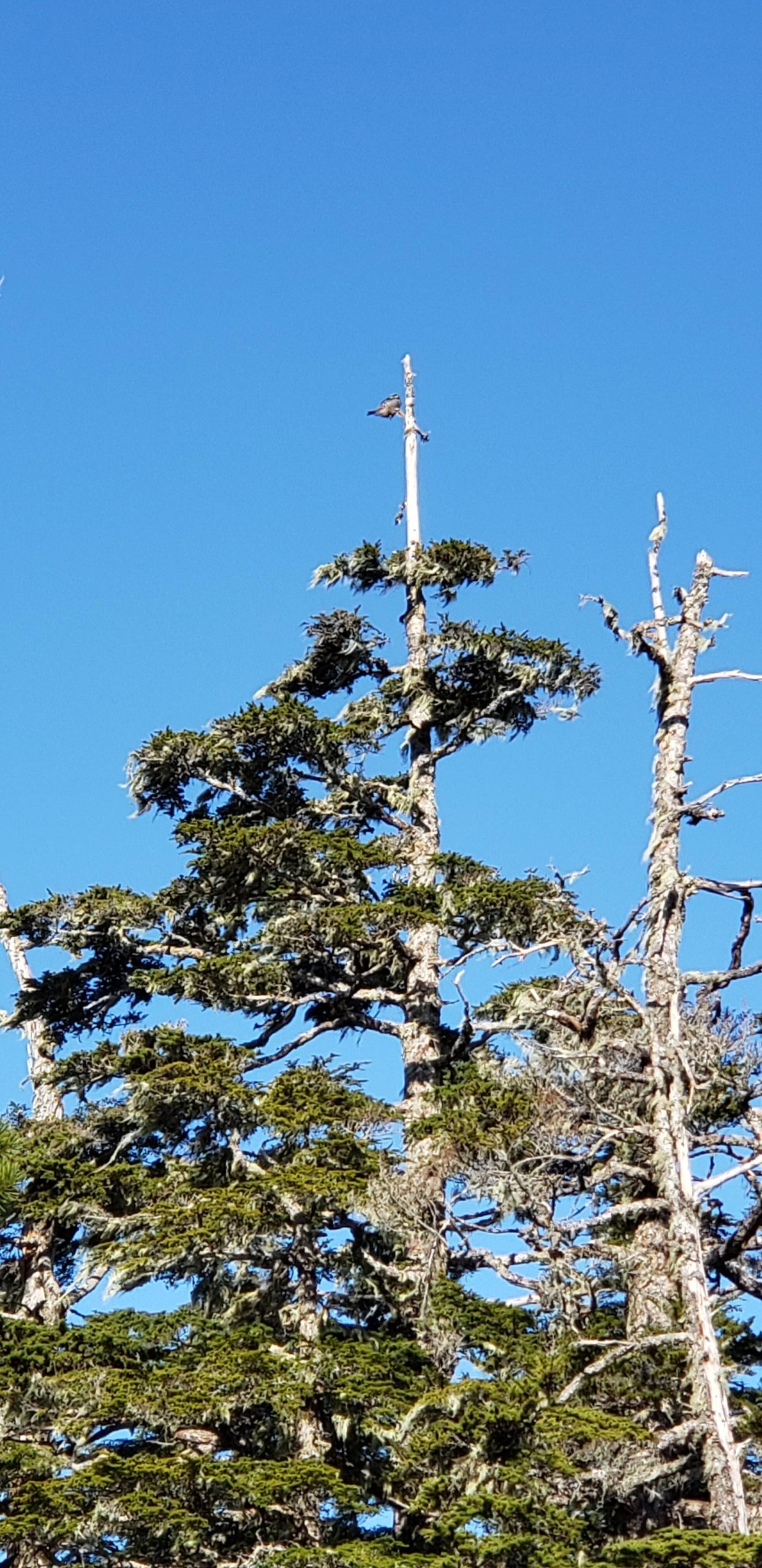
A dark lump perched high up in a dead treetop showed its long tail, which helped us identify it as a hawk owl. (Courtesy Photo / Pam Bergeson)
