March and rally ends the silence
Published 5:22 pm Tuesday, April 9, 2019
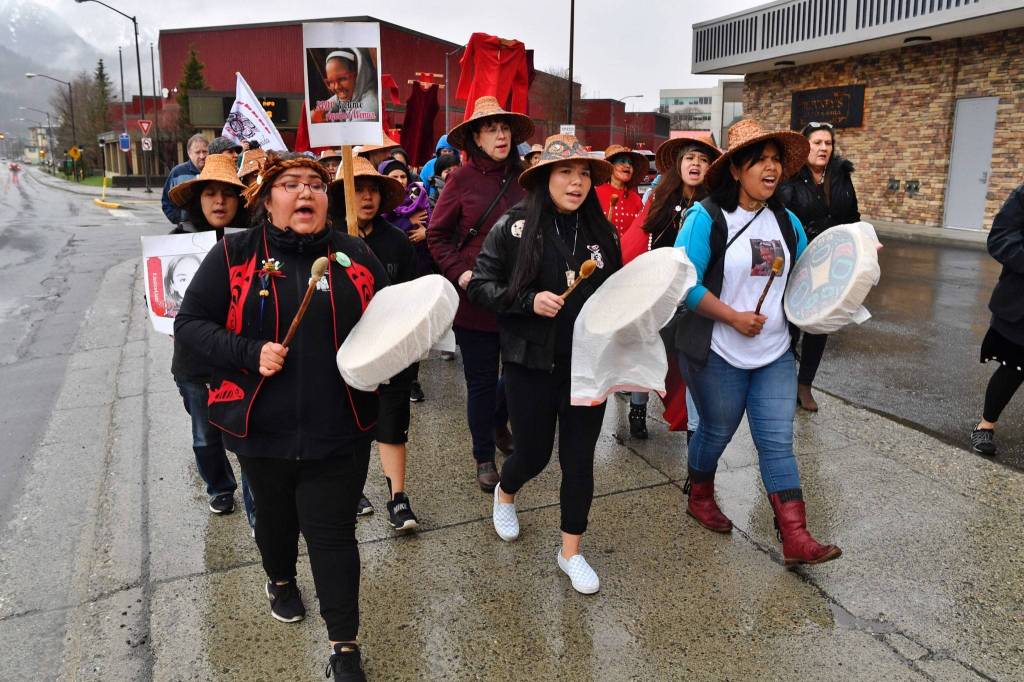
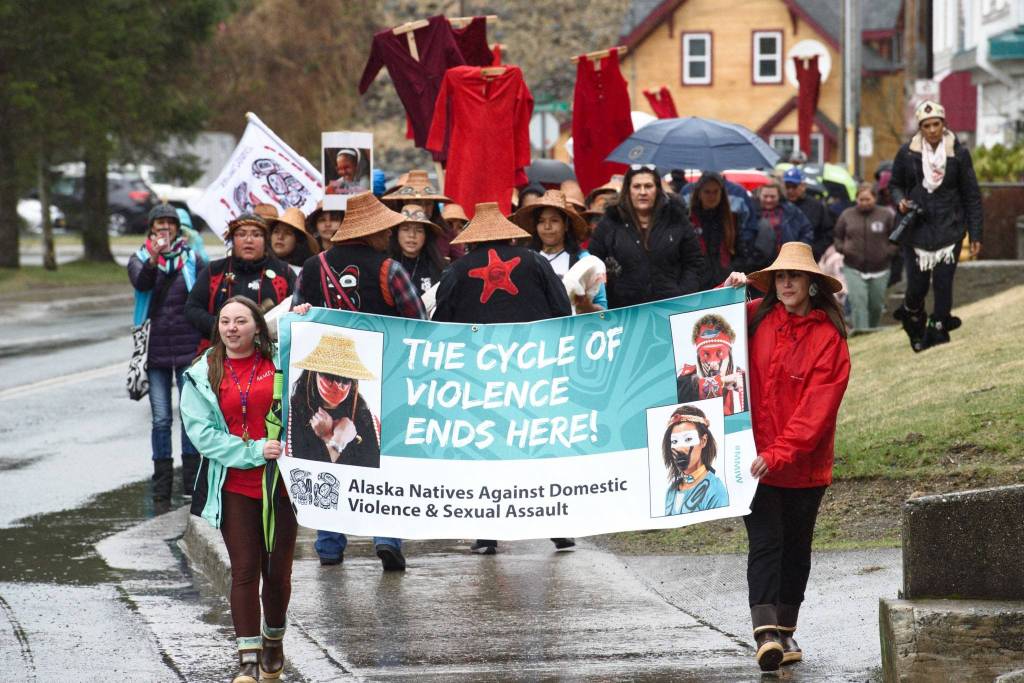


Drum beats echoing off the buildings on Willoughby Avenue added thunder to a drizzly evening.
As the Violence Against Women Awareness March and Rally made its way from Elizabeth Peratrovich Hall to Sealaska Plaza Tuesday, members of Woosh.ji.een Dance Group announced its presence to the crowd of more than one hundred with percussion and leading the group in “The Loon Song.”
“I think that just having a little girl myself, I want to make sure that our community and our country as a whole is a safe place for a young indigenous woman,” said Heather Evoy, a member of the dance group who walked with her children, Judah and Silje.
It was the second annual rally and march hosted by Central Council of the Tlingit and Haida Indian Tribes of Alaska’s Violence Against Women Task Force. The event was held the day before the opening of Tlingit & Haida’s annual Tribal Assembly.
[The story behind Alaska Folk Festival’s 2019 poster]
As the crowd walked and sang, passersby honked in support and faces appeared in the windows and on a balcony at Fireweed Place.
Raising public awareness of violence against women and missing and murdered indigenous women and persons was one of the event’s goals, said organizers.
“High-visibility events like this inspire people to get involved,” said Catherine Edwards of Seattle, co-chair of Tlingit & Haida’s Violence Against Women Task Force before the march.
Edwards said it also pushes issues people might want to avoid because they are unpleasant into the public consciousness.
Chants of, “End the silence, stop the violence,” punctuated speeches delivered at the plaza, and speakers bluntly dragged issues of gender-based violence and sexual predation into the light.
“What I want to talk to you about is something we’re told not to talk about,” said Miciana Hutcherson, who shared her stories of surviving violence and unwanted sexual contact as a call to action. “My first memory is of being molested. The first feeling I remember feeling is fear. I’m not the only woman here with that memory.”
Hutcherson called for those in attendance to end a “culture of silence” and spoke to ways people can be part of the problem without being a predator.
“Not all abuse is physical,” Hutcherson said, and she cited examples of men in positions of power hugging young women for too long or telling off-color jokes in professional settings.
She said such actions train young women to be silent if or when they eventually encounter sexual or physical abuse.
“My call to action is simple,” Miciana said. “Speak. Speak to each other about the trauma.”
Tlingit & Haida President Chalyee Éesh Richard Peterson spoke to the role men need to play as advocates and supporters of women.
“I stand with our strong women and say enough is enough,” Peterson said.
He said men need to not only stand with women, but believe women when they share stories of abuse.
Peterson also shared news that caused him to become emotional and moved many in the audience.
[School flooding quickly fixed, but long-term questions loom]
“One of ours, Selina Everson, has walked into the forest today,” Peterson said. “This is a huge loss to our community.”
Everson, a respected Tlingit elder, was an advocate for the Tlingit language, Peterson said, and she was known to many Alaska Native and non-Native children as Grandma Selina.
Peterson evoked her name near the end of his speech.
“For Grandma Selina, enough is enough,” he said.
Not all bad news
The rally and march came the same day members of the Volence Against Women Task Force received updates about federal legislation related to gender-based violence, and they said there’s some encouraging news.
“I see some progress,” said Patricia Alexander of Sitka, co-chair of the task force.
Among the items she highlighted were the U.S. House of Representatives voting to reauthorize the Violence Against Women Act and the reintroduction of Savanna’s Act, a bill co-introduced by Sen. Lisa Murkowski to direct the Attorney General to review law enforcement and justice protocols to address missing and murdered indigenous people.
Alexander praised actions by Rep. Don Young, who voted for the bill and added Alaska-specific language that the task force co-chairs felt strengthened it.
“That’s not usual behavior, and we welcome it,” Alexander said.
Michelle Demmert, Chief Justice for Tlingit & Haida’s Tribal Court, said Young advocated for a pilot program that would create an inter-tribe working group that would allow Alaska Native tribes territorial jurisdiction in their villages to prosecute crimes, including gender-based violence, regardless of whether the accused is a member of the tribe.
Young also expanded the scope of villages that could be included in the program to villages consisting of at least 75 percent Alaska Natives.
“We’re really interested in safe and healthy communities, and we want to stop the violence,” Demmert said.
• Contact arts and culture reporter Ben Hohenstatt at (907) 523-2243 or bhohenstatt@juneauempire.com. Follow him on Twitter at @BenHohenstatt.