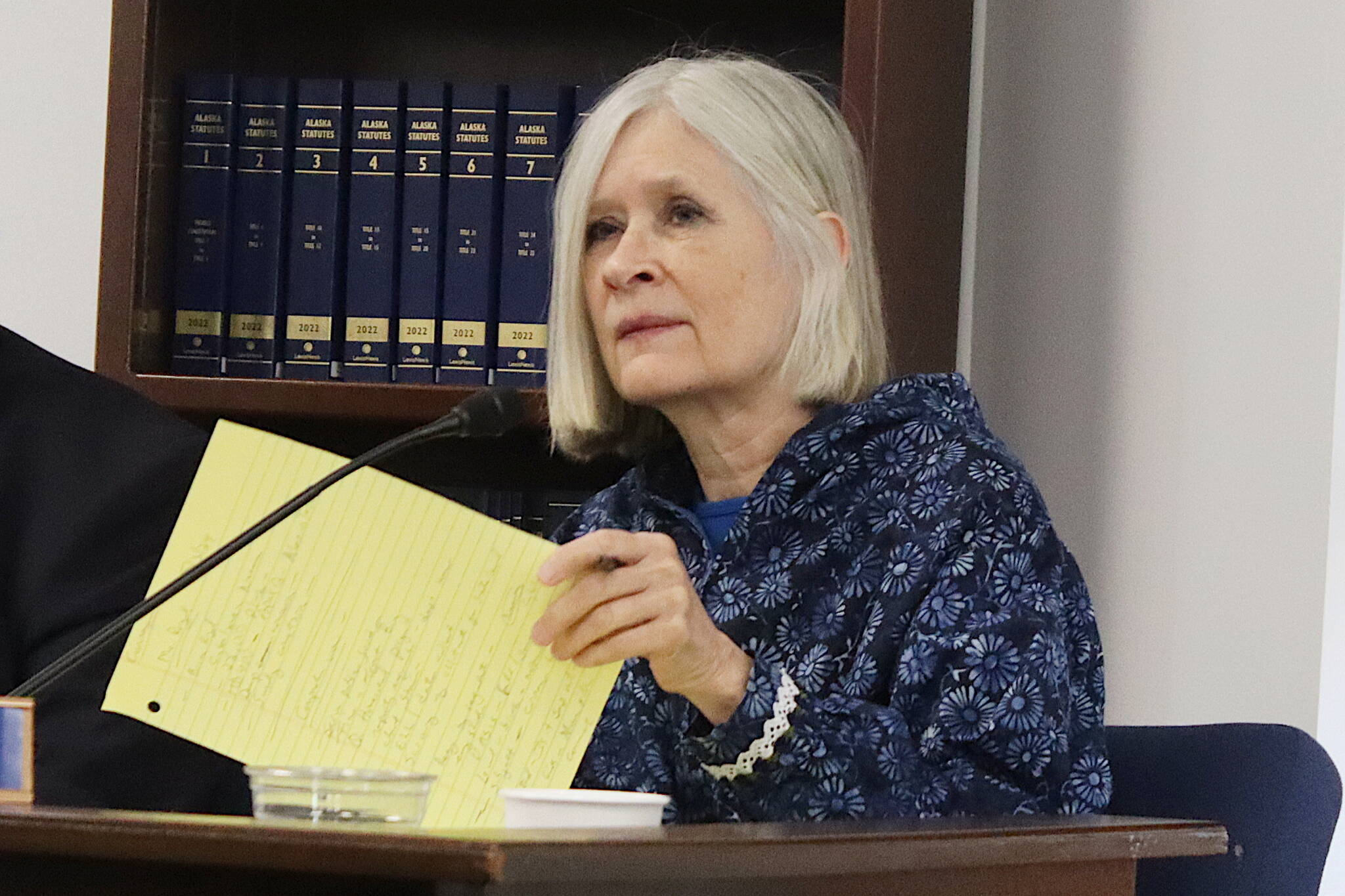
Rep. Andi Story, a Juneau Democrat, listens to a presentation during a House Education Committee meeting on Friday at the Alaska State Capitol. (Mark Sabbatini / Juneau Empire)

Rep. Andi Story, a Juneau Democrat, listens to a presentation during a House Education Committee meeting on Friday at the Alaska State Capitol. (Mark Sabbatini / Juneau Empire)

Juneau lawmaker’s bill adding four Indigenous languages to state’s official list unanimously passes Senate

Legislation by Rep. Andi Story also renames, expands size of state Native languages council.

A Juneau legislator’s bill adding four Indigenous languages to Alaska’s official list, giving the state a total of 23, unanimously passed the state Senate on Monday, positioning it to be sent to Gov. Mike Dunleavy during the closing days of the legislative session.

House Bill 26 by Democratic Rep. Andi Story passed the House by a 37-1 vote near the end of last year’s session. The lower chamber will need to concur with changes made by the Senate, including the deletion of a sentence in existing law stating English will be used for all government actions since the clause has been determined to be unconstitutional.

The bill also changes the Alaska Native Language Preservation and Advisory Council (ANLPAC) to the “Council for Alaska Native Languages” and expands the five-member council by two members.

The legislation reflects two years of work by the council that was established in 2012, said Sen. Donny Olson, a Golovin Democrat who carried the bill in the upper chamber, during a brief floor presentation Monday.

”The bill brings the council’s mission into the present day by focusing on the implementation of Alaska Native languages rather than only preservation,” he said.

Adding members to the council and changing its name is intended “to be more inclusive of all Native languages and cultures throughout the state,” Olson said. The council will also be relocated to the Alaska Department of Education and Early Development, rather than the Department of Commerce.

“These minor changes will have a major impact on the Council for Alaska Native Languages and will help carry languages from our past into the future for generations to come,” he said.

Added to Alaska’s official languages in the bill are Cup’ig and Wetał (Ts’etsa’ut), while the existing Tanana language is divided into the Benhti Kokhwt’ana Kenaga’ (Lower Tanana) and Sahcheeg xut’een xneege’ (Middle Tanana) languages. A report prepared for the council by D. Roy Mitchell IV about “Alaska’s 23 Indigenous languages” details the history and reasons for inclusion of Cup’ig and Wetał to the 20 languages detailed in a 1974 map by Michael Krauss.

“The Wetał language, also called Ts’etsa’ut, was spoken on both sides of the Portland Canal on what is now Southeastern Alaska and British Columbia, from unknown ancient times up until the late 1920s or early 1930s, when the last highly proficient speaker passed away,” Mitchell wrote. However, it had ceased to be spoken in Alaska when Krauss began his work with Alaska Native languages in 1960.

The Central Yup’ik area on Krauss’ map “includes a distinctly different Yupik language, Cup’ig, which requires its own, dictionary distinct from that of Central Yup’ik,” Mitchell added. “The Cup’ig people of Nunivak Island (modern day village of Mikoryak) have considered their language to be distinct all along. Please note that the significantly distinct Cup’ik dialect of Chevak and Hooper Bay is nonetheless a dialect of Central Yup’ik.”

As for dividing the Tanana language, the area shown as Tanana on Krauss’ map “includes what local people consider to be two, distinct languages, a view shared by the two linguists who have done the most work with these languages.” Mitchell wrote.

While there are few current fluent speakers of languages added in HB 26, support for the bill as a way of preserving and restoring such “overlooked” languages was expressed in a letter by the Alaska Regional Coalition, a consortium representing five Alaska Native regional tribal entities in 100 communities.

“By (passing the bill), the State of Alaska is demonstrating its commitment to preserving the cultural heritage of its Indigenous peoples and ensuring that future generations have the opportunity to learn and use these languages,” the letter states.

• Contact Mark Sabbatini at mark.sabbatini@juneauempire.com or (907) 957-2306.

More in News

CBJ sign reads “Woodstove burn ban in effect.” (City and Borough of Juneau photo)
CBJ issues air quality emergency in Mendenhall Valley

All woodstove and fireplace burning in the valley is prohibited until further notice.

A dusting of snow covers the Ptarmigan chairlift at Eaglecrest Ski Area in December 2024. (Eaglecrest Ski Area photo)
Update: Waterline break forces closure at Eaglecrest Friday, Saturday

The break is the latest hurdle in a challenging opening for Juneau’s city-run ski area this season.

Patrick Sullivan stands by an acid seep on July 15,2023. Sullivan is part of a team of scientists who tested water quality in Kobuk Valley National Park’s Salmon River and its tributaries, where permafrost thaw has caused acid rock drainage. The process is releasing metals that have turned the waters a rusty color. A chapter in the 2025 Arctic Report Card described “rusting rivers” phenomenon. (Photo by Roman Dial/Alaska Pacific University)
Ecosystem shifts, glacial flooding and ‘rusting rivers’ among Alaska impacts in Arctic report

NOAA’s 2025 report comes despite Trump administration cuts to climate science research and projects

The U.S. Capitol in Washington, D.C., on Oct. 1, 2025. (Photo by Jennifer Shutt/States Newsroom)
Moderate US House Republicans join Dems to force vote on extension of health care subsidies

WASHINGTON — Republican leaders in the U.S. House will face a floor… Continue reading

The National Weather Service Juneau issues a high wind warning forDowntown Juneau, Southern Douglas Island and Thane due to increased confidence for Taku Winds this afternoon. (National Weather Service screenshot)
Taku winds and dangerous chills forecast for Juneau

Gusts up to 60 mph and wind chills near minus 15 expected through the weekend.

Chloe Anderson for the Juneau Empire
Fallen trees are pictured by the Mendenhall river on Aug. 15, 2025. Water levels rose by a record-breaking 16.65 feet on the morning of Aug. 13 during a glacial outburst flood.
Lake tap chosen as long-term fix for glacial outburst floods

The U.S. Army Corps of Engineers and Juneau leaders agreed on the plan.

Gift card displays, such as this one in a CVS in Harlem, N.Y., have been a source of concerns for lawmakers hoping to combat gift card fraud. “Card draining,” or stealing numbers from poorly packaged cards, is one of the costliest and most common consumer scams, and states are trying to combat it with consumer alerts, arrests and warning signs on store displays. (Photo by Robbie Sequeira/Stateline)
Alaskans targeted by scammers posing as government officials, FBI warns

The FBI reports Alaskans lost over $26.2 million to internet-based scams in 2024, with $1.3 million of those losses due to government impersonation scams

A buck enters the view of an Alaska Department of Fish and Game trail camera on Douglas island in November 2020. (Alaska Department of Fish and Game courtesy photo)
Douglas deer: The island’s hunt faces calls for new rules

Board of Game is seeking public comment on regulation changes that would affect Juneau.

A cat says hello at Juneau Animal Rescue in February 2025. (Jasz Garrett / Juneau Empire file photo)
New animal shelter site approved by Juneau Assembly

Juneau Animal Rescue secures eight-acre lease, but fundraising remains.

Most Read