
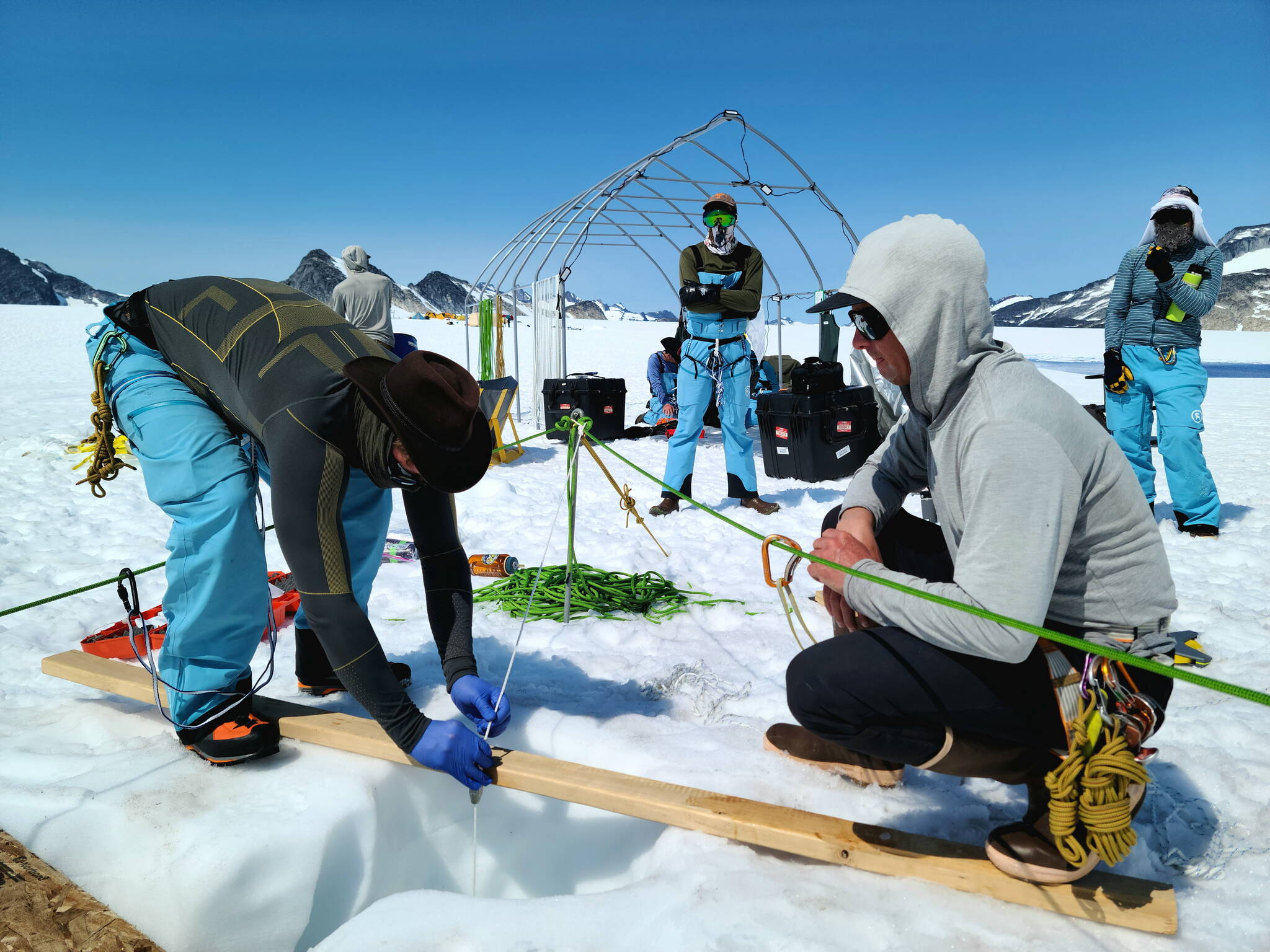
For researchers looking to unravel the mysteries of Jupiter’s moon Europa, a resource has emerged as a potential key to unlocking if the moon is habitable — the Juneau Icefield.
A team on the icefield is probing the thick frozen surface and water beneath, trying to simulate a future mission to the ice moon of Jupiter to search for signs of life and other data. Europa harbors an immense saltwater ocean beneath its icy exterior, for instance, but researchers say figuring out how to penetrate 15 miles of ice requires some technological development.
“We needed an environment with deep ice with water at the bottom,” said Samuel Howell, a project staff scientist for NASA’s Europa Clipper mission, which is preparing the launch of a mission in October of 2024. “When looking around for these types of places, we were put in contact with (the Juneau Icefield Research Program).”
While the mission won’t directly land on or orbit Europa — which is approximately the size of Earth’s moon — due to its intense radiation environment, it is a crucial step toward understanding the moon’s potential habitability, Howell said. He is also the principal investigator of NASA’s Ocean Worlds Reconnaissance and Characterization of Astrobiological Analogs (ORCAA) project, which is collaborating with JIRP.
The ORCAA analog mission is attempting to access a subglacial lake in the Juneau Icefield with a planetary “cryobot” to simulate a potential future mission to Europa. By utilizing cryobot technologies researchers plan to sample melted glacial ice and liquid subglacial reservoirs to understand the interplay of energy, materials and organisms within the icy ecosystems.
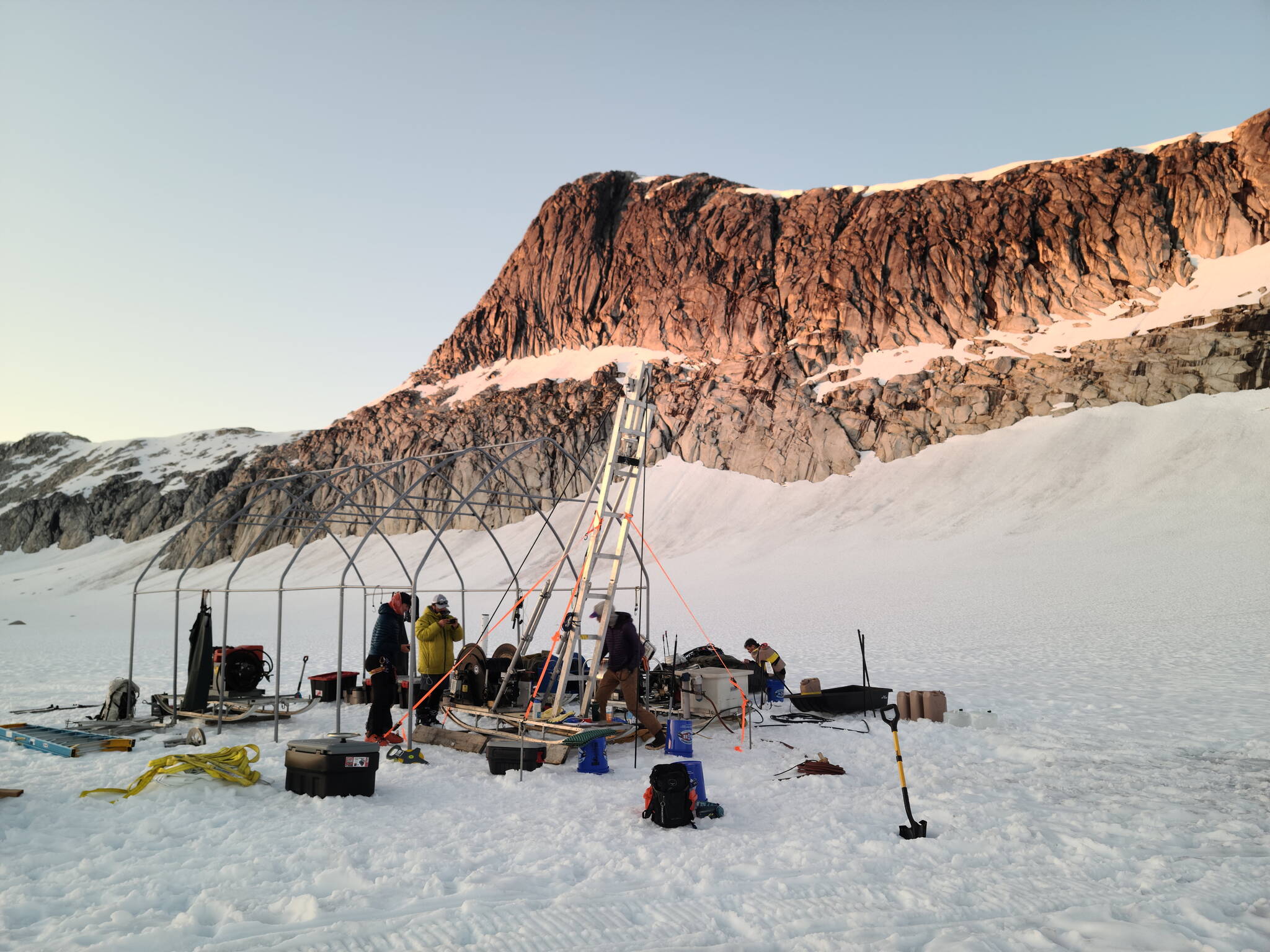
Researchers gather at a camp and data-collection site on the Juneau Icefield earlier this month during a project intended to aid with the study of the Jupiter ice moon Europa. (Photo courtesy of Jacob Holmes)
JIRP: A partnership in planetary exploration
JIRP’s expertise and research infrastructure provide valuable support, Howell said. Specifically, JIRP’s Camp 10, situated near a temperate ice basin, shows promising signs of an unexplored subglacial reservoir. This basin, near a supraglacial lake inhabited by photosynthetic life, presents an excellent opportunity to study the hydrologic and geologic interactions that shape habitable niches within planetary icy environments, he said.
Through the partnership with JIRP — an eight-week immersion where undergraduate, graduate, and high school juniors and seniors traverse from Juneau to Atlin, British Columbia — students will participate in sampling and simulated mission activities.
“JIRP students are motivated to learn about how we use ice as a system of studying and understanding our Earth,” said Jill Mikucki, a microbiologist, educator and Antarctic researcher who is working on the mission. “When we think about space exploration it really takes a commitment of generations, so it’s a real natural thing to integrate with a student learning program.”
JIRP operates by having science teams develop their plans as part of the overall program, and students then have the opportunity to participate in the research, working alongside experienced scientists, said Seth Campbell, director of academics and research at JIRP.
Campbell said one of the key aspects of JIRP’s involvement is collecting geophysical data using ground-penetrating radar. This technology allows researchers to analyze ice thickness and observe reflections at the bottom of the ice, potentially indicating the presence of subglacial lakes.
“This gives them real hands-on science experience, as opposed to talking about what you might do,” he said. “The students will actually be able to process and analyze data with us in real time.”
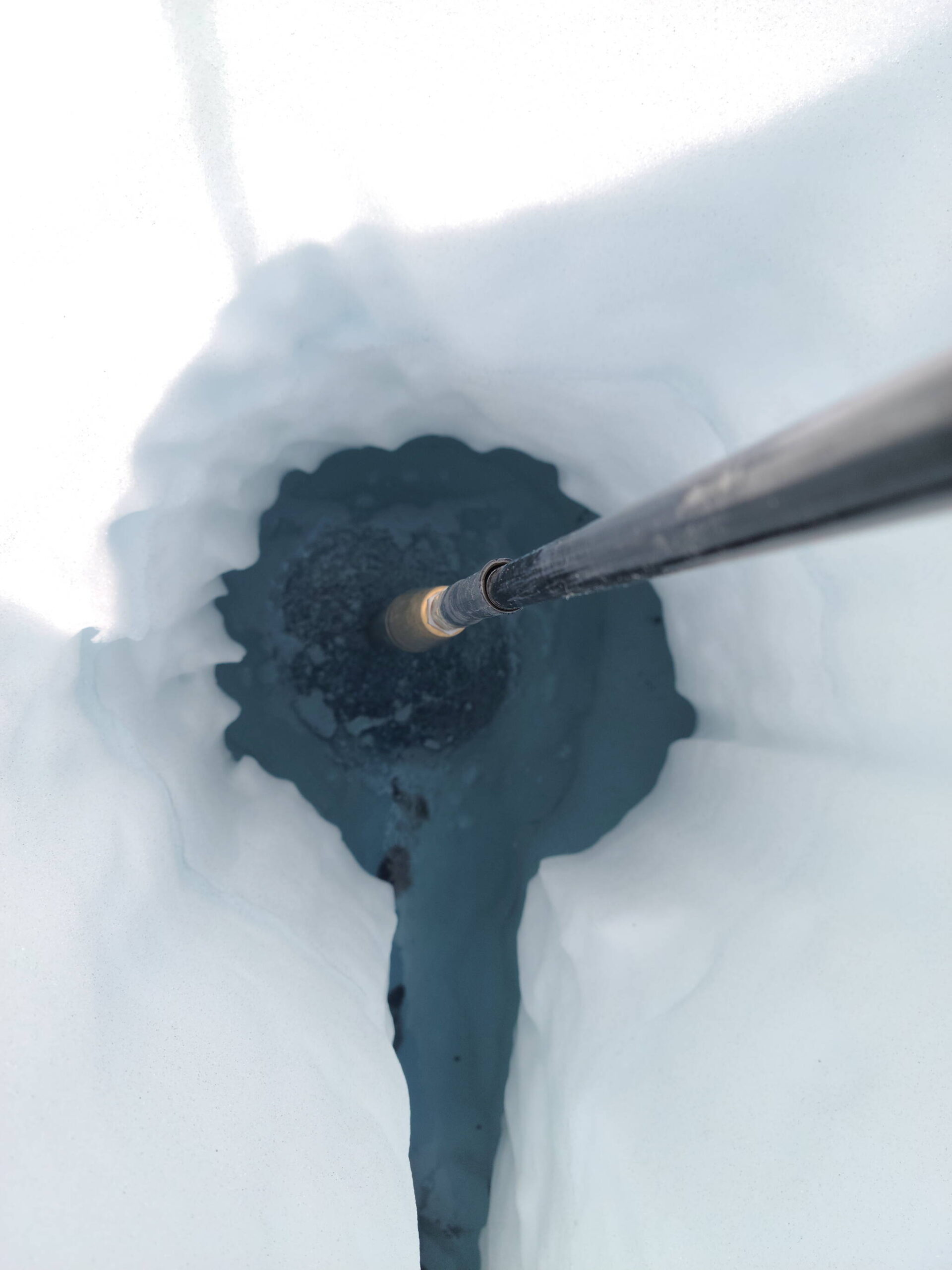
A drill penetrates well below the surface of the Juneau Icefield as researchers study water hundreds of meters beneath earlier this month. (Photo courtesy of Jacob Holmes)
Beneath the icy surface
While the Europa Clipper mission focuses on exploring Europa’s habitability, it also poses the question of how to access the ocean beneath the icy shell.
At the heart of this project is the University of Washington Ice Diver, a proven melt probe that will be used to access the subglacial reservoir. Equipped with enhanced water jetting and sample pumping systems, the Ice Diver will penetrate the ice to significant depths, allowing for the collection of valuable samples and data. The drilling process involves melting snow, which acts as a drilling fluid. The water is heated and pressurized, effectively pasteurizing it, so the process is clean, as the water used is filtered and any potential contaminants are left behind.
However, it’s been a while since the drill has been used. Jacob Holmes, a mountain guide, scientist and veteran, rehabilitated the drill, which was originally built in the 1980s and had been sitting on an airstrip under a tarp for the past 23 years.
“It’s this really old manual operation analog tool that’s giving us the opportunity to use all these amazing technologies and conduct really high-level research,” he said. “It’s this mix of an antique thing with emerging science.”
The drill’s unexpected rediscovery has reshaped the researchers’ plans.
“We were very surprised this drill exists,” Howell said. “We were going to collect some snow and Jill was going to take a nice swim in a lake with the biology. And then it turns out, you know, we can get down to the bottom of the ice and actually see what it’s like a year early.”
The team plans to simulate a condensed planetary reservoir access mission. By closely observing changes in the physical environment, habitability and concentrations of biological communities, they aim to determine the indicators of life within these icy environments.
But the journey to discover extraterrestrial life is no easy feat. Mikucki said drilling a hole for studies of biology is still in its relative infancy because it hasn’t been done much.
“Detection — or drilling through ice — is still something that’s challenging, despite the fact that we’ve got all this technology that we’ve usually used for paleoclimate or glaciological studies,” she said.
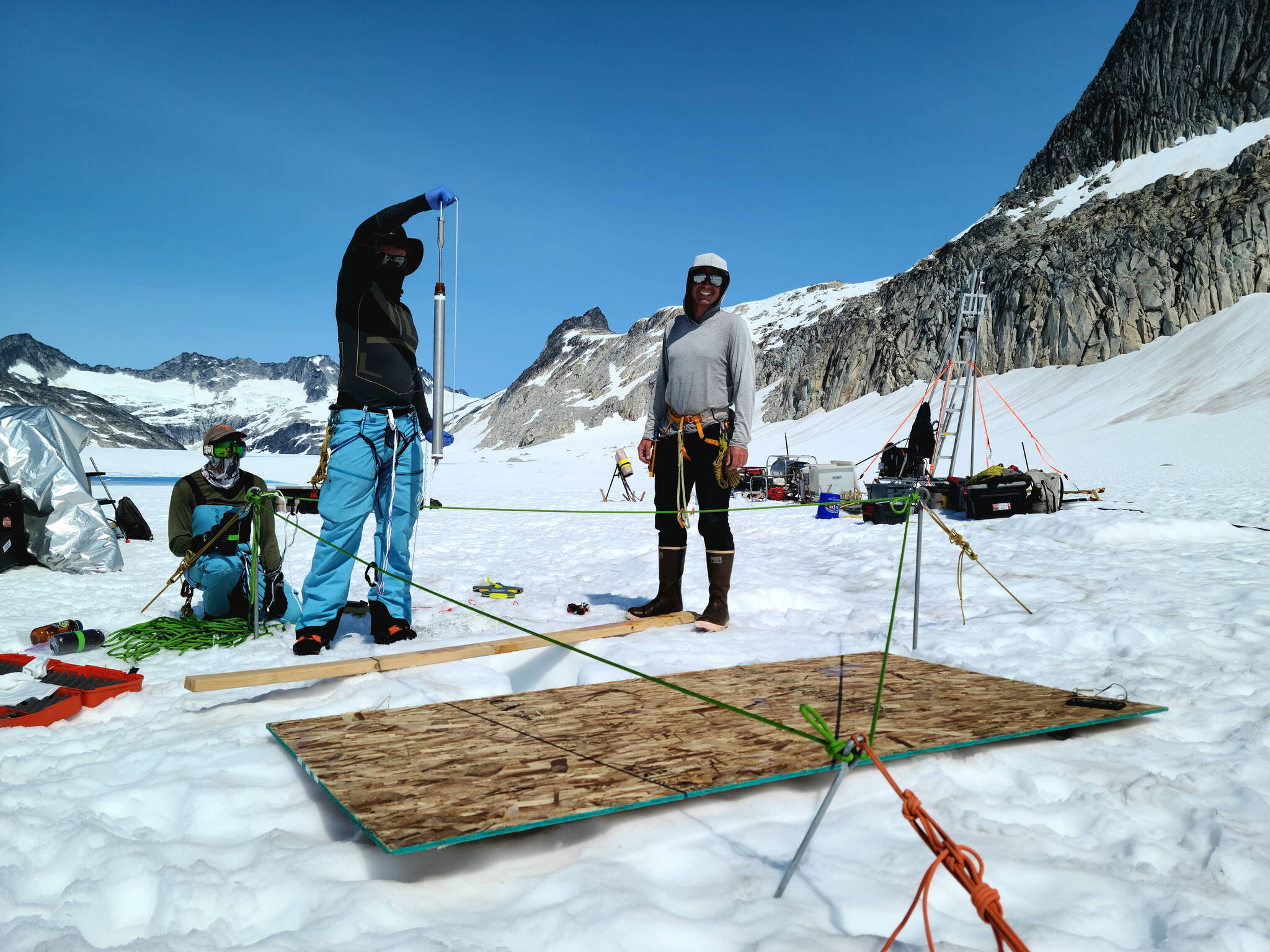
Scientists Jake Shaffer and Jared Clance, along with field mountaineer Brian Muller, collect water samples from an air-water interface on the Juneau Icefield earlier this month. Researchers are studying the bottom of the water table at bedrock — 272 meters down — and doing a biochemical analysis for elements such as major ions, dissolved organic carbon and biomolecules. Such data may provide links about connections between the top and bottom of the water table. (Photo courtesy of Jacob Holmes)
Life on Europa: A Paradigm Shift in our Understanding of Habitability Beyond Earth
The discoveries made by Europa Clipper could revolutionize the perception of Earth’s place in the cosmos, inspiring further exploration of icy worlds within our solar system and beyond.
Scott M. Perl, co-principal investigator of the mission, is a research scientist at the NASA Jet Propulsion Laboratory who specializes in life in extreme environments and their preservation within the mineral and rock record. He said having the necessary ingredients for life does not guarantee its existence.
“Just because you have all the ingredients for life…doesn’t mean that life is there,” he said. “It has to be chemically driven. It has to have the right habitat, the right food and a stable environment over a long period of time for life to exist.”
The Europa Clipper is one of NASA’s outer planets flagship missions, with only three occurring previously, according to Howell. Such missions are motivated by compelling scientific reasons, which in the case of Europa Clipper involves the discovery of Europa’s global subsurface ocean. He further emphasized Europa’s subsurface ocean, estimated to be about 3.5 billion years old, sets it apart and makes it a prime candidate for investigating habitability beyond Earth.
The mission’s objectives go beyond merely confirming the existence of an ocean. Scientists are aiming to study Europa’s habitability and potential for sustaining life.
“For a long time, our understanding of habitability has been Earth-centric,” Howell said. “We believed that habitable planets must resemble Earth… But if places like Europa can support the emergence of life on their own, without any assistance from us, it opens up the possibilities of habitability in unexpected places.”
The implications of discovering life on Europa would be profound, challenging many such preconceived notions, he said.
“Even cold, seemingly dead worlds in other solar systems, with moons like Europa, could host life,” Howell said. “This realization expands our perspective on where life could exist and suggests that life might be more abundant throughout the universe.”
• Contact Therese Pokorney at therese.pokorney@juneauempire.com.
