
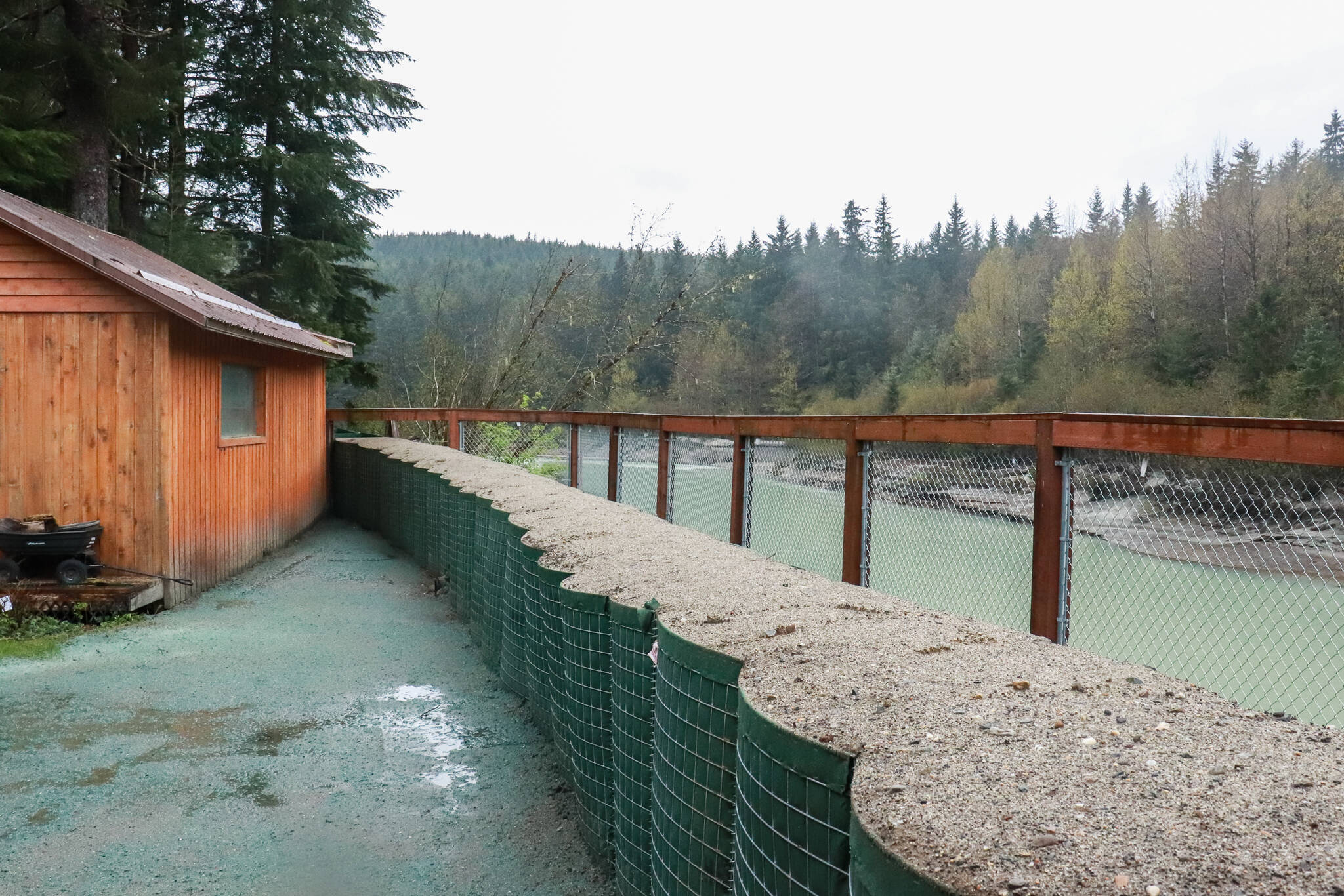
The Juneau Assembly unanimously passed extending a semipermanent levee along the Mendenhall River on Monday to protect city and school properties.
Phase One of the two-mile installation, beginning at upper Marion Drive and ending at Rivercourt Way, was completed on Saturday. The levee will next be expanded another mile to Kax̱dig̱oowu Héen Elementary School.
Beginning Tuesday, contractors are scheduled to begin installing barriers along the river adjacent to Dimond Park from the end of Rivercourt Way. The barriers will be installed on the trail adjacent to the riverside edge of Dimond Park, with work taking place on both sides. Contractors and equipment will access the trails near the Dimond Park Fieldhouse and the north side of Thunder Mountain Middle School.
Both sides of the Mendenhall Pedestrian Bridge will remain open to the public, and the city expects minimal impacts to vehicular traffic. However, the public is advised to avoid the area as trails will be closed during the installation.
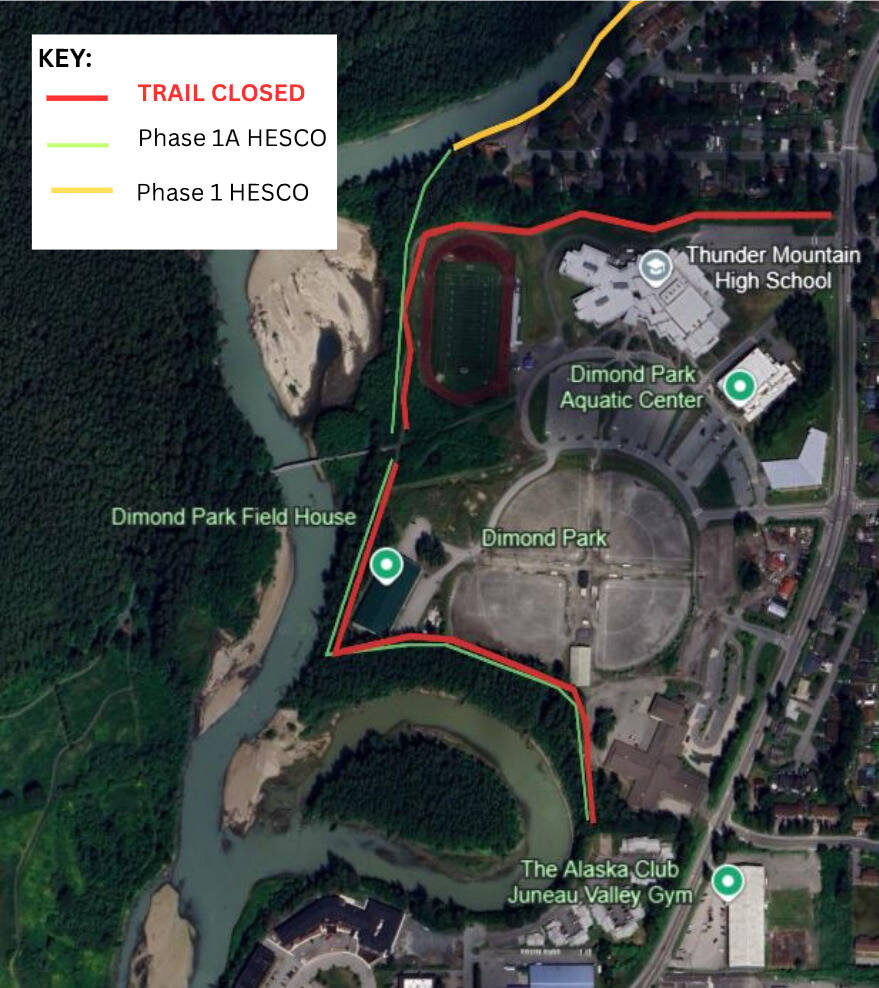
A map shows the work that will take place to install Phase One A of the HESCO barriers on city property, protecting two schools, Dimond Park Field House, Dimond Park Aquatic Center and the Mendenhall Valley Public Library. (Map provided by City and Borough of Juneau)
Work is now expected to continue through late May or early June. Phase One of the HESCO barrier installation is ahead of schedule — it was initially estimated to be completed by July.
City Manager Katie Koester said the city is also more than $2 million under its $8 million projected cost for Phase One, which may mean lower assessments for each of the 466 households in the Local Improvement District established by the Assembly to share costs with the city. The city is paying 60%, and the property owners the remaining 40%, or about $6,300 each under the originally estimated cost.
The decision to extend the Phase One project took place at a special Assembly Committee of the Whole meeting. Flood-fighting inundation maps released Thursday were discussed and presented by Michael Baker International (MBI).
The study by MBI uses 2D surface water models to simulate increasing flood stages. It shows the barriers work as intended and do not cause downstream or upstream impacts to developed properties at flood levels similar to last year’s flood.
But Koester said at flood stages higher than 16 feet, additional short-term protection to the Mendenhall Valley is needed, even beyond the extension approved Monday.
“We’re going to need to be working this year on what does flood fighting look like in spring of 2026,” she said. “We are going to need to be looking at Phase Two, and that includes looking at how we’re funding Phase Two and all those other variables, because it’s apparent from these maps that we need to do more to protect our community from higher events.”
This map demonstrates the City and Borough of Juneau’s Phase One A inundation protection for an 18-foot flood. It shows that, along with city and school property protected from flooding, areas like Duck Creek and Meander Way would be protected. (Figure from City and Borough of Juneau presentation)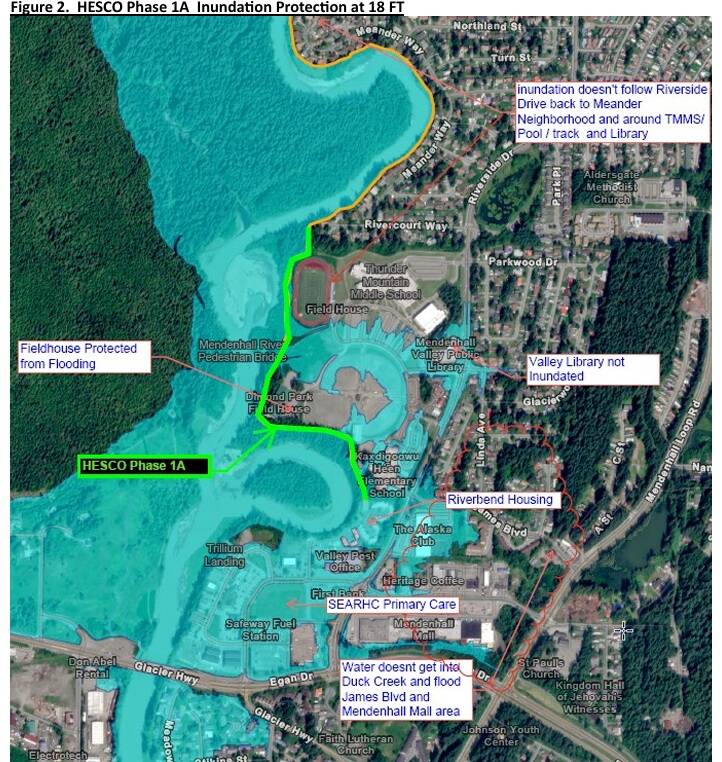
Koester said the Monday decision to move forward with Phase One A could be made without public input since the expansion does not require additional funding and is only on city property. It’s estimated to cost $500,000 and city funding not used in the initial levee will cover it.
“It’s just changing the scope slightly of an existing project because there’s already appropriated funds and authority,” she said.
A second phase of the extension, Phase One B, proposes that the HESCO barriers end at Brotherhood Bridge at an additional cost of $850,000. The goal is to protect critical infrastructure in a flood above 16 feet. This phase would install additional barriers on private property. The Assembly said conversations with the property owners will take place. It will be discussed further at the Committee of the Whole Meeting on June 2.
Koester said further modeling is needed to understand the full downstream impact of extending the barriers to Brotherhood Bridge. She said it’s her goal to find fair short- and long-term flood solutions.
She said options for future funding include more LIDs or a special tax district with a flood mill levy. People in the current LID would not be responsible for new costs associated with Phase One A and Phase One B.
“At some point we will need to have faith in CBJ residents to support a project that protects their neighbors when they may have already benefited from this proposed extension,” she wrote in a May 8 letter to Deputy Mayor Greg Smith.
There’s still enough remaining materials to extend the barriers 6,200 feet from Rivercourt Way to Egan Drive at Brotherhood Bridge, according to John Bohan, chief engineer for CBJ’s Capital Improvement Program.
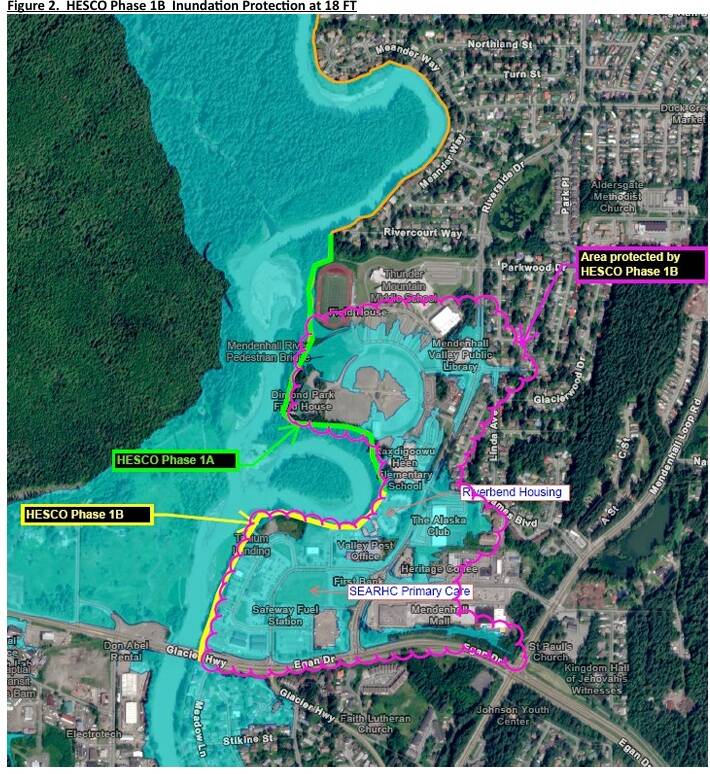
This map demonstrates the City and Borough of Juneau’s proposed HESCO Phase One B inundation protection for an 18-foot flood. It aims to protect critical infrastructure like SEARHC Primary Care, Safeway, the Mendenhall Valley post office and Riverbend Housing. (Figure from City and Borough of Juneau presentation)
Experts consider an 18-foot flood stage unlikely, requiring 1.5 times the volume of the August 2024 glacial outburst flood and an atmospheric river event. Homes that would see flooding at 18 feet, regardless of extending the barriers to Brotherhood Bridge, would take on more water if Phase One B is approved. One of those homes belongs to Bob Deering, who lives downstream of Brotherhood Bridge in the Meadow Lane neighborhood.
Deering, an engineer himself, said he understands Phase One B’s protection to the infrastructure upstream may outweigh the increased risk of flooding to his home. He said he will wait to see the downstream impacts in a developing MBI model.
“We’re acutely interested in what’s coming,” he said. “Nobody flooded in our area. There were riverbank impacts, but nobody flooded. But everybody’s worried about it.”
He said if Meadow Lane residents are part of a future LID to help pay for Phase One B, he wants to know if the city is accountable in the event of unforeseen circumstances.
“Should we pay for HESCO barriers that are required as a result of the city taking their action? The city could be causing the problem for us versus just Mother Nature causing that,” Deering said.
He said that the next steps need to be long-term, but as an engineer, he has “complete sympathy” for the city and is impressed by how quickly the existing levee was installed.
Questions can be submitted to floodresponse@juneau.gov. Frequently asked questions are also included in Monday’s meeting packet. The city also emphasized the need for possibly affected homeowners to sign up for the National Flood Insurance Program at floodsmart.gov.
The U.S. Army Corps of Engineers, which recommended the HESCO barriers to CBJ, held a forum in November 2024. Deering said he would like to see them have another.
“I think it would help the community trust in the process,” he said. “The public doesn’t have a seat at the table, other than through this generic email address. I would like to see a more established public process.”
• Contact Jasz Garrett at jasz.garrett@juneauempire.com or (907) 723-9356.
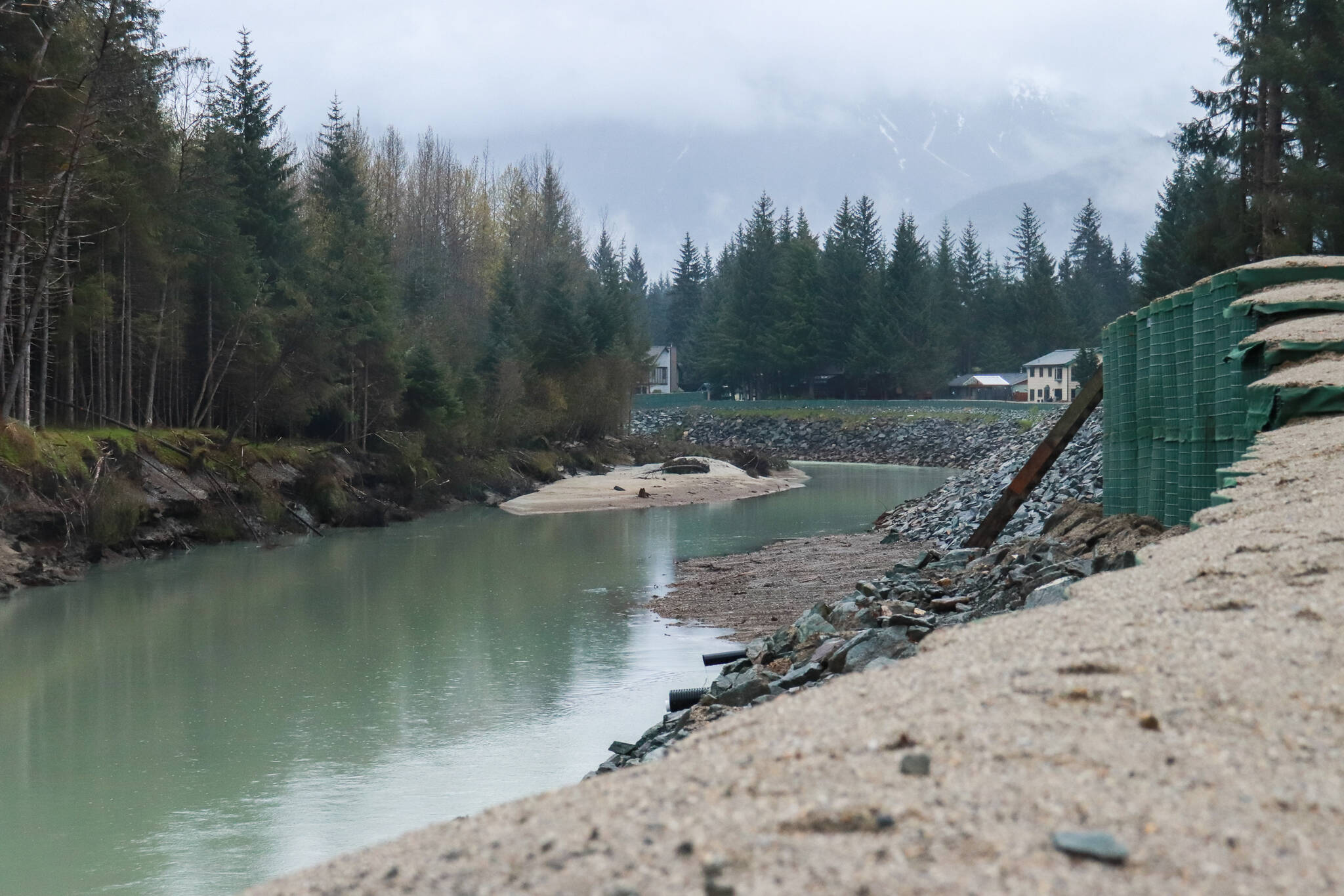
HESCO barriers line the Mendenhall River on Monday, May 12, 2025. (Jasz Garrett / Juneau Empire)
