
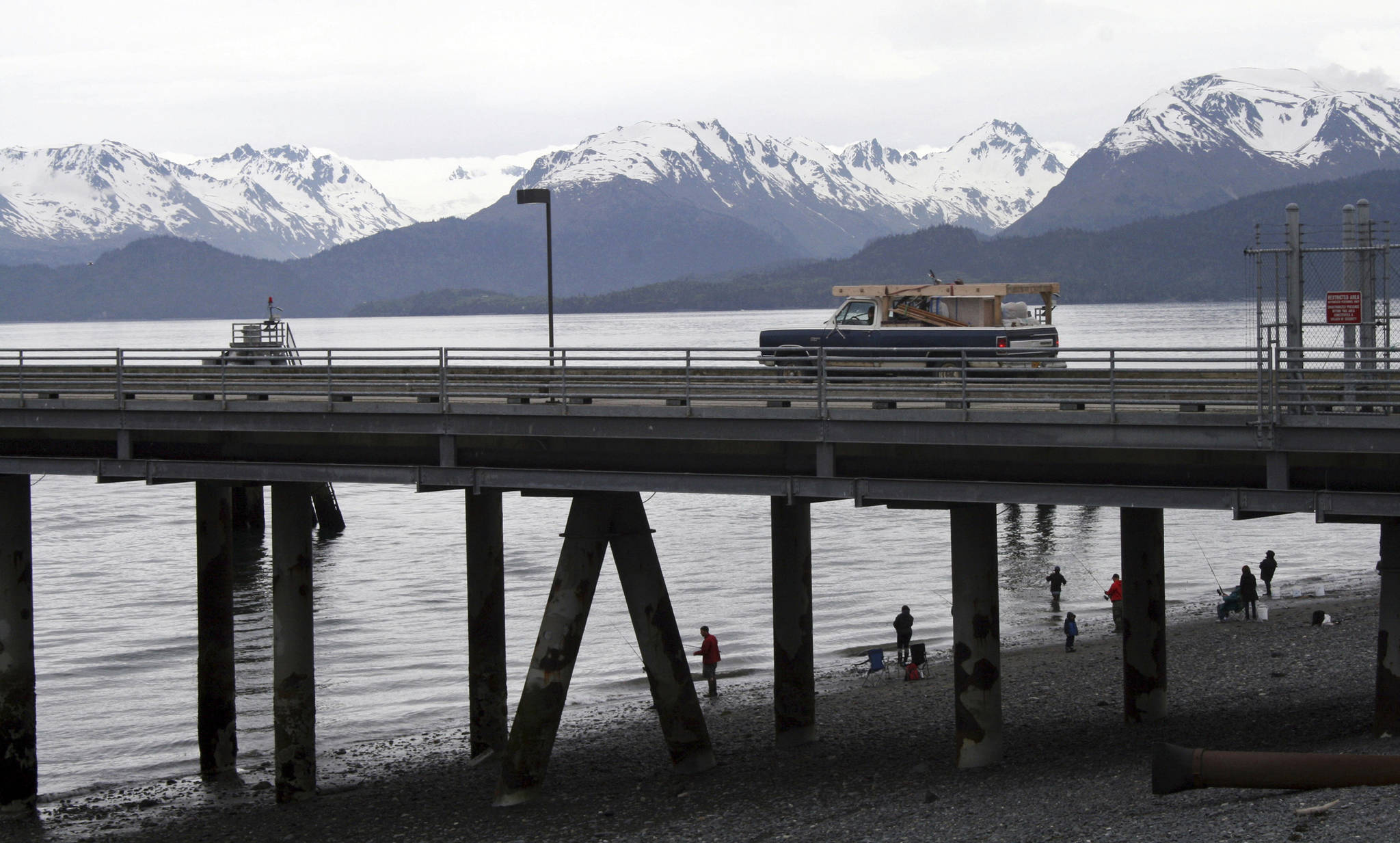
In this May 2015 photo, a vehicle drives on a pier to be loaded onto an Alaska state ferry while people fish underneath the pier in Homer, Alaska. The U.S. Supreme Court will hear oral arguments Monday, April 19, 2021, in a case that will determine who is eligible to receive more than $530 million in federal virus relief funding set aside for tribes more than a year ago. More than a dozen Native American tribes sued the U.S. Treasury Department to keep the money out of the hands of Alaska Native corporations, which provide services to Alaska Natives but do not have a government-to-government relationship with the United States. (AP Photo / Mark Thiessen)

In this May 2015 photo, a vehicle drives on a pier to be loaded onto an Alaska state ferry while people fish underneath the pier in Homer, Alaska. The U.S. Supreme Court will hear oral arguments Monday, April 19, 2021, in a case that will determine who is eligible to receive more than $530 million in federal virus relief funding set aside for tribes more than a year ago. More than a dozen Native American tribes sued the U.S. Treasury Department to keep the money out of the hands of Alaska Native corporations, which provide services to Alaska Natives but do not have a government-to-government relationship with the United States. (AP Photo / Mark Thiessen)

High court seems ready to send virus funds to Alaska Natives

Justices heard arguments in a case involving the massive pandemic relief package.

By Jessica Gresko

Associated Press

WASHINGTON — The Supreme Court seemed inclined Monday to say that hundreds of millions of dollars in coronavirus relief money tied up in court should benefit Alaska Natives rather than be spread more broadly among Native American tribes around the U.S.

The justices heard arguments in a case involving the massive pandemic relief package passed last year and signed into law by then-President Donald Trump. The $2.2 trillion legislation earmarked $8 billion for “Tribal governments” to cover expenses related to the pandemic.

The question for the court is whether Alaska Native corporations, which are for-profit companies that provide benefits and social services to more than 100,000 Alaska Natives, count as “Indian tribes.”

The federal government set aside more than $530 million for the so-called ANCs, but the funds have been tied up as a result of lawsuits by Native American tribes. If they win, the disputed funds would be distributed among 574 federally recognized tribes both in and outside Alaska.

The case is important not only because of the amount of money it involves but also because Native Americans including Alaska Natives have been disproportionately affected by the pandemic. They are more than three times as likely as whites to be hospitalized from COVID-19 and almost two and a half times as likely to die, according to the Centers for Disease Control and Prevention.

On Monday, a majority of the justices suggested that Congress could have chosen clearer language or perhaps used better grammar when describing who should get the money. But both conservative and liberal justices also suggested that the law was intended to cover the corporations.

“I’ve never heard of a canon that says you have to use perfect grammar, or even that you have to use good grammar when you are a member of Congress,” Justice Stephen Breyer said at one point during about an hour and a half of arguments the justices heard by phone because of the pandemic.

Part of the issue for the justices is that Alaska Native corporations are unique. Created under a 1971 law signed by President Richard Nixon, the for-profit corporations own land and run oil, gas, mining and other enterprises. Alaska Natives own shares in the corporations, and the corporations provide a range of services from healthcare and elder care to educational support and housing assistance.

Arguing for the federal government, Matthew Guarnieri told the justices that the ANCs have consistently been treated as “Indian tribes.” Treating them differently would not only affect funding from the Coronavirus Aid, Relief and Economic Security Act but also leave tens of thousands of Alaska Natives excluded from scores of special federal Indian law programs, the ANCs have said.

Alaska has more than 200 federally recognized tribes, but many are “small and remote and not well-suited to distribute certain benefits,” ANCs argue. Moreover, many Alaska Natives are not affiliated with recognized tribes, the ANCs say, arguing they are the “principal purveyors of benefits and services” to over 100,000 Alaska Natives.

After the CARES Act was passed, three groups of tribes sued to prevent payments to ANCs. They argue that under the language of the law, only federally recognized tribes qualify for the aid and ANCs do not because they are not sovereign governments as tribes are. A trial court ultimately disagreed, but a unanimous panel of the District of Columbia Circuit reversed the decision.

Both the Trump and Biden administrations agreed that the CARES Act makes ANCs eligible for the relief money.

More in News

The northern lights are seen from the North Douglas launch ramp late Monday, Jan. 19. A magnetic storm caused unusually bright northern lights Monday evening and into Tuesday morning. (Chloe Anderson/Juneau Empire)
Rare geomagnetic storm causes powerful aurora display in Juneau

The northern lights were on full display Monday evening.

A tsunami is not expected after a 4.4-magnitude earthquake northwest of Anchorage Wednesday, Feb. 4, 2026. (U.S. Geological Survey)
No tsunami expected after 4.4-magnitude earthquake in Alaska

U.S. Geological Survey says 179 people reported feeling the earthquake.

ORCA Adaptive Snowsports Program staff member Izzy Barnwell shows a man how to use the bi-ski. (SAIL courtesy photo)
Adaptive snow sports demo slides to Eaglecrest

Southeast Alaska Independent Living will be hosting Learn to Adapt Day on Feb. 21.

Cars drive aboard the Alaska Marine Highway System ferry Hubbard on June 25, 2023, in Haines. (Photo by James Brooks)
Alaska’s ferry system could run out of funding this summer due to ‘federal chaos problem’

A shift in state funding could help, but a big gap likely remains unless a key federal grant is issued.

Photo by James Brooks/Alaska Beacon
U.S. Sen. Dan Sullivan stands with acting Coast Guard Commandant Adm. Kevin Lunday during the after the commissioning ceremony for the Coast Guard icebreaker Storis on Sunday, Aug. 10, 2025, in Juneau, Alaska.
Coast Guard’s new Juneau base may not be complete until 2029, commandant says

Top Coast Guard officer says he is considering whether to base four new icebreakers in Alaska.

Students from the Tlingit Culture Language and Literacy program at Harborview Elementary School dance in front of elders during a program meeting in 2023. (Clarise Larson / Juneau Empire file photo)
Sealaska adds more free Tlingit language courses

The new course is one of many Tlingit language courses offered for free throughout the community.

teaser
New Juneau exhibition explores art as a function of cultural continuity

“Gestures of Our Rebel Bodies” will remain on display at Aan Hít through May.

teaser
Juneau protestors urge lawmakers to defund Homeland Security after Minneapolis killings

Hundreds gathered hours before congressional delegation voted on whether to extend ICE funding.

Kyle Khaayák'w Worl competes in the two-foot high kick at the 2020 Traditional Games. (Courtesy Photo / Sealaska Heritage Institute)
Registration opens for 2026 Traditional Games in Juneau

The ninth annual event will feature a college and career fair and international guest athletes.

Most Read