
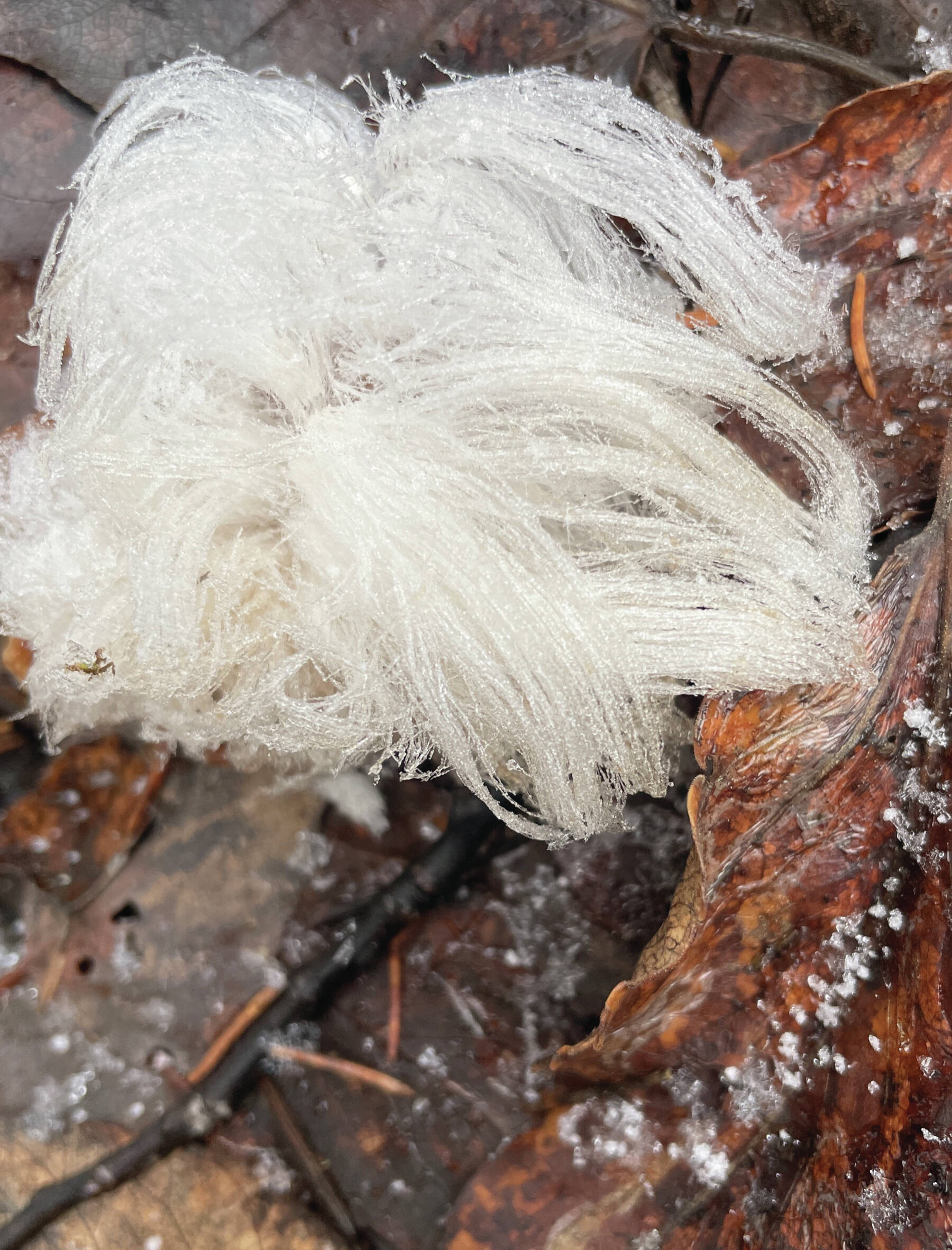
Just when you thought you’d seen everything in the boreal forest, a reader points out white whiskers sprouting from the ground.
Chris Greenfield-Pastro of Fairbanks sent in photos of what she called “hair ice” blooming from the forest floor behind her house. In her images, delicate white lashes of ice curve from woody debris and hunks of fungus.
Keyed into the possibility of seeing them, I scanned the ground during a dog walk later the same day.
And there they were, 28 separate examples in all: strands of ice standing together like a white bristle moustache. Those hairs — 10 times thinner than human hair — dissolved to water when I held a clump in my palm.
Greenfield-Pasto, one of my favorite middle-school teachers who retired a few years ago, performed a bit of research on the phenomenon. She said a fungus that helps decompose dead wood, Exidiopsis effusa, was somehow responsible for hair ice.
There, she was following the lead of Alfred Wegener, a man perhaps best known for suggesting in 1912 that the continents have drifted into their present positions over time.
In 1916, Wegener noticed hair ice in the dead branch of a tree that grew in the Vosges Mountains of eastern France. He postulated that the delicate natural sculpture formed because of the white, cold-functioning fungus he noticed on the branch.
Ten years ago, researchers proved Wegener right, finding Exidiopsis effusa was present in every instance they saw hair ice appearing on dead wood in Germany.
The lead researcher, Diana Hofmann of the Institute of Bio- and Geosciences in Julich, Germany, also proved that the fungus was essential for the formation of hair ice.
She did that by applying a fungicide to wood samples that had sprouted hair ice previously and comparing them to a control where she did nothing. When she re-cooled both samples, the fungicide-treated one did not grow hair ice. The other did.
Hofmann’s team also theorized that the fungus enables the ice to grow in spaghetti-like fashion because the water that freezes “is doped with a recrystallization inhibitor” by the fungus. Without that chemical, the ice would resemble more a common form, like a snowflake or the smooth surface of a frozen lake.
There are some essential factors to the creation of hair ice, ones that Greenfield-Pastro and others in middle Alaska had been experiencing.
One is that moisture exists with which to make ice. Another is an air temperature just below freezing that allows the ice strands to reach out like growing hair. The presence of Exidiopsis effusa, itself white but sometimes hard to see, is also essential. High humidity helps.
Another reason Greenfield-Pastro was able to see the hair ice: A lack of snowcover despite below-freezing temperatures in Interior Alaska. Her amazing eyes locked on the contrast of white wool upon the dark forest floor. She then kneeled to investigate.
Ned Rozell is a science writer with the Geophysical Institute at the University of Alaska Fairbanks.
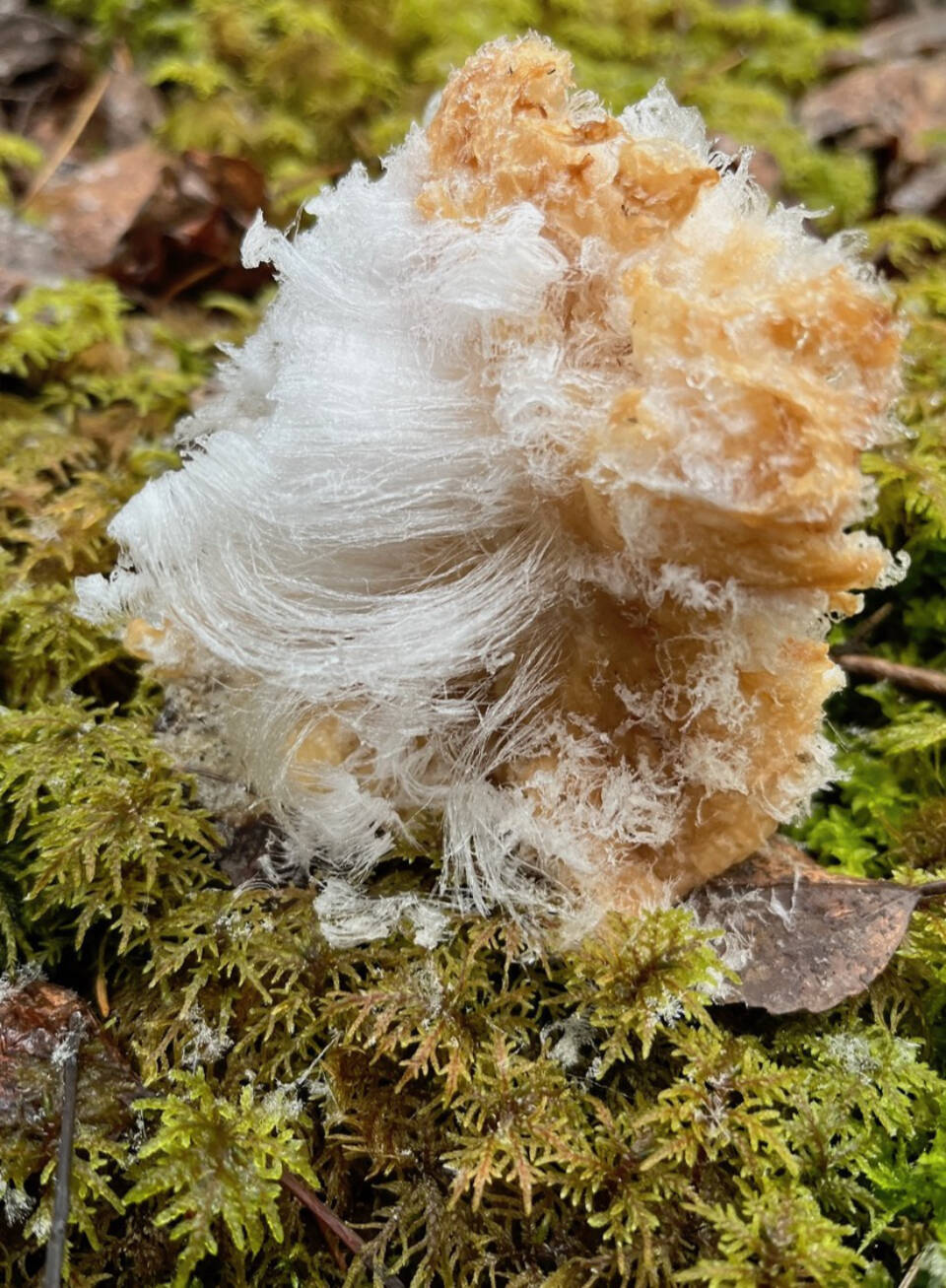
Chris Greenfield-Pastro finds “hair ice” on the forest floor during a recent walk in Fairbanks, Alaska. Photo courtesy Chris Greenfield-Pastro
