
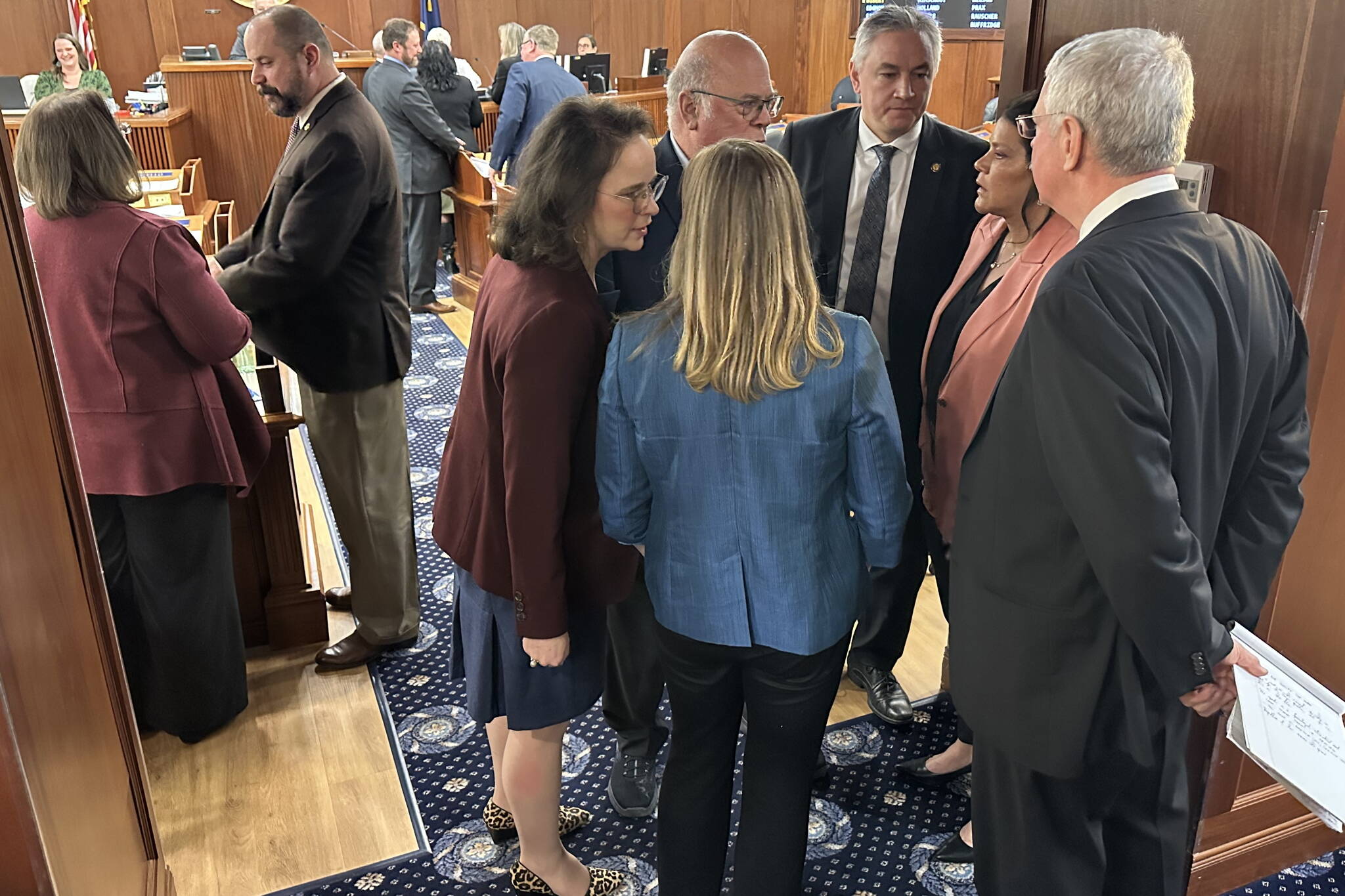
A political power play to advance a bill significantly increasing education funding was executed by the state House majority Wednesday, due to the proposal getting stuck in a committee that is missing a majority caucus member who is in the hospital.
House Bill 69, which boosts the Base Student Allocation about 22% during the coming fiscal year and more than 40% over three years, was discharged from the House Education Committee to the House Finance Committee — essentially its last stop before a floor vote — on what in effect was a 20-19 vote along straight majority-minority caucus lines.
“The reason for this motion is self-evident,” said House Majority Leader Chuck Kopp, an Anchorage Republican who presides over the caucus that includes 14 Democrats, five independents and two Republicans. “We don’t want a technical problem of being a person down in this body to prevent the most important public policy discussion which has been had extensively already in this committee to go forward to the next committee referral.”
Majority members said HB 69 has been heard several times during the past three weeks by the Education Committee, including public testimony from several hundred residents that was mostly favorable, and would have advanced at least a week ago if all seven members were present. However, Rep. Maxine Dibert, D-Fairbanks, is absent for an indefinite period due to a respiratory issue she is expected to fully recover from, meaning there is currently a 3-3 majority-minority split.
Rep. Rebecca Himschoot, a Sitka independent who co-chairs the House Education Committee and sponsored HB69, said after the floor session she asked minority members of the committee privately if they would allow the bill to advance and they declined.
Dibert’s absence also complicates any House floor action where 21 votes among the 40-member body are needed, although Kopp’s motion required only a majority of legislators present. The initial vote passed 21-18 due to Rep. Mike Prax, a North Pole Republican in the minority caucus, inadvertently voting yes, but he effectively negated that vote by asking the House to rescind its action discharging HB 69, which failed by a 20-19 vote along caucus lines.
Members of the all-Republican minority caucus, in addition to expressing sharp disagreement with the politicking taking place during Wednesday’s floor session, engaged in a lengthy discussion about the merits of the bill and education policy in general.
HB 69 is projected to add more than $330 million to next year’s state budget by increasing the current $5,960 BSA to $7,249. Some members of the bipartisan Senate majority have said they will seek to continue a $680 BSA increase in effect this year, at a cost of about $175 million, during the coming year as part of a permanent increase. Republican Gov. Mike Dunleavy is proposing a $180 million package with policy-oriented directives in how funds are spent rather than giving districts discretion through a BSA increase.
House Minority Leader Mia Costello, an Anchorage Republican, said that in addition to being bypassed on HB 69 her caucus is getting shut out of negotiations on an education package with officials from the Senate and the governor’s office.
“We have had negotiations going on between the bodies, with members representing all parties at that table, to try to come to some agreement in terms of what we should do with education funding and also policy,” House Minority Leader Mia Costello, an Anchorage Republican, said in response to Kopp’s remarks. “Now those discussions are continuing on, (but) I’ve been told the minority is not part of those discussions. So what you’re asking us to do is you’re asking us to blindly move a bill out of committee without our voice.”
Some minority members argued policy discussions related to HB 69 should occur during the Education Committee process, while the purpose of the Finance Committee is to consider its fiscal implications for the state’s budget. Majority legislators countered by noting policy discussions on bills are common during Finance Committee hearings.
Differences between the sides could be a factor both in education legislation and broader issues later this session since a drop in oil prices means lawmakers are facing a deficit of hundreds of millions of dollars in next year’s state budget. A three-fourths vote of both the House and Senate — meaning a significant number of minority caucus votes — would be needed to tap a reserve fund if the budget does contain a deficit.
House Speaker Bryce Edgmon, a Dillingham independent, said after Wednesday’s floor session he expects discussions with minority House members on education and other matters to continue as usual.
“We are going to work collectively, as we always do,” he said. “Most of the votes on the floor involve the entire body.”
Costello, in a prepared statement after the floor session, asserted “we are very disappointed that this motion, which disregards the committee process, was made without the majority talking to us.”
“I won’t comment publicly on caucus strategy for obvious reasons, but moving forward, we want them to respect the process and respect the fact that we bring important voices to the conversation,” she said.
Members of the House and Senate majorities have said they are seeking to resolve the education funding issue by mid-March so districts can plan their budgets for the fiscal year that starts July 1 knowing how much money will be available.
“We have worked really hard to be respectful of all the members in our committee through the process,” said Rep. Andi Story, a Juneau Democrat who co-chairs the House Education Committee. She noted the timeline for the committee to hear the bill was extended at the minority’s request to allow for amendments and discussion, and “we had almost a two-hour discussion about the merits of this policy bill.”
“We have no doubt that negotiations can continue as this bill moves on and we think it is time to move it on, because right now our districts need a decision from this body, need some action, and so I urge that it goes on to the next committee referral,” she said.
• Contact Mark Sabbatini at mark.sabbatini@juneauempire.com or (907) 957-2306.
