

By Ned Rozell
In a cavernous room within the university’s new engineering building, a bus squats on four flat tires. In this place, the 1946 International Harvester model K-5 looks small, for maybe the first time in its eventful existence.
Not long after World War II, those black tires crunched the gravel of the new Alaska Highway during a long journey northward. The driver steered all the way to Fairbanks, the end-of-the-road town that needed mass transportation for its post-war boom.
About a decade later, at the end of the bus’s people-moving life, men driving yellow-iron bulldozers pulled four buses as they upgraded a trail from near Healy to a mine to the west called Stampede. They had converted the buses’ interiors into living space that included a steel-barrel stove and a bed frame with mattress.
One bus never made it to Stampede mine. The miners unhitched it from the Cat-train after the bus’s wheel busted away from its axle. Then they yanked it to a bench overlooking the swamplands of the Sushana River, about 25 miles west of Healy.
Over the years, the abandoned bus hosted hunters, trappers and wanderers who happened upon the rain-and-bear resistant shelter just north of Denali National Park and Preserve.
In 1992, 24-year-old Christopher McCandless discovered what he described as the “Magic Bus.” He survived in and around the vehicle for 114 days before he died of starvation, wrapped in a sleeping bag inside.
One bestselling book and blockbuster movie (both titled “Into the Wild”) later, Fairbanks City Transit System No. 142 became perhaps the most famous bus of all time.
Now, the snub-nosed hulk rests in a heated building overlooking the far-north town through which it carried passengers in the 1950s. At the University of Alaska Fairbanks’ Engineering Learning and Innovation Facility on campus, engineers, conservators and exhibitors are prepping the bus to again sit outdoors, one mile up the hill to the west.
The UA Museum of the North team, led by Angela Linn, senior collections manager for Ethnology and History, will work on the bus in the engineering building.
Linn and Roger Topp were recently determining the condition of the 75-year-old bus. As they walked around it, people peered down at them through the windows of a second-story coffee shop that make up part of the west wall.
“Our job is to collect the physical items that tell the story of the north,” said Topp, the director of exhibits, design and digital media at the museum.
He said this unique piece is guaranteed to drum up feelings regarding McCandless, who died what many Alaskans view as a preventable death while others admire his spiritual quest.
“It’s a lightning rod,” Topp said of the bus.
Why would the museum want to curate a lightning rod?
“The bus is a touchstone for many things Alaskan: wilderness, exploration, personal discovery, survival,” said Patrick Druckenmiller, director of the museum. “It evokes very strong emotions. It’s exactly for these reasons that the museum is an ideal place to display the bus.”
The bus made it into the museum’s care months after an Army National Guard Chinook helicopter removed it from the Stampede Trail in June 2020.
In the previous decade, two women drowned in the swift waters of the Teklanika River while trying to reach the bus. Other seekers had to be rescued on some portion of their journeys, which in summer requires the fording of two glacial rivers on the 20-plus mile hike from pavement.
“The bus had been attracting far too many visitors unprepared for the rigors of the challenge,” wrote Corri Feige, the Alaska Department of Natural Resources commissioner, explaining why the bus was extracted from state lands.
Feige and others at DNR looked at several proposals from groups and individuals who wanted the bus. They decided the university museum in Fairbanks would be the best resting place for Bus 142.
“This is probably the most internationally known thing the museum has,” said Linn, manager for the Ethnology and History collections.
While the bus presses down on plywood sheets above a thick concrete floor that allows students to test the strength of steel girders, the museum’s team will make it safe for visitors. Among other things, the museum workers will figure out how to protect the graffiti scratched and Sharpied into the bus’s skin.
Bus 142 will eventually rest in the spruce-and-birch woods not far from the museum, protected from the elements while allowing visitors access. There, it will quietly bask in its unlikely fame, having finally crept its last mile.
Since the late 1970s, the University of Alaska Fairbanks’ Geophysical Institute has provided this column free in cooperation with the UAF research community. This year is the institute’s 75th anniversary. Ned Rozell ned.rozell@alaska.edu is a science writer for the Geophysical Institute.
Images: 1. Fairbanks City Transit System No. 142 of Into the Wild fame inside the engineering building on the UAF campus, where UA Museum of the North conservators will work on its preservation.
2. Roger Topp of the UA Museum of the North captures images inside the former Fairbanks city bus that gained fame as the final resting place of Christopher McCandless.
3. Bus 142 in place just off the Stampede Trail about 25 miles west of Healy in March 2017. An Army Air National Guard Chinook helicopter crew airlifted the bus out in June 2020.
4. A journal entry seen inside the bus in 2017 above the Sushana River from one of the many people who made pilgrimages to the bus after the book and movie Into the Wild.
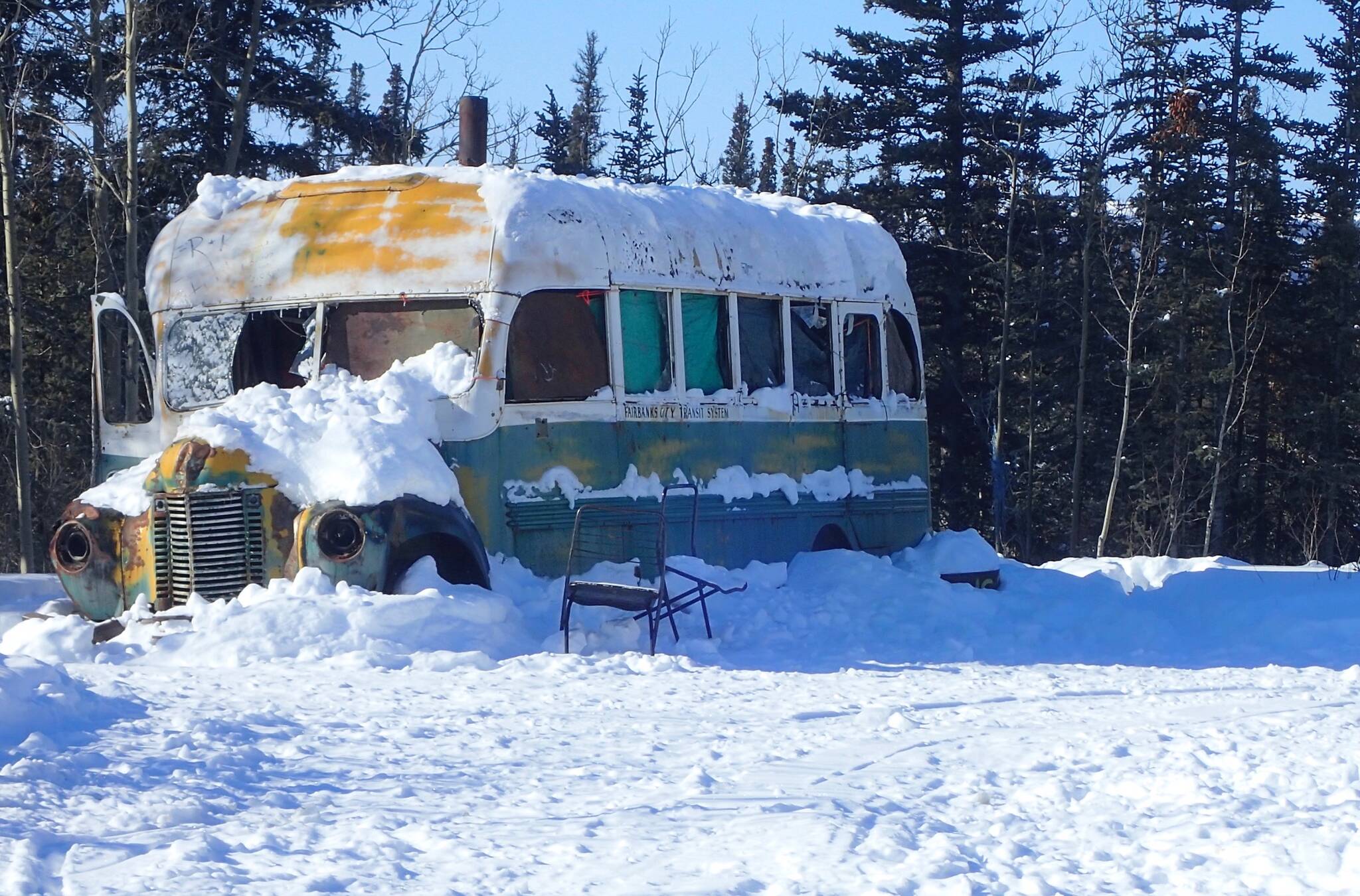
Courtesy Photo / Ned Rozell Bus 142 in place just off the Stampede Trail about 25 miles west of Healy in March 2017. An Army Air National Guard Chinook helicopter crew airlifted the bus out in June 2020.
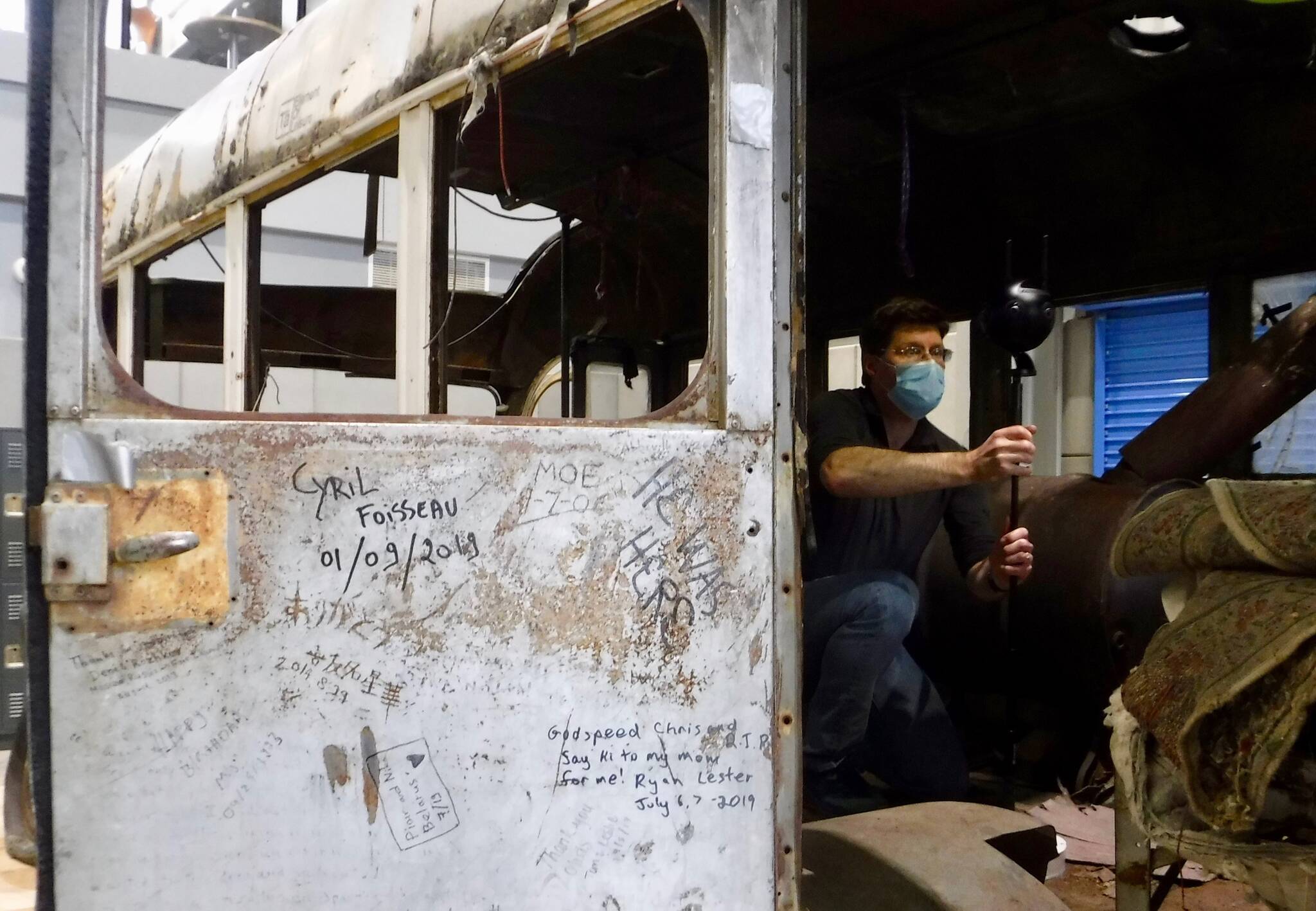
Roger Topp of the UA Museum of the North captures images inside the former Fairbanks city bus that gained fame as the final resting place of Christopher McCandless. (Courtesy Photo / Ned Rozell)
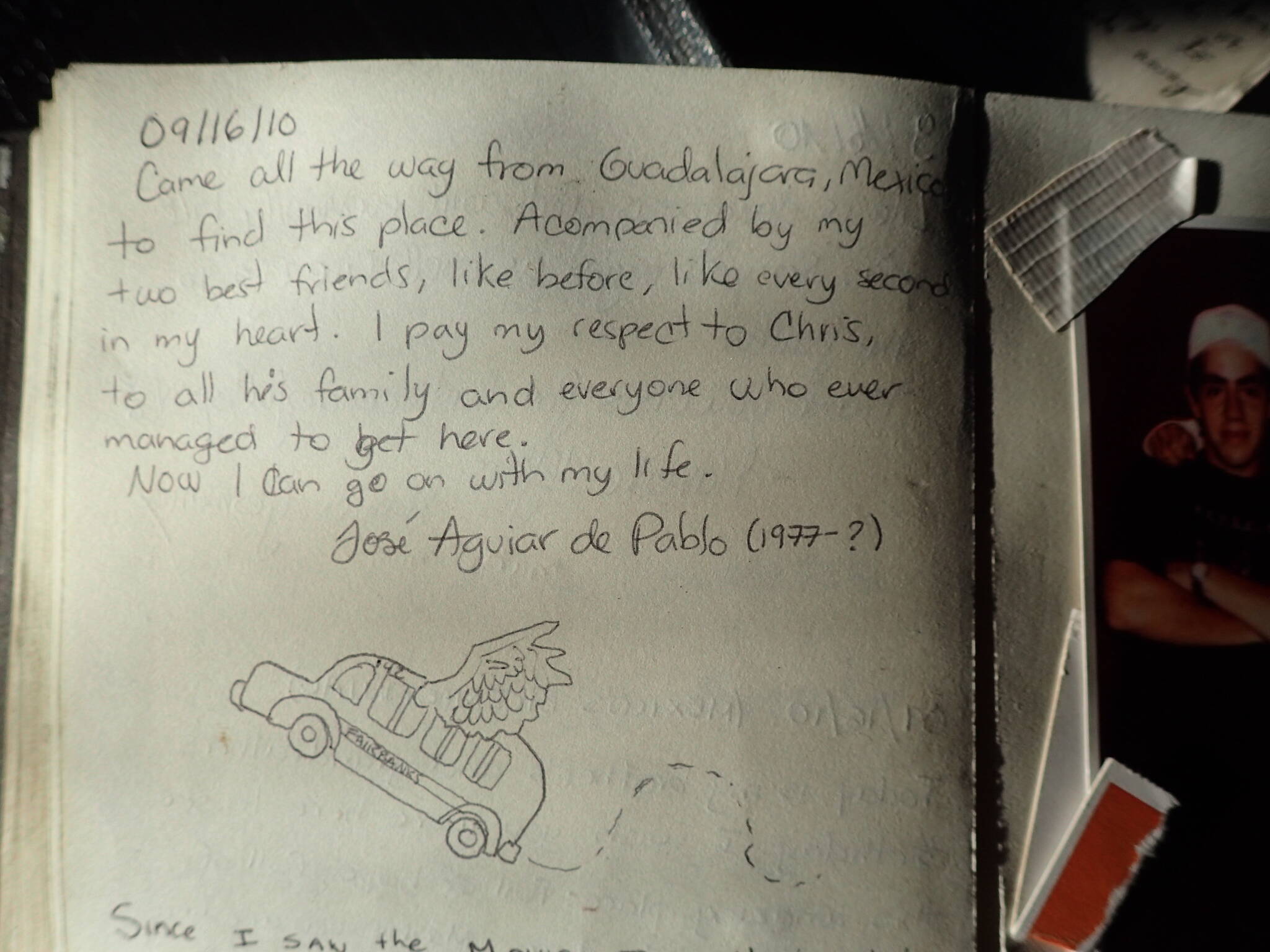
Courtesy Photo / Ned Rozell A journal entry seen inside the bus in 2017 above the Sushana River from one of the many people who made pilgrimages to the bus after the book and movie “Into the Wild.”
