
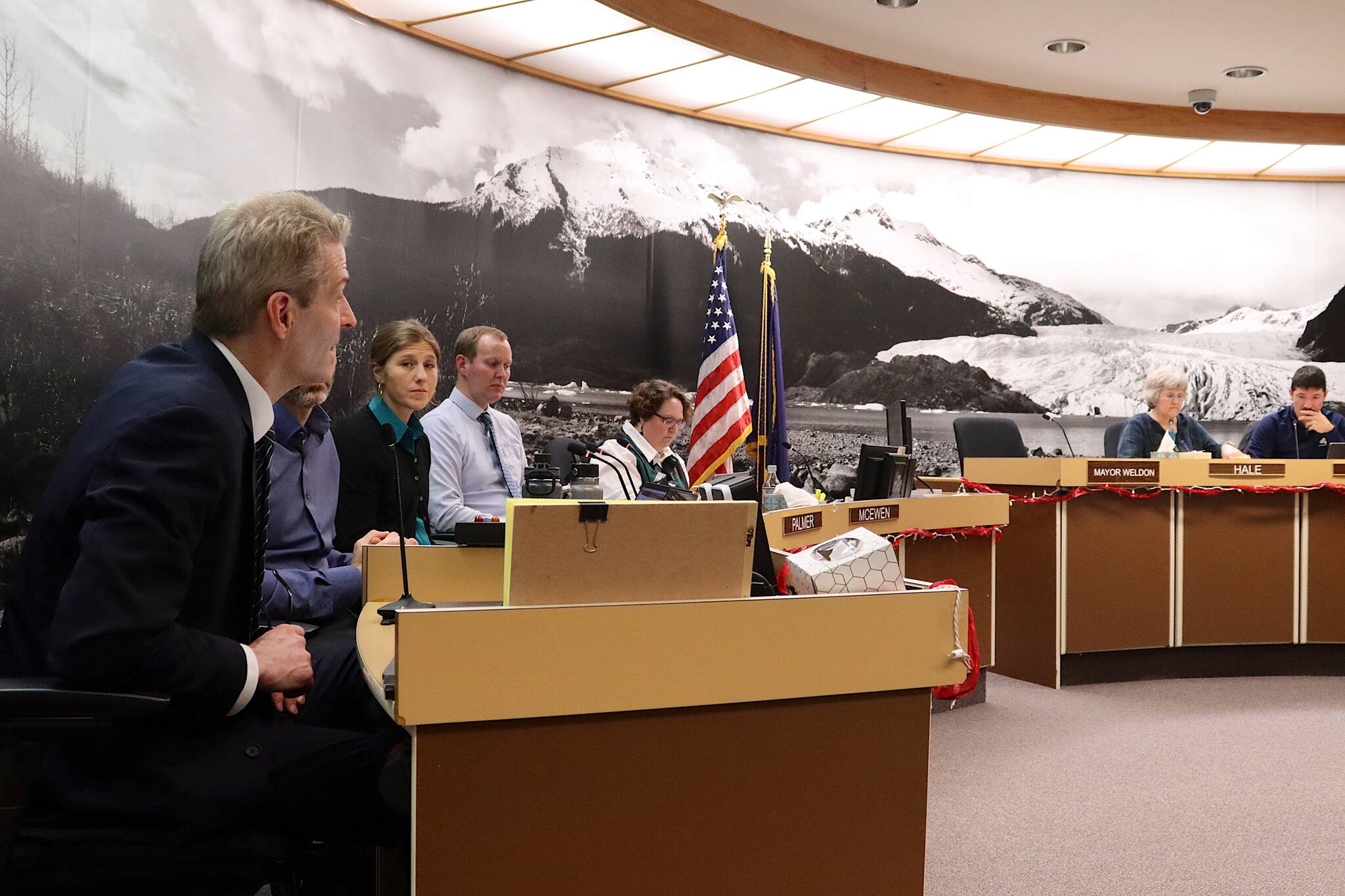
Juneau Assembly members being asked to help bail the Juneau School District out of the nearly $8 million deficit it is facing for the fiscal year ending June 30 got a preliminary overview of the situation Monday in preparation for a joint meeting with the school board Tuesday night for what’s expected to be an intense discussion about possible solutions.
The joint meeting scheduled at 5:30 p.m. in the Assembly Chambers is expected to include discussing the city taking over costs of maintenance, utilities, insurance and related employee expenses in specific buildings, such as those used jointly by the district and city. District Superintendent Frank Hauser is estimating such expenses could total nearly $4.6 million.
However, in addition to whether Assembly members are willing to fund some or all of such costs — including the possibility of doing so in future years since they are ongoing expenses — there are questions about whether the state would accept the legality of such an arrangement, as well as other options the district is exploring including the short-term remedy of a state-approved loan and long-term changes such as closing/consolidating schools.
Hauser, in an overview of the district’s current situation to the Assembly during a Committee of the Whole meeting on Monday night, said the district currently expects about a $5.95 million deficit for the current year and also has a $1.95 million deficit remaining from last year. State law requires the budget to be balanced by June 30 and for the district to pass a balanced budget for the coming fiscal year, meaning long-term fixes to resolve ongoing deficit spending are necessary.
Questions on Monday from Assembly members, in anticipation of Tuesday’s meeting, were generally brief and board-based.
“What needs to be fixed when?” said Christine Woll, chair of the Assembly’s finance committee.
Hauser said he is hoping to have a first draft of a balanced budget ready for consideration by the school board at its next scheduled meeting Feb. 13.
“We’ll have to figure it out if there’s any thoughts around potential loan options, potentially some shared services, looking at some of those for FY24, and then also looking at what that might bring for FY 25,” he said. “Of course the other piece that is challenging is deciding on reorganization, the structural changes that need to happen across the district to try to address larger savings.”
As part of that timeline in having a draft budget ready in two weeks, Hauser said “I’d really like to have a final idea on potential reorganization models,” including options Assembly members are willing to consider.
Hauser, during a school board work session last week, presented three possible school consolidation options. One consolidates the two middle schools and reduces the number of students by transferring sixth grade to elementary schools. Another would additionally “pair” neighborhood elementary schools into grades K-3 and 4-6. The third includes the K-3 and 4-6 pairings, and consolidates grades 7-9 at Thunder Mountain High School and grades 10-12 at Juneau-Douglas High School: Yadaa.at Kalé — with both existing middle school buildings closing.
A question about how much per-student state funding the district is expecting for the coming year was asked by Assembly member Ella Adkison, who is also a staff member for Juneau state Sen. Jesse Kiehl.
Hauser said for now he is using the $5,960 Base Student Allocation in state statute — essentially the same amount as 2017 — although a $340 increase was approved by lawmakers for the current year and a $300 increase for next year appears to be the starting point of negotiations between legislators.
“If that (base amount) changes — there’s conversations that are happening at the Capitol — that would definitely be taken by us into consideration, but at this point my recommendation would be to budget conservatively and make sure we don’t overproject,” he said.
Last April the budget approved by the school board assumed there would be a $350 BSA increase and 4,240 students would be enrolled. Overestimating both meant the district has about $1.4 million less than projected, according to Hauser.
The district in early January announced it was facing a $9.5 million deficit due largely to a series of accounting errors. But Hauser said Monday further scrutiny revealed a $1 million savings in projected health insurance costs, an additional $350,000 are saved by carrying over HomeBRIDGE allocations and $350,000 has been cut so far — with the latter including measures such as a hiring freeze and reducing summer programs.
Deputy Mayor Michelle Bonnet Hale, presiding over Monday’s meeting, asked fellow Assembly members to limit their questions in anticipation of Tuesday’s in-depth discussion. City Manager Katie Koester told Assembly members that in addition to the school district’s financial models, she has compiled information about shared service costs the city might be able to pick up.
“I believe tomorrow will be a packed evening full of questions and discussion, and hopefully some direction,” Koester said.
• Contact Mark Sabbatini at mark.sabbatini@juneauempire.com or (907) 957-2306.
