
By Ned Rozell
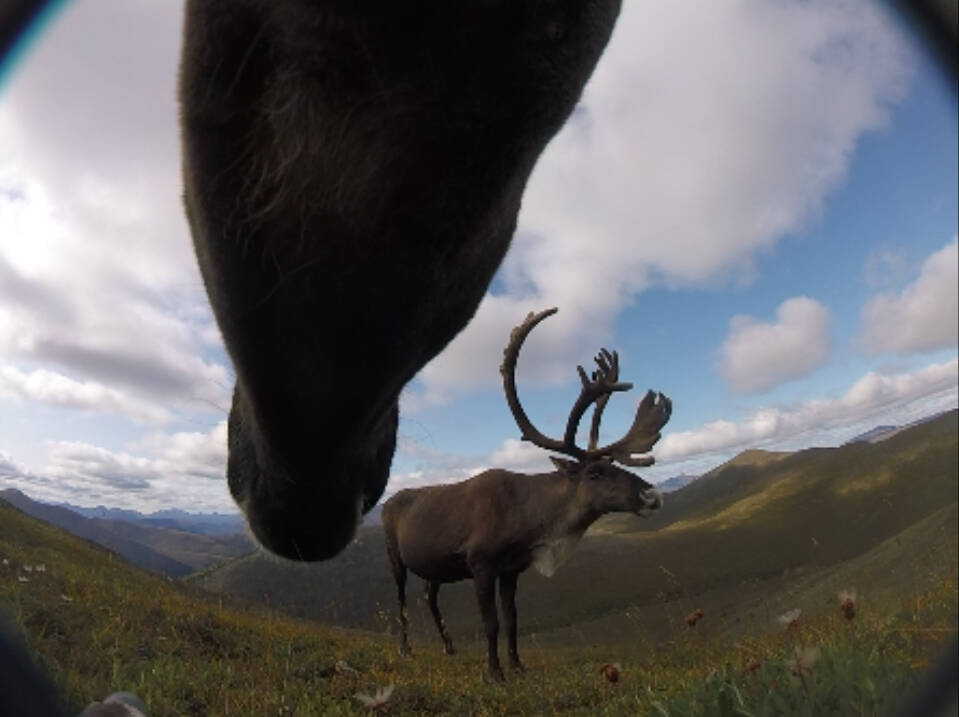
Caribou wearing cameras around their necks have filmed a secret world of mushroom nibbling, desperate head-shaking during bug episodes, and nuzzling of wet newborns seconds after they fall to the tundra.
The caribou cams gave biologists who teamed up from several agencies a new look at the Fortymile herd. Those caribou roam in the highlands between the Yukon and Tanana rivers, from Canada’s Yukon territory almost all the way to Fairbanks.
Jim Herriges, with the Fairbanks Office of the U.S. Bureau of Land Management, wanted to know what female caribou in the Fortymile herd ate during spring and summer. Biologists have studied the herd for decades; they wanted a greater level of detail and thought cameras might reveal what went straight into a caribou’s mouth.
Fecal pellets Herriges had examined under a microscope showed mostly the remains of lichen. Lichen is a favorite caribou food but is low in protein. Herriges knew they needed good nutrition to give birth to healthy newborns and suspected that fecal pellets were not telling the whole story.
He proposed capturing and fitting female caribou with collars that held a video camera for a few months. The collars popped off on Sept. 10 in both 2018 and 2019, the years of the study.
The cameras captured a nine-second video every 20 minutes with a precise GPS location stamp. With them, scientists were able to see not only what, but also, for the first time, where caribou were eating.
A team of biologists from the Alaska Department of Fish and Game, BLM, the Yukon Department of Environment and the University of Montana fitted 30 caribou with these collars, which Herriges later recovered by helicopter.
With an army of volunteer video-watchers and a Ph.D. student who analyzed the data and wrote a paper on the results, the scientists found that female caribou were eating a lot more willow leaves than their droppings revealed.
Libby Ehlers, a Ph.D. student at the University of Montana who watched hundreds of video clips to see what plants caribou cows were eating, is the main author of a recent paper in which she highlights the experiment.
She had a few memorable moments during her hours of watching the view from the underside of a caribou’s throat:
“The mother is feeding on lichen and her baby, probably a couple weeks old, comes into view and quickly licks her muzzle a couple times to likely smell, taste and learn what the mother is eating. It was really neat to witness and capture this learned behavior taking place in a nine-second video clip.
“We had one adult animal die, and we were able to see a variety of different animals feed on her dead body — grizzly bears, ravens and others.”
The Fortymile is one of Alaska’s 31 herds of caribou living from the Canada border west to Adak Island. A July 2017 count by biologists for the Alaska Department of Fish and Game had the Fortymile herd at about 71,400 animals.
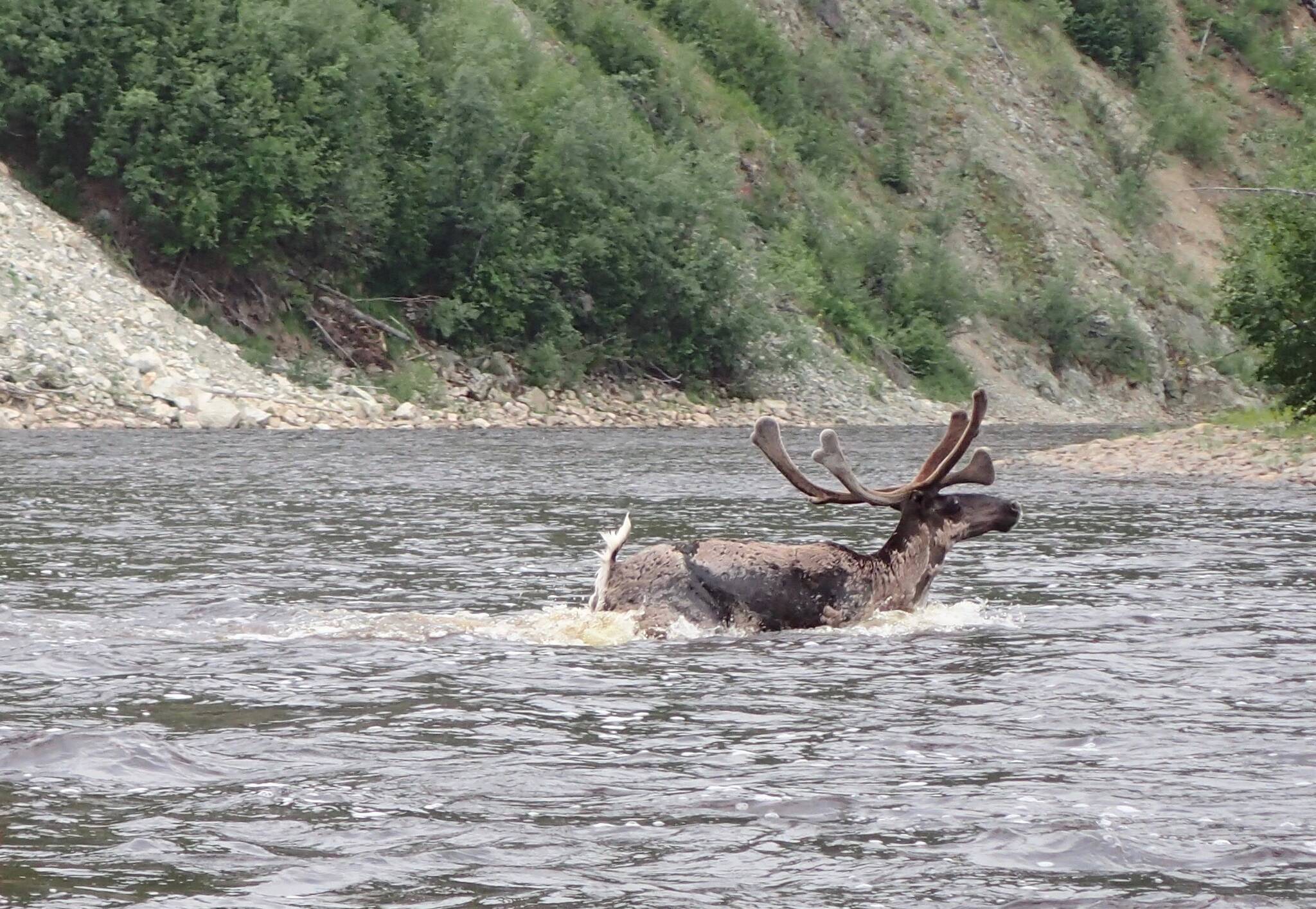
A caribou swims across the Fortymile River in Interior Alaska in 2018. (Courtesy Photo / Ned Rozell)
Biologists with the Alaska Department of Fish and Game have noticed that since 2010, Fortymile caribou females had been giving birth to fewer newborns, and those were trending down in body weight. That made them want to take a closer look at what the caribou were eating during the time of year they give birth and raise their young.
From the caribou-cam study, scientists found that female Fortymile caribou spend almost half of their time eating. The females shifted from lichen to eat shrub leaves (like willow) in June and July. Those were also the months when female caribou could have eaten a lot more had not insects harassed them into shaking their heads, huddling with other caribou into large groups, or moving to find windier areas with fewer insects.
• Since the late 1970s, the University of Alaska Fairbanks’ Geophysical Institute has provided this column free in cooperation with the UAF research community. Ned Rozell is a science writer for the Geophysical Institute.
