
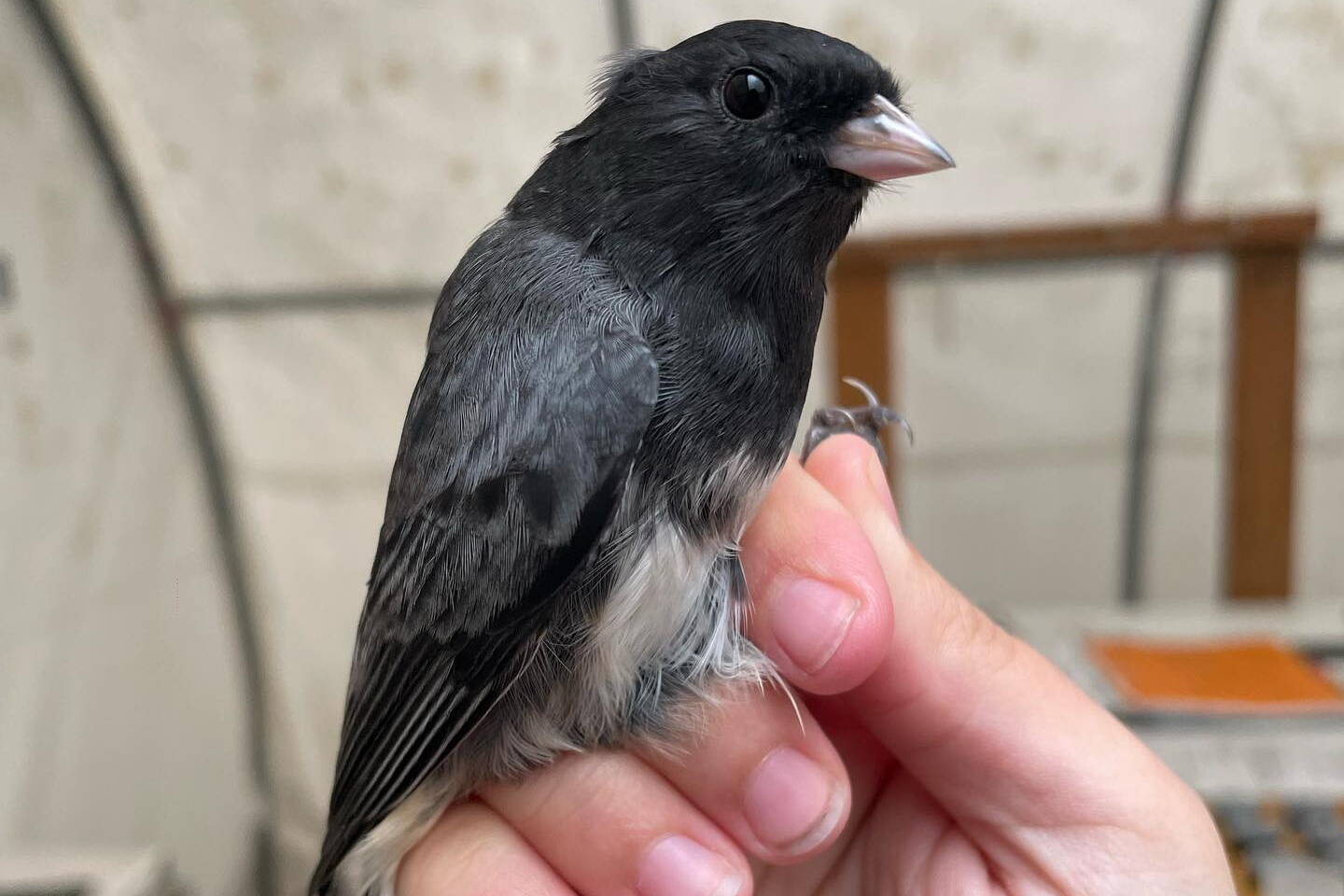
At the mist-netting station in the woods at Creamer’s Field in Fairbanks, volunteers and professionals briefly cupped more than 2,000 songbirds in their hands this fall.
Toward the end of the season in late September, after feeling the warmth of so many juncos, Robert Snowden noticed something.
“Sometimes they just feel a little heavier in your hand,” said Snowden, program director for the Creamer’s Field Migration Station. Snowden works for the Alaska Songbird Institute, a Fairbanks non-profit organization supported by local members and donors.
At the station, bird people for the institute have for the past decade captured songbirds in spring and fall using nets with soft mesh like a badminton net. Bird biologists have operated the station since the early 1990s.
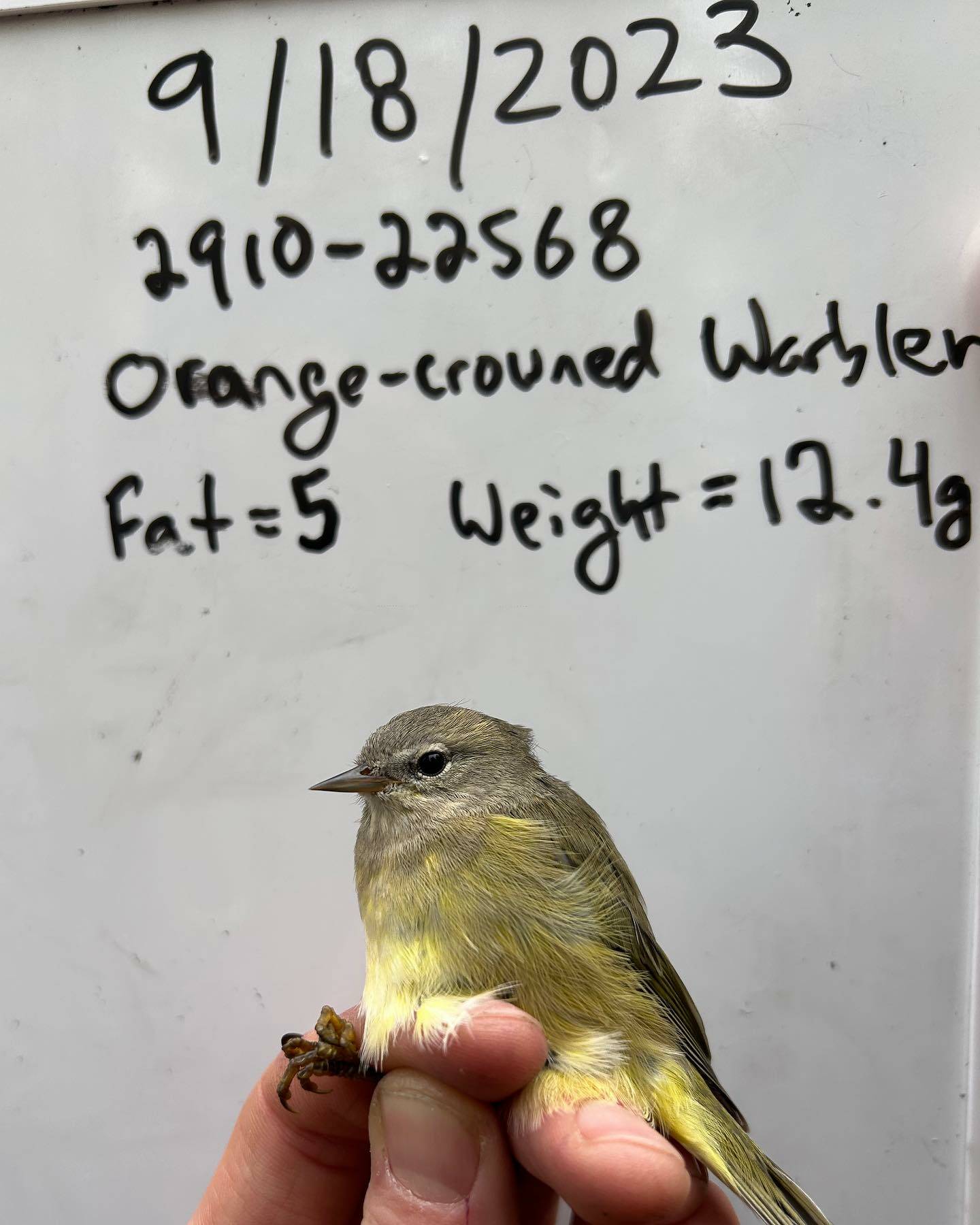
An orange-crowned warbler at the Creamer’s Field Migration Station rests in the hand of a biologist at the who estimated the bird had a fat value of 5 on a scale of zero to 7. Photo courtesy of Alaska Songbird Institute.
Once the early-risers captured a bird, they placed it gently in a cotton bag to weigh it. And then they crimped a metal band on its ankle (though many recaptures had bands already). This allows biologists to know where birds go and to determine which species of birds might be abundant or rare.
Bird-handlers there — which this year included Snowden, intern Alex Pearce, volunteer bander Laurel Devaney, educator and outreach coordinator Georgia Houde, intern Sarah Kennedy, and seasonal bander Larissa Babicz — captured and released more than 2,000 birds this fall at the Creamer’s Field Migration Station. It was the second-highest number in the last 10 years.
The tendency for those tiny birds to bulk up just before long migration flights — along with the popularity of the Fat Bear Week in which people vote on their favorite rotund Katmai grizzly bear — inspired Snowden to initiate a Fat Bird Week on the migration station’s social media accounts.
During the last few weeks, Snowden and his bird-capturing partners have featured slate-colored juncos (described as “chunkos”) who were among the heaviest they have ever captured at the station. Also featured were a few orange-crowned warblers “bulging with fat” and a fox sparrow so bulked up it was one of the heaviest ever recorded at the station. (With heavy being a relative term as it weighed about as much as three empty soda cans).
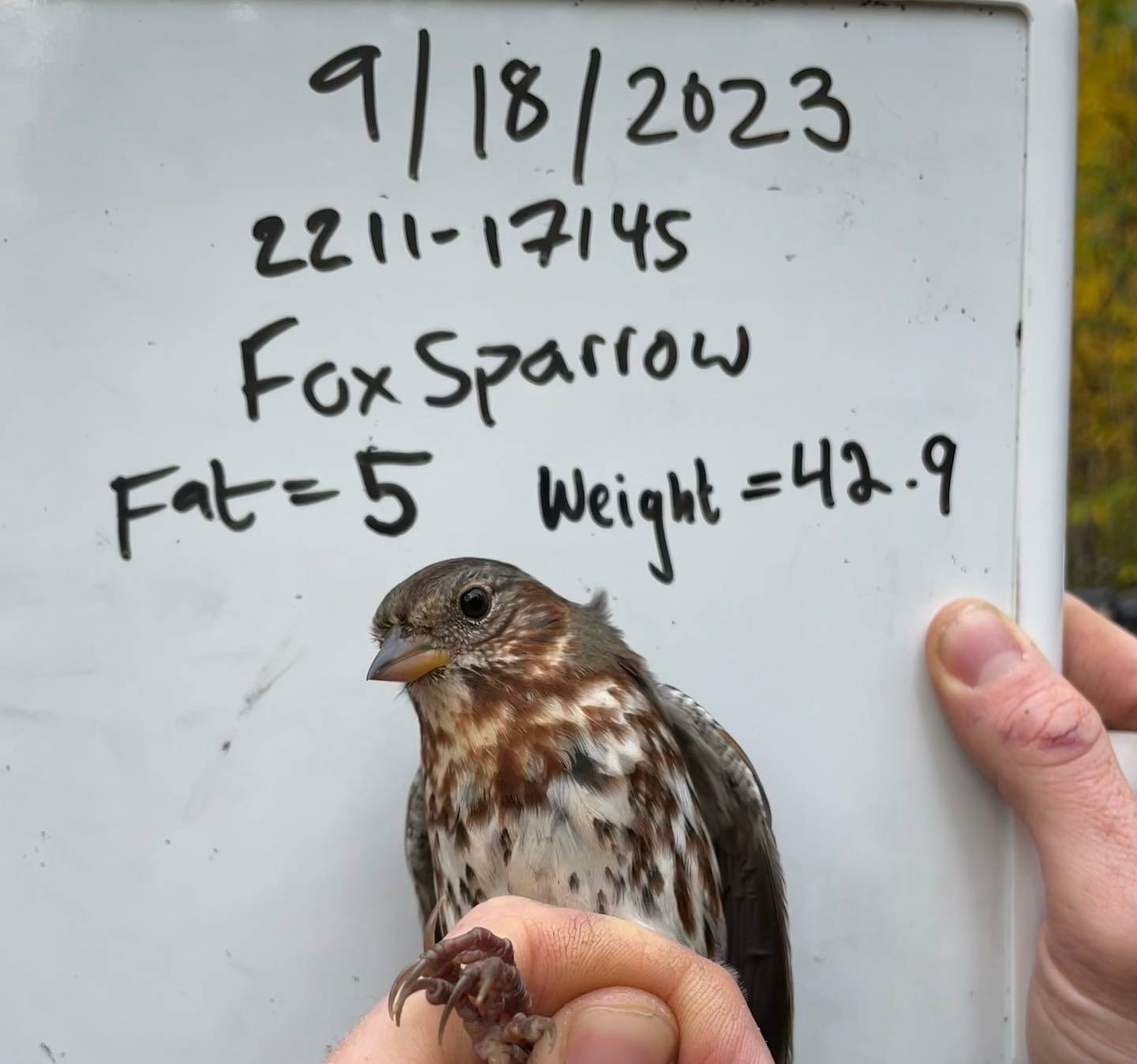
A fox sparrow captured a few times at the Creamer’s Field Migration Station waits for release in the hand of a biologist, who judged this bird to have a fat value of 5 out of a possible 7. (Photo courtesy of Alaska Songbird Institute)
What’s up with fat songbirds? If you happened to eyeball any of these songbirds perched on a branch recently you might have called them svelte. But ornithologists who remove the birds from the mist nets purse their lips and puff on birds’ feathers to check on their body condition. This allows a peek at their transparent skin, often revealing clumps of yellowish orange fat.
The bird banders rank each bird they capture for fat condition, with zero being almost none to 7 being akin to the bear stuffed with the most Katmai salmon.
“Later in the season we often get higher fat scores,” Snowden said. “The birds have more ground to make up and they have to go faster and longer.”
How do they know that? Up to 90% of the juncos, warblers and thrushes captured at the mist-netting station are birds that hatched from eggs in summer 2023. That they know they are flying to Mexico or North Carolina despite never having landed there is one of nature’s great mysteries. But a new junco seems to know that late August and September is the time to gorge on all the insects and seeds it can find.
“Fat in migrating birds is a pretty important thing, just like in grizzly bears getting ready to hibernate,” Snowden said. “And it doesn’t take long for them to pack on fat. Birds can change fat conditions in a few days.”
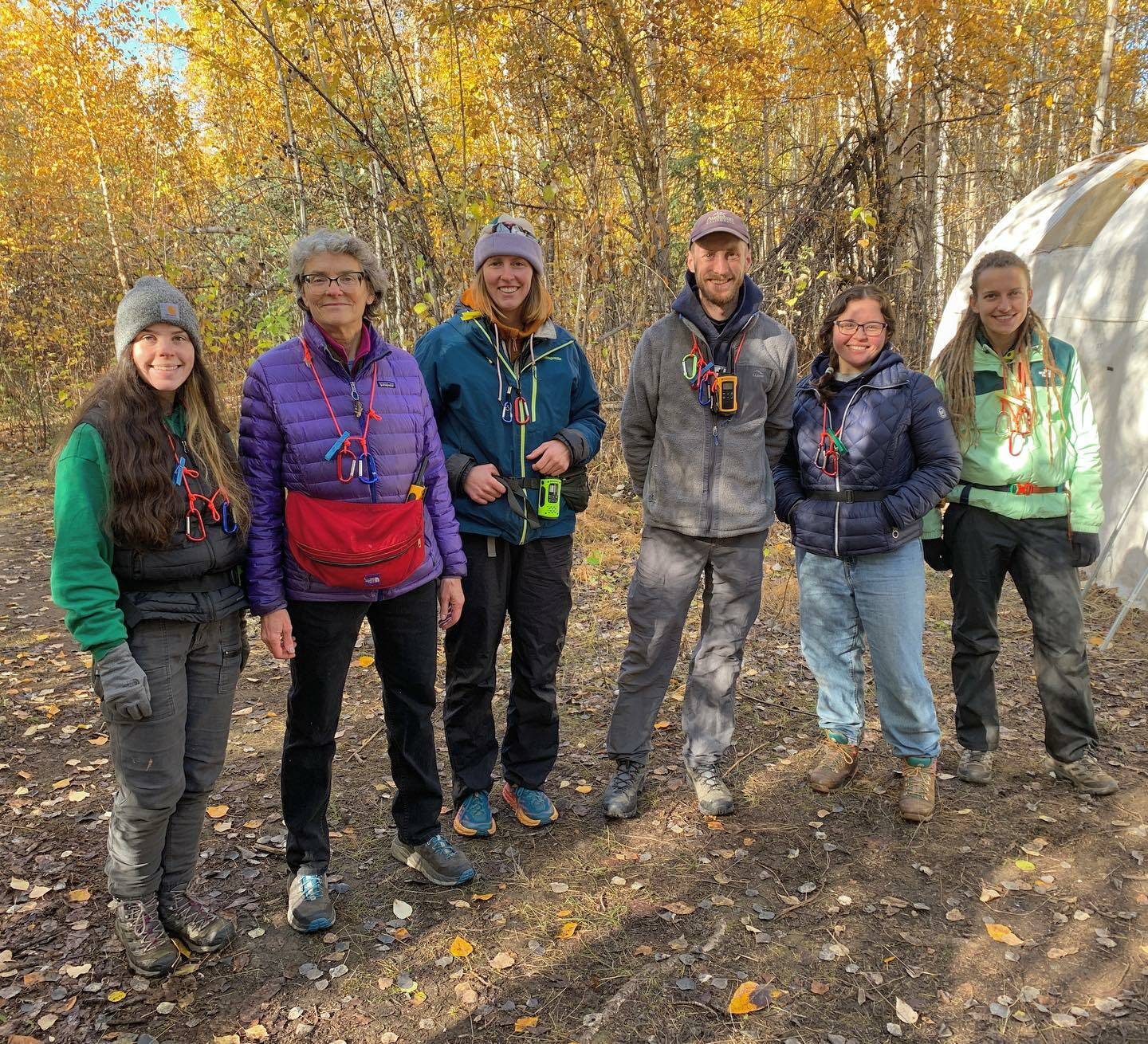
Among those banding birds at the Creamer’s Field Migration Station this fall were, from left, intern Alex Pearce, volunteer bander Laurel Devaney, educator and outreach coordinator Georgia Houde, program director Robert Snowden, intern Sarah Kennedy, and seasonal bander Larissa Babicz. Photo courtesy of Alaska Songbird Institute.
An example: A fox sparrow caught at the station a few days before the nets closed in late September weighed in at 43 grams. That placed the bird in the top 1% of all the fox sparrows captured at the station since the Alaska Songbird Institute took it over from the Alaska Bird Observatory 10 years ago.
“This bird had been first caught about five days earlier and had already put on an extra 4-plus grams by the time it was recaptured,” Snowden wrote on a Facebook post. “A true masterclass in bulking up!”
• Since the late 1970s, the University of Alaska Fairbanks’ Geophysical Institute has provided this column free in cooperation with the UAF research community. Ned Rozell is a science writer for the Geophysical Institute.
