
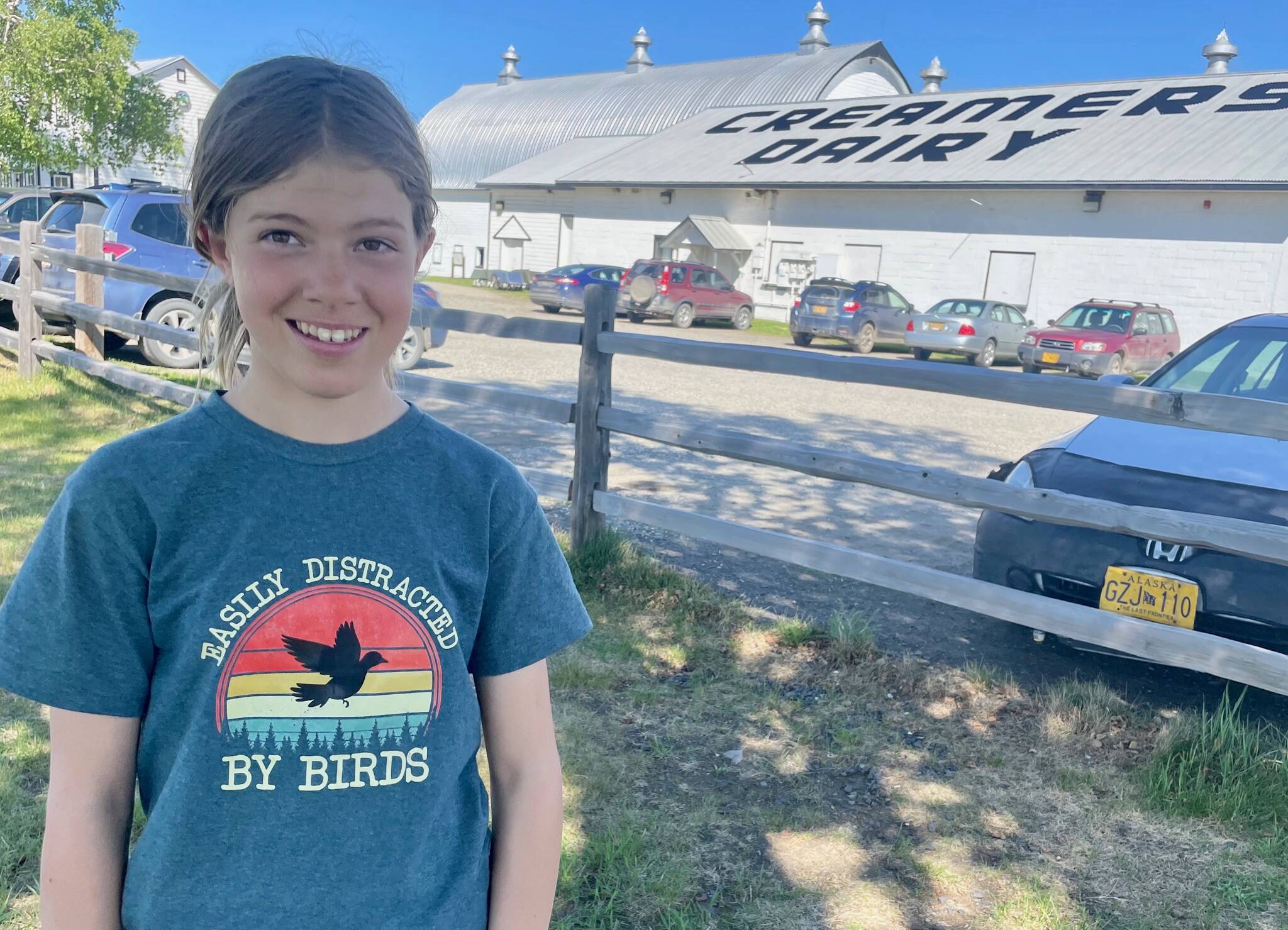
Hazel Sutton was eating lunch on an island at Tanana Lakes Recreation Area in Fairbanks with her family recently when a bird caught her eye. At first, she figured it was a semipalmated sandpiper, an ocean bird that migrates to Interior Alaska each spring to create more sandpipers.
Then she squinted and figured that the bird was larger than a semipalmated sandpiper, but smaller than a sanderling, her second guess. She thumbed through her Guide to the Birds of Alaska by Robert Armstrong. Looking at a reddish patch on its chest, she found what seemed an unlikely match.
“I thought it must be a red-necked stint,” the 13-year-old said recently on a break from her summer activity of monitoring swallow nests at Creamer’s Field Migratory Waterfowl Refuge. “Actually, I was absolutely sure.”
Had they been standing next to that new teenager (she had turned 13 less than a month earlier), other Fairbanks birders might have snorted into their binoculars. Red-necked stints are simply not found in the middle of Alaska.
But Hazel had her mother’s camera in her pocket. It has a decent zoom and the bird was less than 50 feet away. She snapped a picture.
Later that evening, Hazel’s mother Iris Sutton drove her to Creamer’s Field, where Fairbanks’ most avid birders gathered at the end of their “Big Day,” a 24-hour period where people try to see and hear as many types of bird as they can. Hazel had executed her own Big Day with the help of her family.
She shared her photo with the others, some groggy from staying up all night, who gathered in the gravel parking lot next to the white barn. They passed around the camera with Hazel’s image of the bird on the screen. They agreed that she might somehow be right — a bird from Asia might be getting its feet wet in Fairbanks.
Fairbanks biologist and avid birder J.J. Frost drove to Tanana Lakes. There, he found the bird. He confirmed her identification.
“I am speechless, but that’s what it is!” Frost wrote on a message board devoted to Fairbanks birding.
“Exceptionally rare,” he later wrote in an email about the red-necked stint. “In birding parlance this would be considered ‘accidental’ — there is no regular pattern of occurrence in our region, and the species may well never be seen again in Fairbanks. So far as I know, this is the first record ever for Fairbanks, and likely for Interior Alaska as a whole.”
Red-necked stints would perhaps be overlooked by less passionate birders. They resemble other sandpipers — birds often seen running from the surf on the Pacific coast.
The birds spend winters in New Zealand, the coast of Australia and the saltwater swath from Malaysia north to Korea. In springtime, they migrate northward to breed on the tundra of northeastern Russia, as well as Alaska’s St. Lawrence Island, the Seward Peninsula and the northwestern coast. How Hazel’s bird got to a lake hundreds of miles from the ocean — likely traveling alone — is anybody’s guess.
“This bird was an adult, in full breeding plumage, and did not show up amid a big pulse of North American migrants,” Frost said. “So it presumably crossed the Bering Sea and wandered inland for whatever reason.”
Hazel Sutton’s mother said her daughter’s professional-level bird curiosity has developed in the last few years, but she showed a “significant interest” in their chickens way before that.
“She would spend hours playing with them when she was a little girl, and they all had names,” Iris Sutton said.
“She’s got good observation skills,” Tricia Blake of the Alaska Songbird Institute said of Hazel, a mentor with the institute’s Swallow Ecology Project this summer. “Observation is the foundation of good science, right? She’s a natural. She’ll be a great scientist if she chooses that path.”
Frost, who knew Hazel from her diminutive appearance with binoculars hanging from her neck at several of his guided birdwalks, said he remembers a few other young Fairbanks birders with enthusiasm and unusual skills for their age, “but youngsters like Hazel don’t come along very often.”
• Since the late 1970s, the University of Alaska Fairbanks’ Geophysical Institute has provided this column free in cooperation with the UAF research community. Ned Rozell is a science writer for the Geophysical Institute.
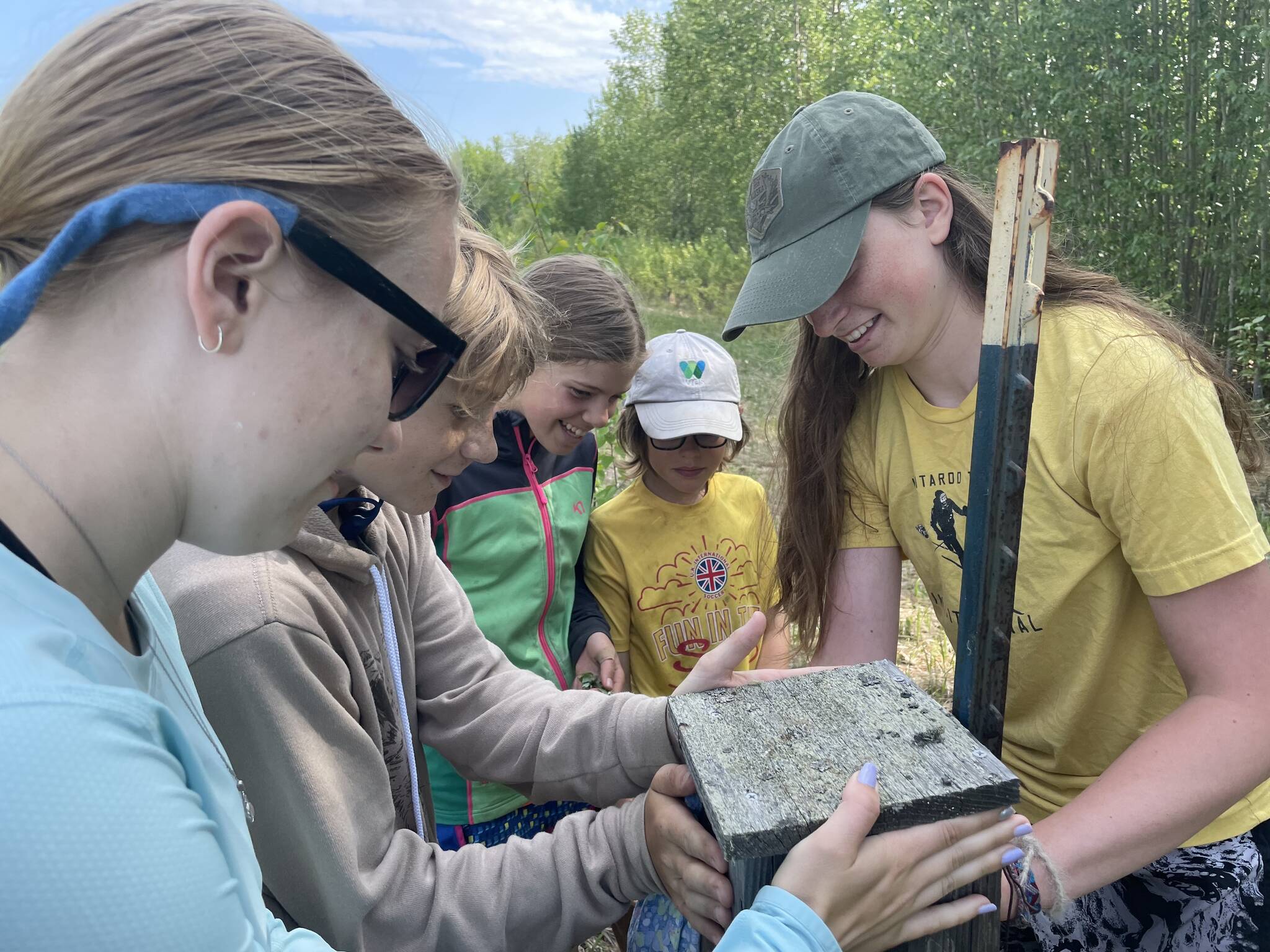
Helpers with the Alaska Songbird Institute’s Swallow Ecology Project prepare to capture a black-capped chickadee that is nesting in a swallow box at Creamer’s Field Migratory Waterfowl Refuge in Fairbanks. Their goal was to place a band on the bird’s leg and release it. From left are Aurora Brant, Dashell Neibaur, Hazel Sutton, Gunnar Benson and Molly Cable. (Courtesy Photo / Ned Rozell)
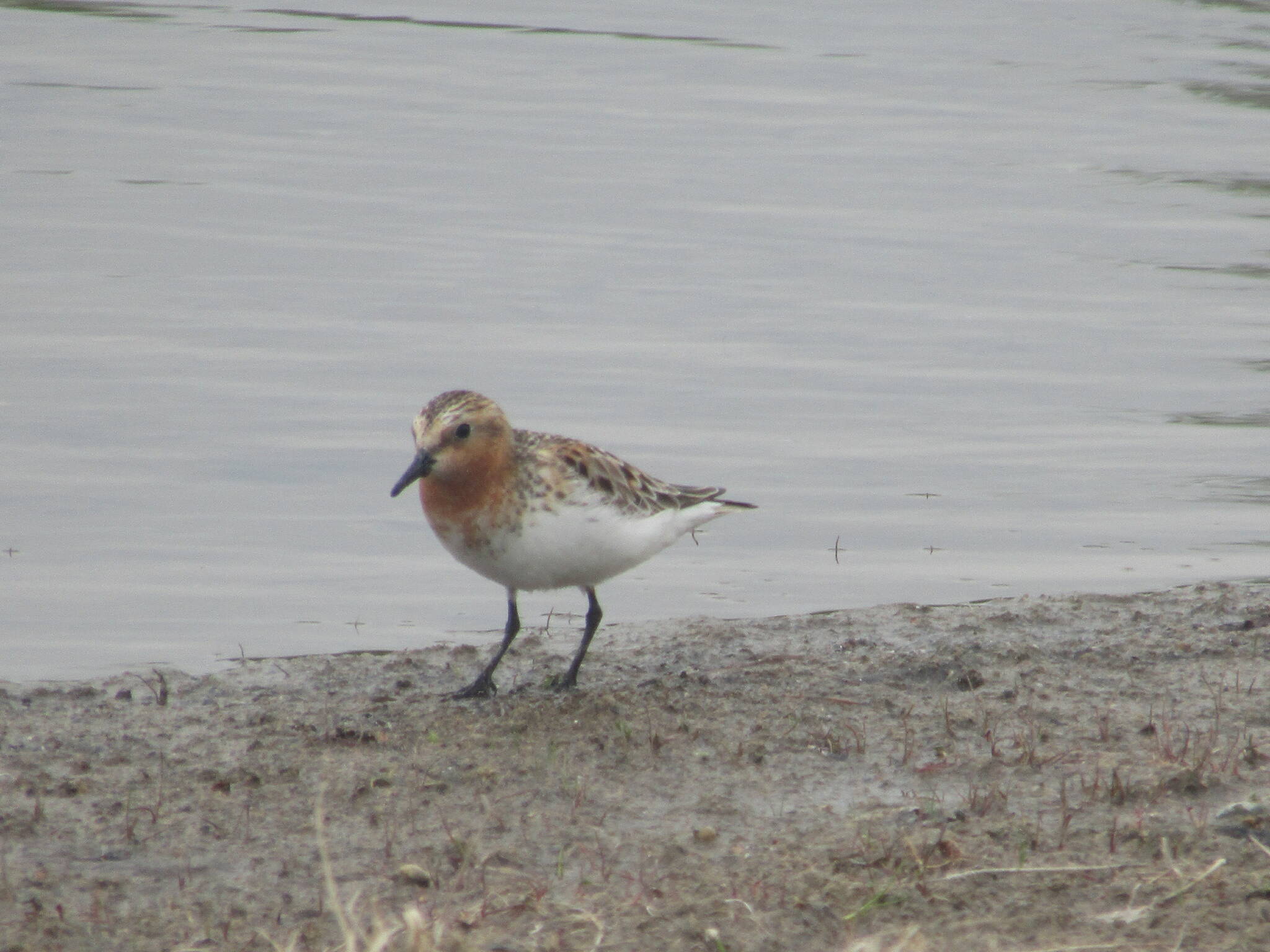
A red-necked stint feeds at Tanana Lakes Recreation Area in south Fairbanks. (Courtesy Photo / Hazel Sutton)
