
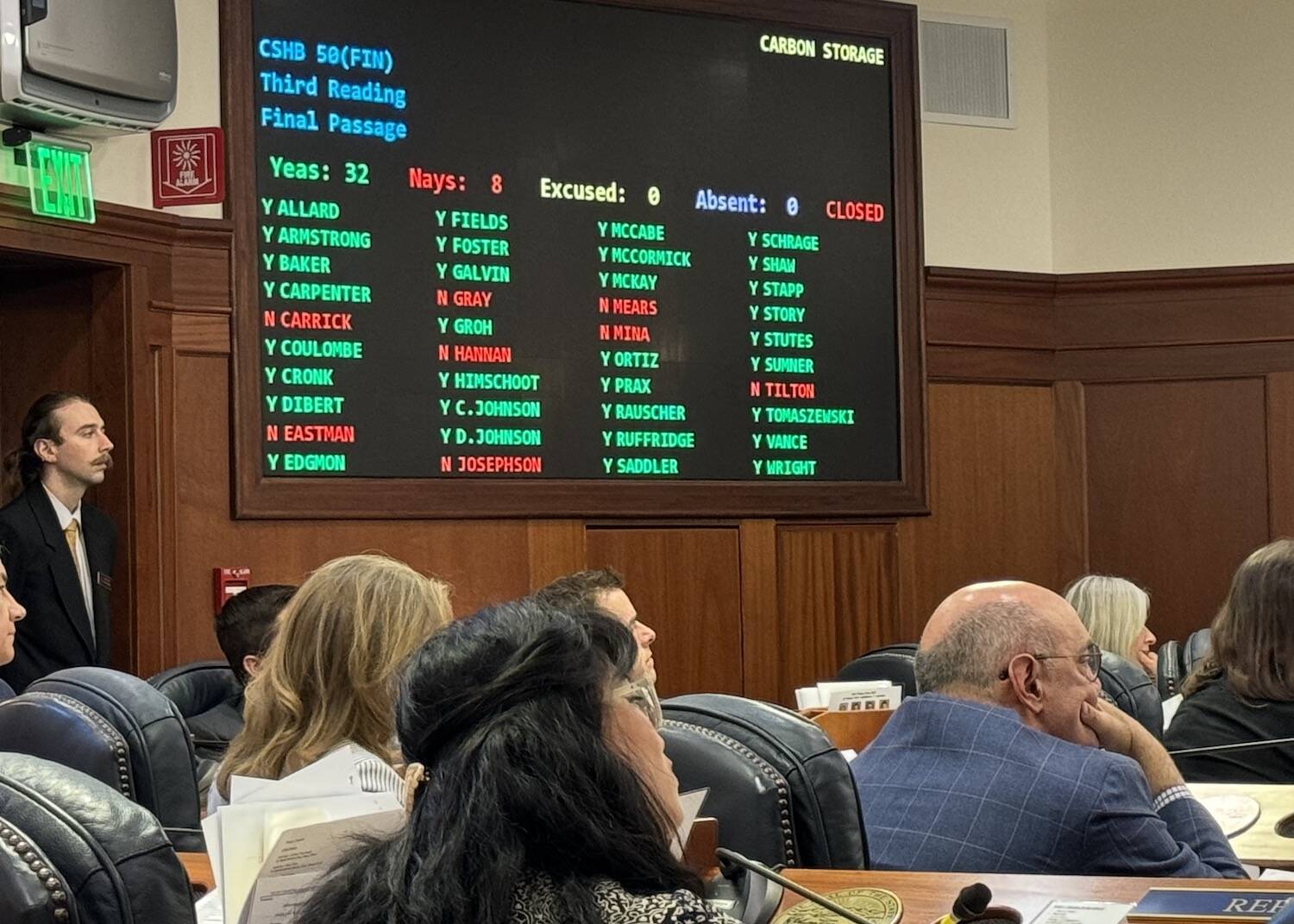
The Alaska House of Representatives voted Wednesday to allow companies to collect carbon dioxide and inject it deep underground. Supporters said they believe it will boost the state’s oil, coal and gas industries.
Legislators passed House Bill 50 on a bipartisan 32-8 vote, sending it to the Senate for further consideration.
Introduced by Gov. Mike Dunleavy last year, HB 50 was originally advertised as a way to generate money for the state while also reducing human-caused climate change.
But as the bill advanced, lawmakers stripped out the proposed minimum levels of revenue and argued that the bill was necessary for oil and gas work here.
“Our economic engine is at stake. It is a fact … the financiers are requiring you, as a business, to have a plan for reducing your carbon footprint,” said Rep. Ben Carpenter, R-Nikiski. “You can disagree with whether that’s smart or wise or not, but the simple fact is that financiers are requiring it.”
Under HB 50, the state would set rules for companies that collect carbon dioxide and store it underground, a process known as carbon storage or geologic carbon sequestration.
In Alaska, the rights to subsurface resources are owned collectively by the state’s residents through the state government. The original version of the bill required minimum payments by participating companies, based on the amount of carbon dioxide injected underground.
Legislators removed that provision and replaced it with language allowing the commissioner of the Department of Natural Resources to negotiate the financial terms of carbon deals with no minimum charge. Some funding formulas exist to pay for long-term monitoring of injection wells.
The changes left both legislators and executive branch officials uncertain about how much revenue it will raise for the state, and it isn’t clear whether the fees levied by the program will equal or exceed the cost to run it.
“So I’m supposed to vote when the Department of Revenue says, ‘We don’t know what this will do?’” said Rep. Andy Josephson, D-Anchorage, before the vote.
Interest in carbon storage has grown over the past decade as companies sign “net zero” agreements that require them to balance their carbon dioxide emissions with programs that remove carbon from the atmosphere.
Australia-based oil and gas firm Santos, for example, has publicly said that its goal is to be net zero by 2040. Santos is developing the Pikka oil project on Alaska’s North Slope.
“Well, I know that there are guilty Australians and Californians who want to pay this state to pollute. That’s okay with me,” said Rep. Will Stapp, R-Fairbanks.
Speaking Wednesday, several lawmakers said banks and other financial institutions are pressuring oil and gas firms into carbon reductions, and failing to pass the bill could cripple the amount of investment available for oil and gas work here.
“Alaska is on the world stage, competing for the world market, and that world market has shifted,” said Rep. Justin Ruffridge, R-Soldotna and a supporter of the bill.
Rep. Tom McKay, R-Anchorage, said he views the bill as critical to the eventual construction of a trans-Alaska natural gas pipeline.
Natural gas produced at Prudhoe Bay contains large amounts of carbon dioxide, which must be removed before shipping.
“Because of the perceived climate crisis … we can no longer vent CO2,” McKay said, referring to the process of releasing the greenhouse gas into the atmosphere.
“We’re pushed into a corner where we have to vote for this, we have to support this so we can scrub out the CO2 and put it into the ground,” he said.
Climate change, which is being caused by human emissions of greenhouse gases including carbon dioxide, is well established, but McKay wasn’t the only legislator to pooh-pooh the idea.
Rep. Kevin McCabe, R-Big Lake, referred to the idea as “climate change nonsense” and said the bill isn’t about climate at all but is “merely the state of Alaska trying to take advantage of what some big companies’ boards of directors have told them that they must do.”
Rep. David Eastman, R-Wasilla, said he recalls when he deployed to Iraq with the U.S. Army after being told that country had weapons of mass destruction. He said the carbon bill has a similar feeling.
“There are now only a small number of voices who are saying as loudly as they can that this whole carbon sequestration business is not what it’s cracked up to be. And 20 years on, I am quite confident that we will all come to that same appreciation,” he said before voting against HB 50.
Rep. Zack Fields, D-Anchorage, said he voted in favor of the bill because he thinks it will result in jobs, environmental benefits and some revenue, particularly local property taxes for the North Slope, where some of the first carbon storage work is expected.
Fields said carbon storage is an important first step toward direct air capture — plucking carbon dioxide from the open air and injecting it underground.
Fields said he believes that idea — still experimental — is necessary for future efforts to fight climate change, and facilities in Alaska could create demand for electricity. That, in turn, would drive the construction of renewable power plants, he said, creating jobs and lowering power prices for consumers.
Rep. Andrew Gray, D-Anchorage, disagreed, saying the idea that the carbon storage bill will benefit the environment is a “myth,” and “I am unwilling to sign on to that myth.” He voted no on the bill.
HB 50 advances to the Senate, where members of the Senate’s majority caucus have said they are eager to hear the bill.
• James Brooks is a longtime Alaska reporter, having previously worked at the Anchorage Daily News, Juneau Empire, Kodiak Mirror and Fairbanks Daily News-Miner. This article originally appeared online at alaskabeacon.com. Alaska Beacon, an affiliate of States Newsroom, is an independent, nonpartisan news organization focused on connecting Alaskans to their state government.
