
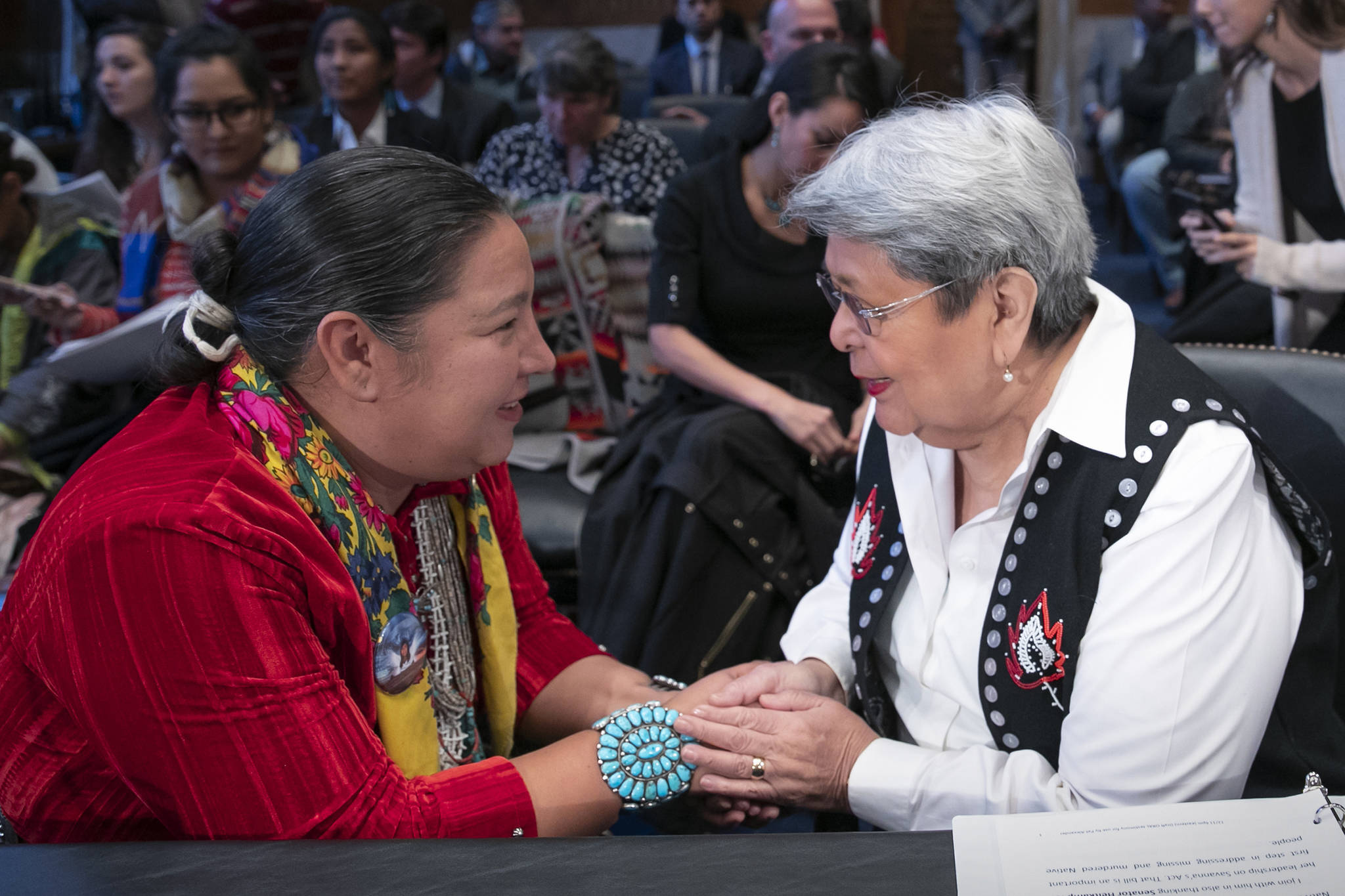
Correction: A previous version of this article stated Alexander wore a vest with a dove on it. The bird is actually a black-legged kitty wake, the crest of the T’akdeintaan of Hoonah. The article has been updated with that change.
When she got to the names of the victims, Patricia Alexander’s voice began to break.
Alexander, the co-chair of the Central Council Tlingit and Haida Indian Tribes of Alaska’s (CCTHITA) Violence Against Women Task Force, was testifying before the U.S. Senate Commitee on Indian Affairs in Washington, D.C. The committee was holding a hearing specifically about missing and murdered American Indian and Alaska Native women.
Alexander, who was one of three women testifying, first thanked the senators for allowing her to speak. Then she began naming Alaska Native women in Southeast who have died in unsolved circumstances in just the past two and a half years. The emotion hung heavily in her voice as she read their names.
Jade Williams, 19, of Kake. Francile Turpin, 37, of Klawock. Judylee Guthrie, 28, of Klawock.
“The future of Indian country depends on whether all of us work together to ensure that Native women live in environments that are free of such rampant, unaccountable violence,” Alexander said.
[Watch her testimony here at the two-hour mark of the hearing]
Speaking with the Empire by phone Friday, Alexander said CCTHITA’s General Counsel Madeline Soboleff-Levy was contacted about finding someone to testify, and Soboleff-Levy reached out to Alexander. Alexander has extensive experience in the health and social services world, she said, and has worked closely with Native populations in Southeast Alaska and in Arizona. Alexander prepared her testimony by consulting others including CCTHITA Tribal Court Chief Justice Michelle Demmert.
On Tuesday night, Alexander arrived in the nation’s capital for a whirlwind couple of days. She said the city had changed quite a bit since her last time there — 43 years ago. She didn’t get to be a tourist much, as she was meeting with people and preparing her testimony.
She wore a vest with a black-legged kitty wake — the crest of the T’akdeintaan of Hoonah — on the back when she testified in the Dirksen Senate Office Building. Two others testified alongside her: Amber Kanazah Crotty, a delegate from the 23rd Navajo Nation Council; and Kimberly Loring Heavy Runner, a woman whose sister Ashley went missing in June 2017.
Alexander, who lives in Sitka, talked at length in her testimony and her interview with the Empire about the fact that law enforcement agencies aren’t doing a good enough job of collecting data about missing and murdered Native women. A recent study from the Urban Indian Health Institute in Seattle supported this, finding that police departments nationwide are not keeping robust enough statistics.
Alexander accentuated the point that in cases of missing and murdered women, authorities sometimes forget about the victim.
“What we were trying to get across is, just because a perpetrators cannot be identified and arrested, does not mean the victim cannot be identified and served,” Alexander said. “The rights of the victim should not be denied just because law enforcement fails to apprehend perpetrators.”
Alexander was adamant that law enforcement agencies in Alaska in particular need more federal support. The training manual for the Alaska State Troopers is decades old, she said, and much of the academy training is focused on wildlife management instead of dealing with missing people or murder cases.
She pointed to rural communities as well, some of which have Village Public Safety Officers (VPSOs), and some of which don’t even have that line of defense.
“We don’t even have 911 in the villages,” Alexander said. “You’re on your own. There’s no amber alert when children go missing.”
The senators on the committee, including Sen. Lisa Murkowski, R-Alaska, asked questions of the panelists and tried to get a better understanding of how the federal government can make a difference in these small communities. Alexander said she was encouraged by the apparent commitment the senators are making to understand these systematic issues and get them fixed.
By the time she got back to Sitka on Thursday night, Alexander was a little jet-lagged but also more positive about the challenge at hand. She said the fact that the senators want to have more hearings like this — so called boots-on-the-ground hearings to speak with people who are personally affected by these cases of missing and murdered women — might be the start of making progress.
“I think it’s going to take all of us to try to resolve these issues,” Alexander said. “We’re going to have to work together and I want to re-emphasize that I’m not taking issue with the Alaska State Troopers or the VPSOs or those that are trying to do this work. They need resources, so we’ll work to do what we can to get more resources up to Alaska.”
• Contact reporter Alex McCarthy at 523-2271 or amccarthy@juneauempire.com. Follow him on Twitter at @akmccarthy.
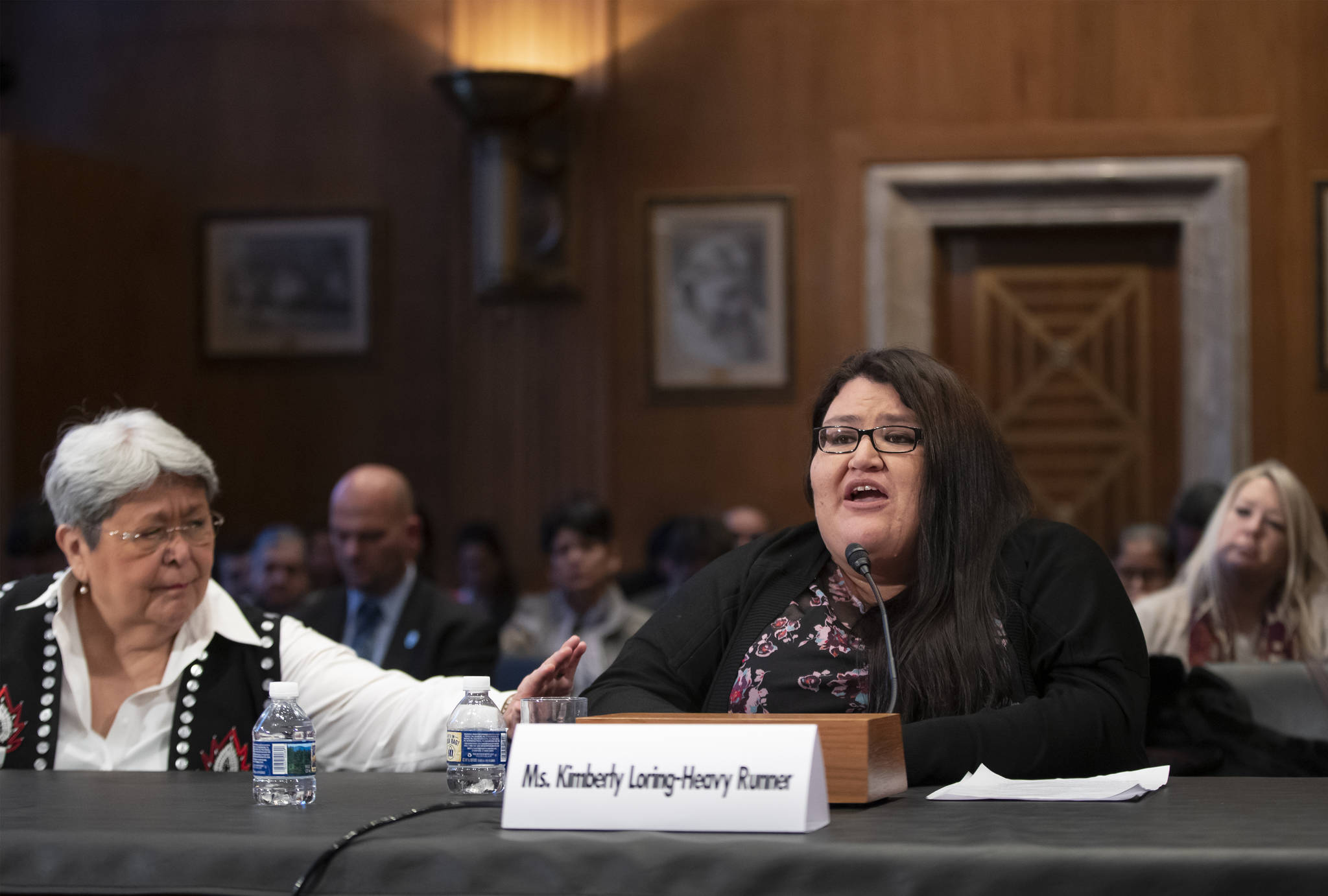
Kimberly Loring, right, whose sister, Ashley Loring HeavyRunner disappeared from the Blackfeet Reservation in Montana in 2017, is comforted by Patricia Alexander of the Tlingit and Haida Indian Tribes of Alaska, left, as the Senate Committee on Indian Affairs holds a hearing to examine concerns about investigations into the deaths and disappearance of Native American women, on Capitol Hill in Washington, Wednesday, Dec. 12, 2018. (AP Photo | J. Scott Applewhite)
