
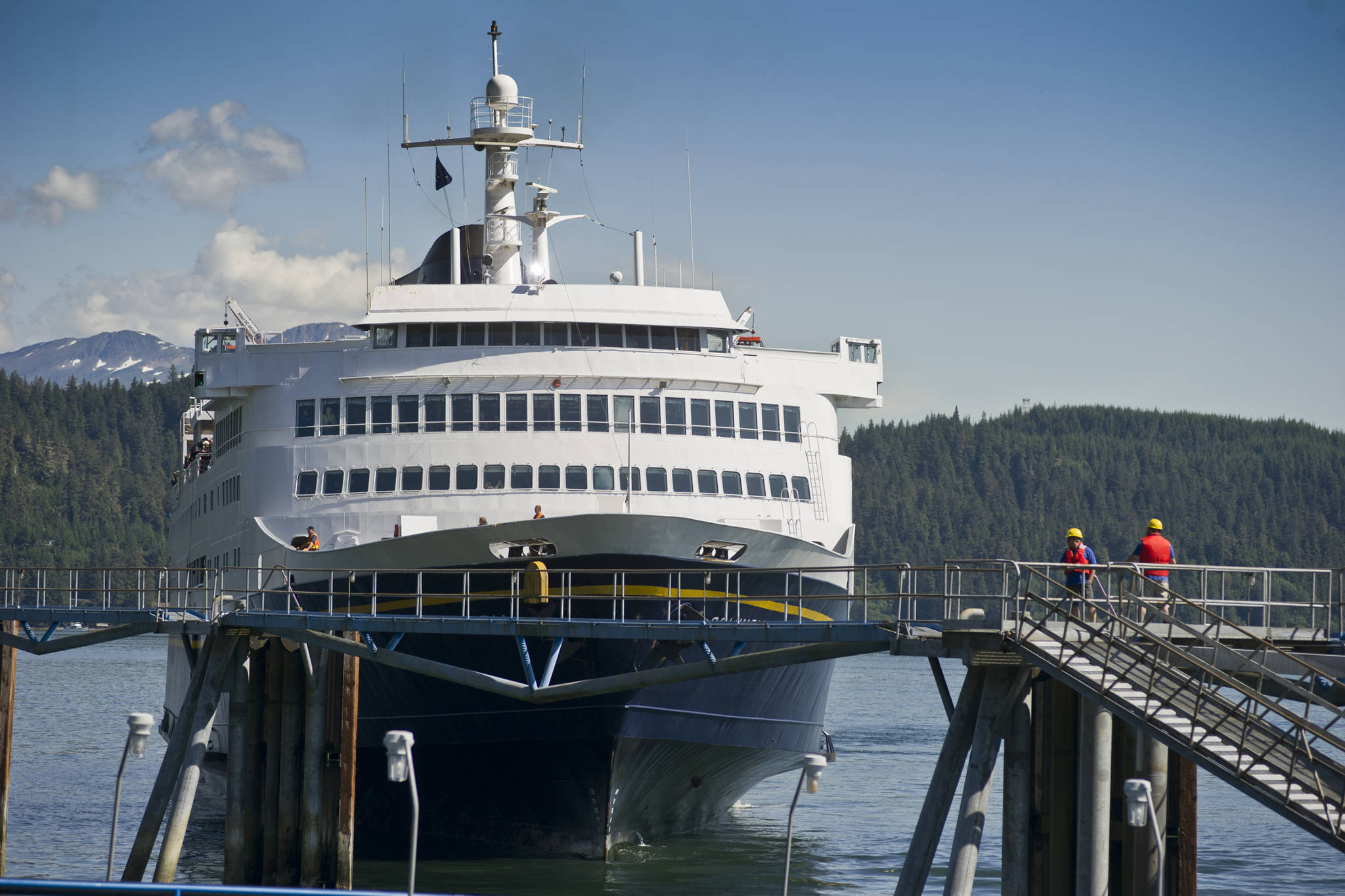
“The Dunleavy administration is all about truth in budgeting,” Revenue Commissioner Bruce Tangeman said in a press release two weeks ago.
Apparently, Department of Transportation Commissioner John MacKinnon didn’t get that message. Because this week he blamed the wrong former governor for why the two new Alaska-class ferries “cannot be deployed this summer on the planned routes.”
[New Alaska ferries need $30M in work before entering service]
MacKinnon was the deputy commissioner of DOT from 2003-2006, then the acting commissioner until 2008. It was during that time that DOT began developing the concept for building a Southeast Alaska shuttle ferry to operate as a day boat between Juneau, Haines and Skagway.
To function as a day boat, sailing time, including vehicle loading and unloading, would need to be completed in 12 hours or less. Even with bow and stern doors allowing “roll on-roll off” operations, this proved difficult to execute in the Lynn Canal corridor. So in 2009, DOT dropped the day boat concept. The new plan was for one ferry with crew quarters and doors for side loading.
Enter Gov. Sean Parnell. In December 2012, his administration decided to build two smaller ferries, both with roll on-roll off capabilities and no crew quarters. In a DOT document titled “Alaska Class Ferries — Project Overview and Change in Direction,” agency managers provided a brief history of Alaska-class ferry project and the rational for the decision. It touted “significant construction and operating cost savings,” greater “versatility and capacity” and the ability to serve “as a backup for other system vessels.”
It all might have made sense if the new ferry construction was the only Lynn Canal transportation project under consideration at that time. But it wasn’t. DOT’s highway division was working on the Supplemental Environmental Impact Statement (SEIS) for the Juneau Access project.
The highway up the east side of Lynn Canal had been the preferred alternative identified in the 2006 EIS. But the project was halted by a successful court challenge. However, as evidenced by Parnell’s decision to construct the first three miles beyond Echo Cove, albeit to a lower standard, it was still preferred to improving ferry access in the corridor.
Because building the highway would dramatically alter the mode of travel between Juneau and Haines, DOT should have deferred the design and construction of the ferries until the Record of Decision for the SEIS was approved by the Federal Highway Administration. Instead, Parnell modified the state design contract with the Elliott Bay. Then he negotiated with Vigor Alaska to build the two day boats in its Ketchikan Shipyard. That contract was awarded in September 2014.
The same month the SEIS was published. And as if by waving a magic wand, the two ferries that had been designed for 12-hour round trip sailings up Lynn Canal were now deemed suitable for the 30-minute shuttle between Haines and the new port at Katzehin.
Two months later, Parnell lost his bid for re-election. And he left his successor, Gov. Bill Walker, with a contract to build two Alaska-class ferries that weren’t ideally suited for either purpose.
Because Walker also inherited a state in fiscal crisis, he halted work on the Juneau Access Road, as well as five other major projects. After appointing a new DOT commissioner, he directed the department to resume work on the SEIS. In December 2016, he selected the “No Action” alternative.
It took another 18 months to complete the SEIS in a manner that allowed the state to avoid repayment of the federal funds it had spent on the project. It was only after that Record of Decision in June 2014 that Walker was in a position to initiate modifications to the new ferries.
One could argue that Walker contributed to this problem by deciding against building the road. But Parnell created it by putting politics ahead of sound engineering management.
As a past deputy and acting commissioner of DOT, and because he married a legislator who was on the Senate Transportation Committee in 2014, MacKinnon ought to know all this. If he didn’t, in the interest of transparency to the public he serves, he should have gotten the full story before blaming Walker. That’s also the right thing to do before asking the Legislature for the funds to correct the problem.
• Rich Moniak is a Juneau resident and retired civil engineer with more than 25 years of experience working in the public sector. He contributes a weekly “My Turn” to the Juneau Empire. My Turns and Letters to the Editor represent the view of the author, not the view of the Juneau Empire.
