
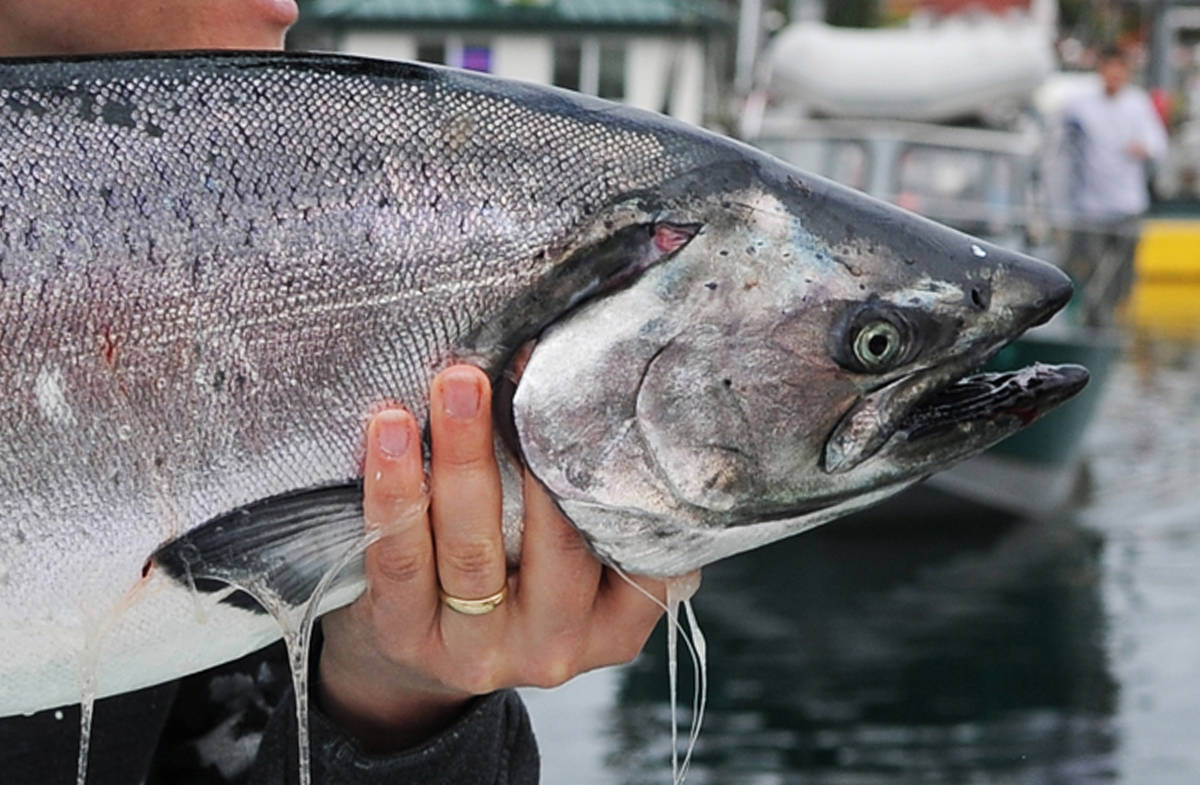
A king salmon during the 67th annual Golden North Salmon Derby at the Don D. Statter Memorial Boat Harbor in August 2013. (Michael Penn | Juneau Empire)

A king salmon during the 67th annual Golden North Salmon Derby at the Don D. Statter Memorial Boat Harbor in August 2013. (Michael Penn | Juneau Empire)

Alaska scientists pen letter backing salmon measure

58 retired fisheries biologists and managers, some local, sign statement of support

Former scientists and fisheries managers are taking sides over Ballot Measure 1.

On Wednesday, a group of 58 experts from state and federal agencies released a statement of support for the measure, which would change how development is permitted on some fish habitat.

That follows a letter of opposition penned by 10 former habitat managers and State of Alaska commissioners, published in the Anchorage Daily News in late September.

Ballot Measure 1 creates a different permitting structure for development on anadromous (e.g. salmon) fish habitat in Alaska. Oil and mining companies say it’s bad for business. Measure backers call it a much-needed update to state law.

Why are so many retired state employees speaking out? Alaska law bars current state employees from using their positions to advocate for “partisan political purposes.”

Only retired permitting, habitat and fisheries biology experts are allowed to speak out without repercussions.

Wednesday’s support statement, put together by conservation group Cook Inletkeeper, makes the case that Alaska’s current laws are too vague to properly protect wild salmon.

Current habitat protections fall into Alaska’s Title 16, the Alaska Anadromous Fish Act. It’s about a page and a half long , single-spaced. Ballot Measure 1 is eight pages, and adds detail on what kind of habitat harm the Alaska Department of Fish and Game should allow from which projects.

Retired Juneau fisheries biologist Phil Mundy, one of the letter’s signers, worked for the Alaska Department of Fish and Game and the National Marine Fisheries Service for 23 years. Title 16 is “sketchy,” and vague, Mundy told the Empire.

The state’s spawning and rearing streams are largely intact, Mundy said, unlike Washington state’s Columbia River Basin, where Mundy worked for 13 years.

Passing the ballot measure would prevent what happened there from happening here, Mundy said. Alaska’s habitat may be pristine, he said, but that’s not guaranteed to last.

“You don’t wait until the horses run off to close the barn door,” Mundy said.

The larger number of experts voicing support for the measure was telling, Mundy added.

“As a consequence of being a larger group of people, we have a much broader experience with salmon habitat and salmon habitat issues. I would go with the weight of opinion,” Mundy said.

A spokesperson for opposition group Stand for Alaska, Kati Capozzi, said the statement of support has a lot of federal managers, which weakens its relevance, she said. Twenty of the 58 signers worked exclusively for federal agencies. Ballot Measure 1 would affect state law, something federal fisheries scientists know less about, Capozzi said.

“This is something that the state will have to implement, this is something that the state will have to live with and pay for, so you would think that they would be looking a little more toward state officials,” Capozzi said.


• Contact reporter Kevin Gullufsen at 523-2228 and kgullufsen@juneauempire.com. Follow him on Twitter at @KevinGullufsen.


More in Home2

A sign reading, "Help Save These Historic Homes" is posted in front of a residence on Telephone Hill on Friday Nov. 21, 2025. (Mari Kanagy / Juneau Empire)
OPINION: The Telephone Hill cost is staggering

The Assembly approved $5.5 million to raze Telephone Hill as part of… Continue reading

Jeff Lund/contributed
The author would rather fish for steelhead, but he’ll watch the Super Bowl.
I Went to the Woods: Super Bowl spectacle

At some point on Sunday, dopey characters, hopelessly addicted to Doritos, will… Continue reading

Win Gruening (courtesy)
OPINION: Eaglecrest’s opportunity to achieve financial independence, if the city allows it

It’s a well-known saying that “timing is everything.” Certainly, this applies to… Continue reading

A tsunami is not expected after a 4.4-magnitude earthquake northwest of Anchorage Wednesday, Feb. 4, 2026. (U.S. Geological Survey)
No tsunami expected after 4.4-magnitude earthquake in Alaska

U.S. Geological Survey says 179 people reported feeling the earthquake.

Gov. Mike Dunleavy gestures during his State of the State address on Jan. 22, 2026. (Photo by Corinne Smith/Alaska Beacon)
OPINION: It’s time to end Alaska’s fiscal experiment

For decades, Alaska has operated under a fiscal and budgeting system unlike… Continue reading

The Spruce Root team gathers for a retreat in Sitka. Spruce Root, is an Indigenous institution that provides all Southeast Alaskans with access to business development resources. (Photo by Lione Clare)
Woven Peoples and Places: Wealth lives in our communities

Sustainable Southeast Partnership reflects on a values-aligned approach to financial wellness.

Cars drive aboard the Alaska Marine Highway System ferry Hubbard on June 25, 2023, in Haines. (Photo by James Brooks)
Alaska’s ferry system could run out of funding this summer due to ‘federal chaos problem’

A shift in state funding could help, but a big gap likely remains unless a key federal grant is issued.

Photo by James Brooks/Alaska Beacon
U.S. Sen. Dan Sullivan stands with acting Coast Guard Commandant Adm. Kevin Lunday during the after the commissioning ceremony for the Coast Guard icebreaker Storis on Sunday, Aug. 10, 2025, in Juneau, Alaska.
Coast Guard’s new Juneau base may not be complete until 2029, commandant says

Top Coast Guard officer says he is considering whether to base four new icebreakers in Alaska.

At the Elvey Building, home of UAF’s Geophysical Institute, Carl Benson, far right, and Val Scullion of the GI business office attend a 2014 retirement party with Glenn Shaw. Photo by Ned Rozell
Alaska Science Forum: Carl Benson embodied the far North

Carl Benson’s last winter on Earth featured 32 consecutive days during which… Continue reading

Most Read