
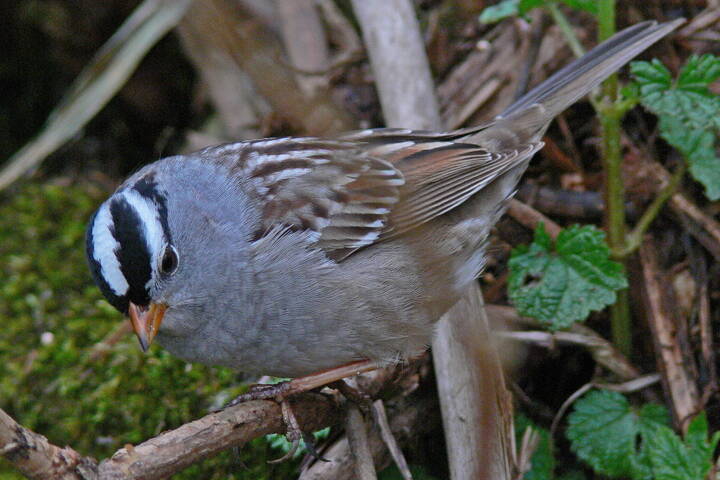
These are some natural history tidbits about three of the several species I’ve enjoyed seeing this spring.
Yellow-rumped warblers
Usually the earliest warblers to arrive, they appeared on migration in late April this year, often in small flocks, after wintering in the southern U. S. and Mexico. They are very versatile, active foragers, feeding chiefly on insects and spiders, flitting rapidly from one branch to another, gleaning bugs when they find them. They sometimes make short fly-catching flights (called “hawking”) for passing insects and even shoot up vertically in pursuit of a potential edible. They can glean bugs from tree trunks and the ground and skim low over water surfaces too. However, the diet is highly variable, including (in season) a diversity of fruits, buds, seeds, tree sap, honeydew from aphids; they’ve even been recorded to visit peanut-butter feeders.
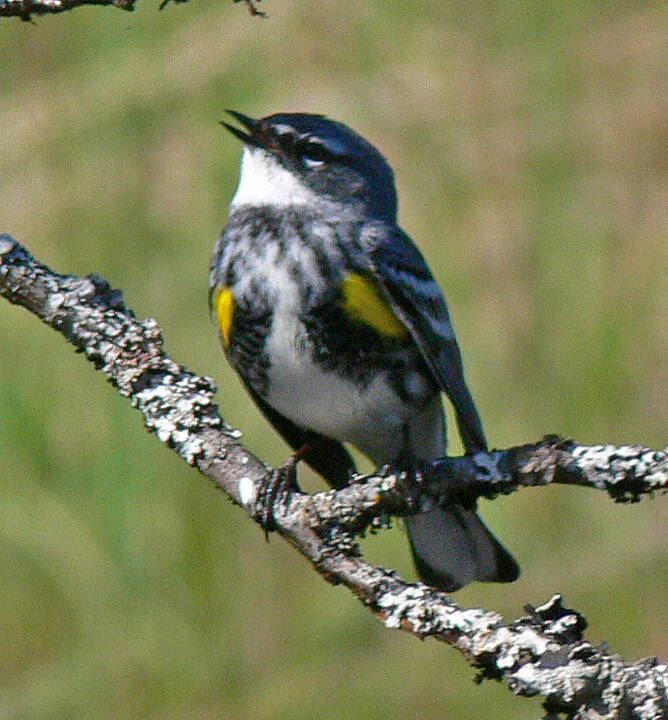
A male yellow-rumped warbler sings. (Photo by Bob Armstrong)
Here we also know the yellow-rumped warblers as myrtle warblers. East of the Rockies, Audubon’s warbler was formerly a separate species, but hybrids and genetic evidence showed them to be two forms of the same species. They breed in northern and western montane forests, and spend the winters in southern U. S., Central America and the Caribbean islands.
This species has not been as thoroughly studied as some other songbirds, but some basics are known. Territories are strongly defended against others of the same species, although nesting density is usually low. They like to nest on conifer branches, usually laying about four eggs. The females incubate, but males may feed their mates occasionally during this time, and both parents feed the chicks. Chicks fledge after 10 to 14 days in the nest, and fledglings are fed by the parents for a while. They probably start breeding when they are a year old.
White-fronted geese
White-fronted geese have been hanging out on the wetlands for several days in early May. They’re on their way from wintering grounds in Mexico and the west-coast states to nesting areas in the far north. A flock of 40 or 50 moved around the meadows, flying low and then settling to graze for a while. One day I watched them all sail over to the river and forage in the shallows. As Arctic terns gracefully cavorted overhead, the whole gang gradually moved upriver along the shore finding things both on the sands and in the water. They eat mostly seeds and grasses, sometimes berries too, and they grub up roots and rhizomes from the wet meadows. I don’t see this species every year, so this was a good sighting for me.
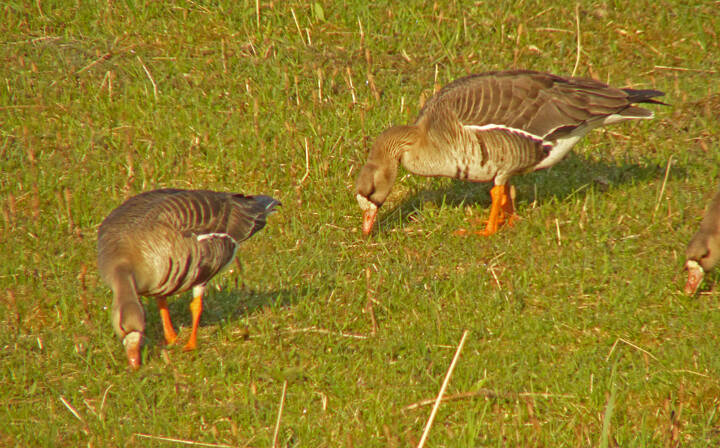
Greater white-fronted geese forage in the wetlands. (Photo by Bob Armstrong)
The species we see is the greater white-fronted goose (the lesser one lives in the Old World), which nests in the Arctic of North America and Siberia. Highly gregarious in the off-season, they tend to be territorial on the nesting grounds. The favored habitat for nesting is open tundra, usually near water. Females do the job of incubating the eggs (typically four of them) for about 25 days. The chicks can fly when they are about six weeks old. When the juveniles are about a year old, they may start forming pairs, but they don’t usually breed until they are three years old. Families tend to stay more or less together during the first year or two after the young fledge. After wintering down south, both adults and non-breeding juveniles return to the nesting grounds.
White-crowned sparrows
White-crowned sparrows are coming through town, foraging in many places. I enjoyed watching one of them figure out how to get at the peanut butter in the feeder; it took a couple of minutes of contemplation, but he made it. Out on the wetlands at low tide, they were foraging on the exposed mud of the sloughs. They forage chiefly for seeds and (especially in the breeding season) arthropods; occasionally they take buds and fruit. Sometimes they mix with the golden-crowned sparrows in loose groups under the shrubbery. One afternoon I watched both kinds of sparrows wade across the little wooden dam that makes my pond. As the shallow water flowed over the dam, they picked up little items as a snack, quite un-bothered by the mallards doing the same, just downstream.
This species breeds all across northern North America and the alpine zones of the mountainous west, wintering in southern U. S. and Mexico. Most populations are migratory, but some California populations are year-round residents. They use a variety of habitats for nesting, usually consisting of a mix of open areas with some shrubs, often near open water and tall conifers. Females build the nests and incubate clutches of four or five eggs for about twelve days; both parents feed the chicks, which stay in the nest for eight or ten days. Fledglings are tended by at least one parent (the male if the female re-nests) for about four weeks. Both male and female juveniles mature and start breeding when they are a year old.
This is a well-studied species; in particular, researchers have learned a lot from this species about song development and song-learning.
• Mary F. Willson is a retired professor of ecology. “On the Trails” appears every Wednesday in the Juneau Empire.
