Mid-June, and a few days ago we saw a wood duck with two tiny chicks on Moose Lake. Another female with two fluffy ones came through my home pond, going downstream. That’s always fun. But it got more interesting:
For much of the first part of June, there has been a male wood duck on my pond, hanging out with a few mallards. Occasionally a female wood duck showed up, too, and typically swam up and down the pond with the male. One afternoon, I watched a female cock her head and look up at the hanging seed-feeder. Then she took off, almost vertically, toward the feeder and struck it, sending a little shower of seeds down to the pond. She ate some of them but had to share with the male and the mallards. She did this trick at least eight times. Some strikes were more productive than others: a full-body strike was better than a foot strike, and one time she missed the target. How did she figure out that trick?
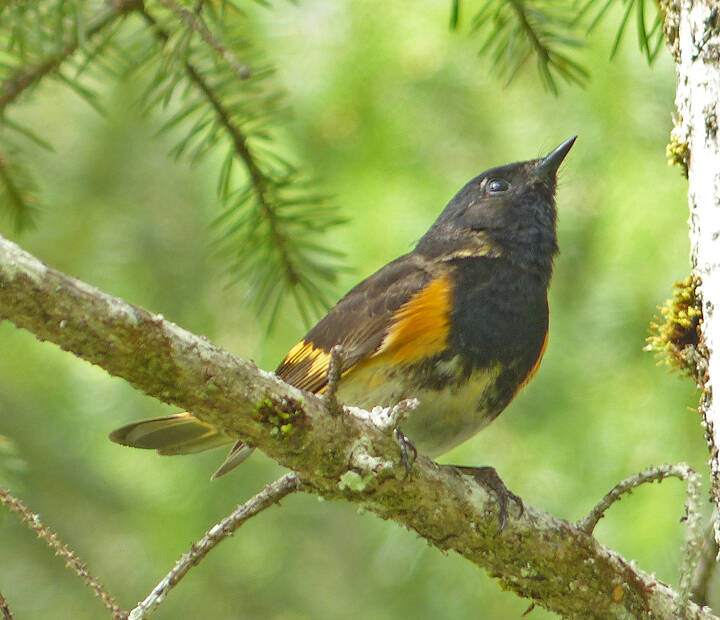
Birding walks in the Dredge Lake area and near the visitor center (go early to avoid the mobs of visitors) found avian songsters. There were Swainson’s thrushes and robins, a vireo, and several kinds of warblers including the northern waterthrush. Of particular interest were American redstarts, a warbler that reaches the far northwestern edge of their breeding range here in Southeast. We found lots of them singing, but the only ones were could see lacked the showy red and black plumage of fully adult males. These were probably first-year males (yearlings, hatched last year), which look a lot like females (which can occasionally sing too), but are capable of breeding. We have seen fully adult males in these places in other years, and they may really be here this year too, but we just missed them. The apparent preponderance of first-year males is puzzling.
One day on the Back Loop, we saw a young robin floundering clumsily about in the middle of the driving lane, presumably struck by a previous vehicle. My friend was driving and pulled over immediately. She jumped out, looked right and left for traffic, and stepped out onto the highway. Alerting oncoming cars, she tried to chivvy the kid off the road. No luck…So then she “summoned up her predatory instincts” and pounced on it. Holding it gently, she carried it off the road into the edge of the woods, where an agitated parent greeted it. We hoped the youngster would eventually recover.
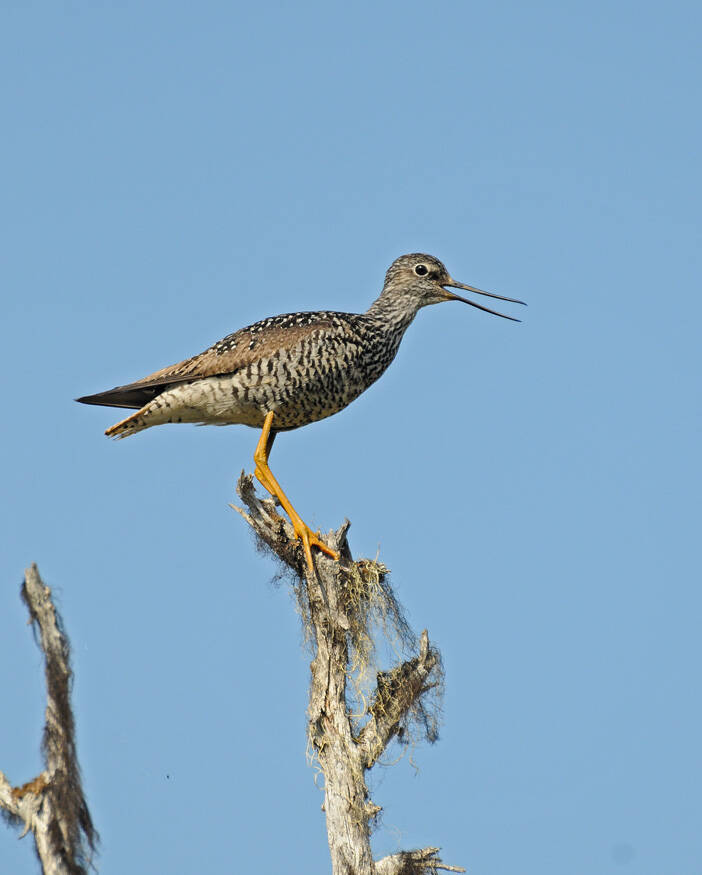
A little group of friends set out the Pt. Bridget Trail to Cowee Meadows, somehow managing to do this on the only rainy day in a long stretch of otherwise fine weather. In the first muskeg near the trailhead, we were greeted vociferously by a pair of agitated greater yellowlegs (a medium-size shorebird that likes to nest in the muskegs). They perched high in the trees and yelled loudly and continuously, protesting the presence of ourselves and our canine companion, and they didn’t quit until we were well out of sight in the forest. They were still there, protesting again, when we returned several hours later, but now they were in a different part of the muskeg. So I thought there were probably some chicks running around, followed overhead by watchful parents.
On from the muskeg and into the forest, we enjoyed the handsome flowers of rusty Menziesia and a few late blueberry flowers. White flowers of at least five species decorated the trailside. But the best was yet to come. Where the forest opens out into meadows, a sea of color appears. On this day, the big show was blue of lupine and yellow of buttercups, with occasional northern geranium, chocolate lily, cow parsnip, and others. A few lupine plants already bore seed pods while blue flowers still bloomed at the top of the inflorescence. Shooting stars were coming to the end of their blooming time, although some flowers were still bright pink. However, the next big show was already underway! The irises were starting to bloom, in all shades of purple and even a white one, with millions of buds still to open.
The irises are not the only ones with variable flower color. Chocolate lilies are well-known for the range of color from the customary dark brownish tone to a less-usual yellowish form. That range of variation seems to be very common in the meadow. An occasional lupine bears pink or white flowers, but I have not detected intergrades of color with the typical blue-flowered form. Shooting stars rarely have pale flowers but we were too late to be able to spot any variants from the usual pink.
The big, conspicuous buttercups have some relatives out there, one of which we tried to find. The shore buttercup (known by various names) grows in the muddy, somewhat saline channels where the tall vegetation cannot survive well, sprawling out more sideways than tall. After a bit of searching, we found the tiny yellow flowers.
• Mary F. Willson is a retired professor of ecology. “On The Trails” appears every Wednesday in the Juneau Empire.