
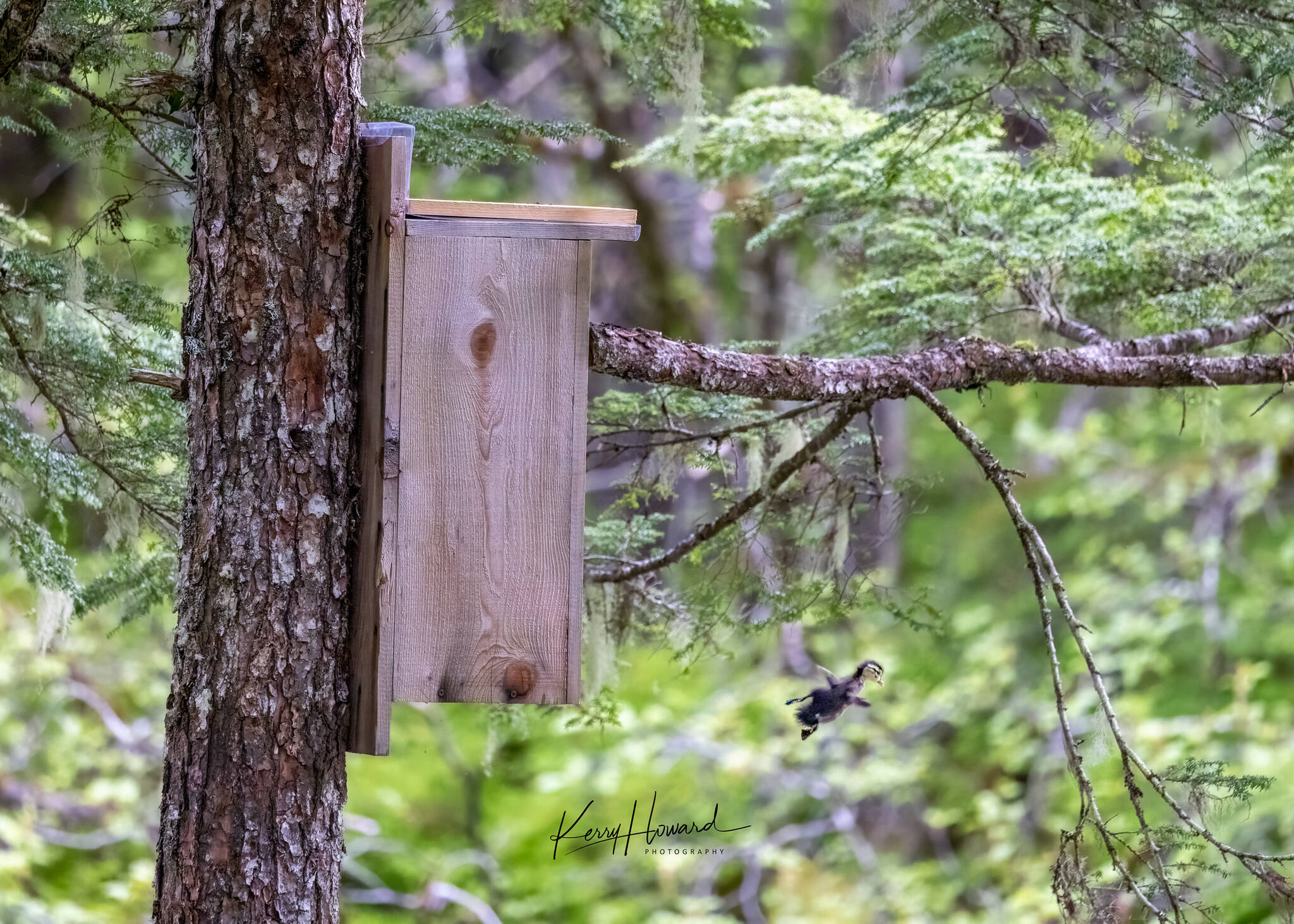
A little wood duck jumps from its nest, soon to be joined by its siblings. (Photo courtesy of Kerry Howard)

A little wood duck jumps from its nest, soon to be joined by its siblings. (Photo courtesy of Kerry Howard)

On the Trails: Wood ducks

Wood ducks nest seasonally in forested areas across North America from coast to coast in southern Canada and the northern tier of states. From southern British Columbia, a narrow strip of breeding range extends northward along the coast through Southeast Alaska. We see them here in Juneau fairly commonly. They nest in several places in the Mendenhall Valley, for instance. These western breeders migrate south for the winter, flying at night; many of them go to the Central Valley of California. They are often year-round residents in most of the eastern U.S., Cuba, parts of the Pacific Northwest, and California.

They are cavity-nesters, using tree cavities and nest boxes. Suitable tree cavities are often found in old, large, mature trees with broken branches that have heart rot. Deforestation of old-growth probably reduced the availability of good nest sites and drainage programs brought loss of suitable wetland habitat. Furthermore, wood ducks were overhunted in times past. However, they seem to have made a good recovery, in part because hunting is better regulated, and also conservation-minded folks have installed nest boxes in many places. Much of what we know about their nesting biology comes from research on nest box breeders.

Females choose the nest site while accompanied by their attentive mate. Most nests are placed fairly close to water, although some nests have been found over a kilometer away from any water. The female lines the chosen nest site with down feathers from her body. Wood duck males are quite faithful during the formation of a clutch, but males may mate with other females when the first clutch is completed. Clutch size averages about 10 to 12 eggs, with lots of variation. One egg is laid per day, typically, and the male attends to the female when she comes to the cavity to lay the egg of the day. The female begins incubation a few days before the clutch is completed, so hatching is not completely synchronous. The incubation period is roughly four weeks, sometimes longer, depending in part on ambient temperatures. Ducklings are downy and able to walk and feed independently. They usually leave the nest on the morning after hatching, being called by the female waiting below, and can survive a long jump down from the nest opening to the ground. After leaving the nest, the brood stays with the female for several weeks. Survival from hatching time until they can fly is commonly around 50%. There is no male parental care.

Brood parasitism is reported to be quite high (in some cases over 50%), either by other female wood ducks or mergansers, and perhaps other cavity-nesting ducks. Many animals prey on eggs and incubating females; in the east and south, raccoons and rat snakes often top the list (no info for SEAK).

The scientific name is Aix sponsa. Aix is a Greek word for waterfowl; “sponsa” means “bride” — in this case, referring to the fancy dress of the male. There is one other species in the genus: the mandarin duck, which is native to the eastern Palearctic but has been introduced to other parts of the world.

• Mary F. Willson is a retired professor of ecology. “On The Trails” appears every Wednesday in the Juneau Empire.

More in Sports

The Juneau-Douglas High School: Yadaa.at Kalé Crimson Bears won fourth place during the Division II Hockey State championships in Palmer last weekend. Photo courtesy of Rapi Sotoa
Juneau takes home fourth place during high school state hockey tournament

The Crimson Bears also received the Sportsmanship Award last weekend.

Senior Juneau-Douglas High School: Yadaa.at Kalé hockey players were recognized at the Treadwell Arena on Friday, Jan. 23, 2026 before the Crimson Bears faced the Homer High School Mariners. Head coach Matt Boline and assistant coaches Mike Bovitz, Luke Adams, Jason Kohlase and Dave Kovach honored 11 seniors. (Chloe Anderson / Juneau Empire)
JDHS celebrates hockey team’s senior night with sweeping victory over Homer

The Crimson Bears saw an 8-2 victory over the Mariners Friday night.

Photo by Ned Rozell
Golds and greens of aspens and birches adorn a hillside above the Angel Creek drainage east of Fairbanks.
Alaska Science Forum: The season of senescence is upon us

Trees and other plants are simply shedding what no longer suits them

Things you won’t find camping in Southeast Alaska. (Jeff Lund/Juneau Empire)
I Went to the Woods: Sodium and serenity

The terrain of interior Alaska is captivating in a way that Southeast isn’t

An albacore tuna is hooked on a bait pole on Oct. 9, 2012, in waters off Oregon. Tuna are normally found along the U.S. West Coast but occasionally stray into Alaska waters if temperatures are high enough. Sport anglers catch them with gear similar to that used to hook salmon. (Photo provided by the National Oceanic and Atmospheric Administration/West Coast Fisheries Management and Marine Life Protection)
Brief tuna bounty in Southeast Alaska spurs excitement about new fishing opportunity

Waters off Sitka were warm enough to lure fish from the south, and local anglers took advantage of conditions to harvest species that make rare appearances in Alaska

Isaac Updike breaks the tape at the Portland Track Festival. (Photo by Amanda Gehrich/pdxtrack)
Updike concludes historic season in steeplechase heats at World Championships

Representing Team USA, the 33-year-old from Ketchikan raced commendably in his second world championships

A whale breaches near Point Retreat on July 19. (Chloe Anderson/Juneau Empire)
Weekly Wonder: The whys of whale breaching

Why whales do the things they do remain largely a mystery to us land-bound mammals

Renee Boozer, Carlos Boozer Jr. and Carlos Boozer Sr. attend the enshrinement ceremony at the Naismith Basketball Hall of Fame in Sprinfield, Massachusetts, on Saturday, Sept. 6, 2025. As a member of the 2008 U.S. men's Olympic team, Boozer Jr. is a member of the 2025 class. (Photo provided by Carlos Boozer Sr.)
Boozer Jr. inducted into Naismith Hall of Fame with ‘Redeem Team’

Boozer Jr. is a 1999 graduate of Juneau-Douglas: Yadaa.at Kale

Photo by Martin Truffer
The 18,008-foot Mount St. Elias rises above Malaspina Glacier and Sitkagi Lagoon (water body center left) in 2021.
Alaska Science Forum: The long fade of Alaska’s largest glacier

SITKAGI BLUFFS — While paddling a glacial lake complete with icebergs and… Continue reading

Photo by Jeff Lund/Juneau Empire
The point of fishing is to catch fish, but there are other things to see and do while out on a trip.
I Went to the Woods: Fish of the summer

I was amped to be out on the polished ocean and was game for the necessary work of jigging

A female brown bear and her cub are pictured near Pack Creek on Admiralty Island on July 19, 2024. (Chloe Anderson for the Juneau Empire)
Bears: Beloved fuzzy Juneau residents — Part 2

Humor me for a moment and picture yourself next to a brown bear

Isaac Updike of Ketchikan finished 16th at the World Championships track and field meet in Budapest, Hungary, on Tuesday. (Alaska Sports Report)
Ketchikan steeplechaser makes Team USA for worlds

Worlds are from Sept. 13 to 21, with steeplechase prelims starting on the first day