
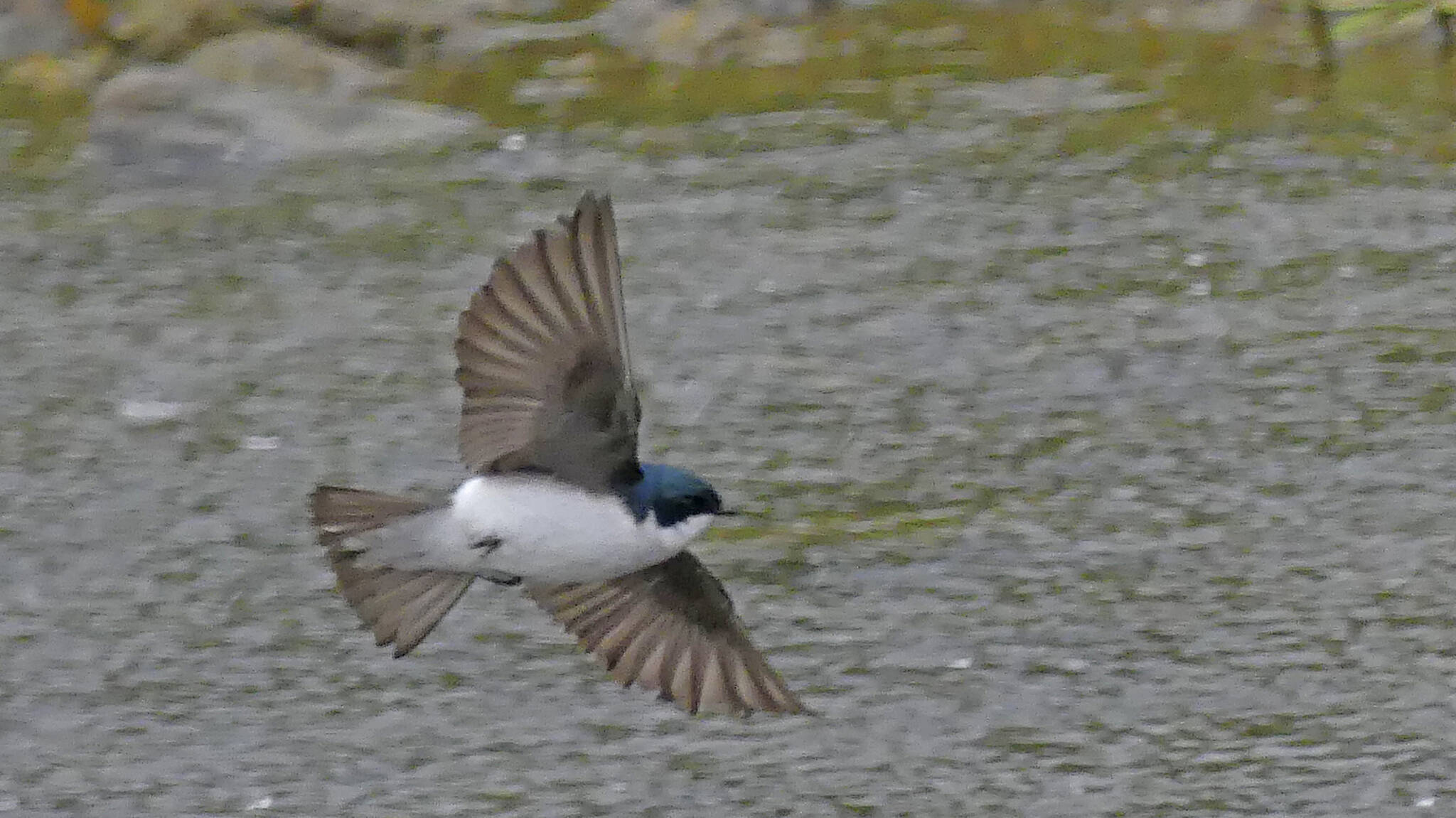
In early May, one of my great pleasures was watching violet-green swallows in their fast, circular flights over water (e.g., the river, Kingfisher Pond). They’d just arrived from their wintering ground in Mexico and Central America and were preparing to move to their nesting areas. Flying insects form their diet; there are no reports of them eating anything else. I see these swirling flocks in spring and also in fall, as they get ready to move south. They seem to have been less thoroughly studied than our other swallows, but some basics (and a couple of odd-ball observations) have been documented.
“VGs” (as I call them) belong to the genus Tachycineta, which has nine species, mostly in Latin America. They are closely related to our familiar tree swallows, the only other member of the genus in North America, but they are slimmer and have narrower wings and shorter tails.
VGs, unlike our other swallows, nest in montane forests from central Alaska to northern Mexico, using tree cavities, rocky crevices, or convenient nest boxes, commonly in coniferous forest but also in mixed stands and aspen woods. Although they are often colonial, sometimes pairs nest separately from others. There are rare reports of them way out the normal range in central Canada, including a mixed pair formed of a female VG and a male tree swallow, but the nesting attempt failed. As often happens for cavity-nesters, there can be stiff competition for nest sites, not only with other VGs but also wrens, chickadees, house sparrows, and so on. There is, however, a report of three VG pairs occupying western bluebird nests, cleaning the nest and feeding the bluebird chicks. The VGs may have inherited the nest sites after the bluebirds left.
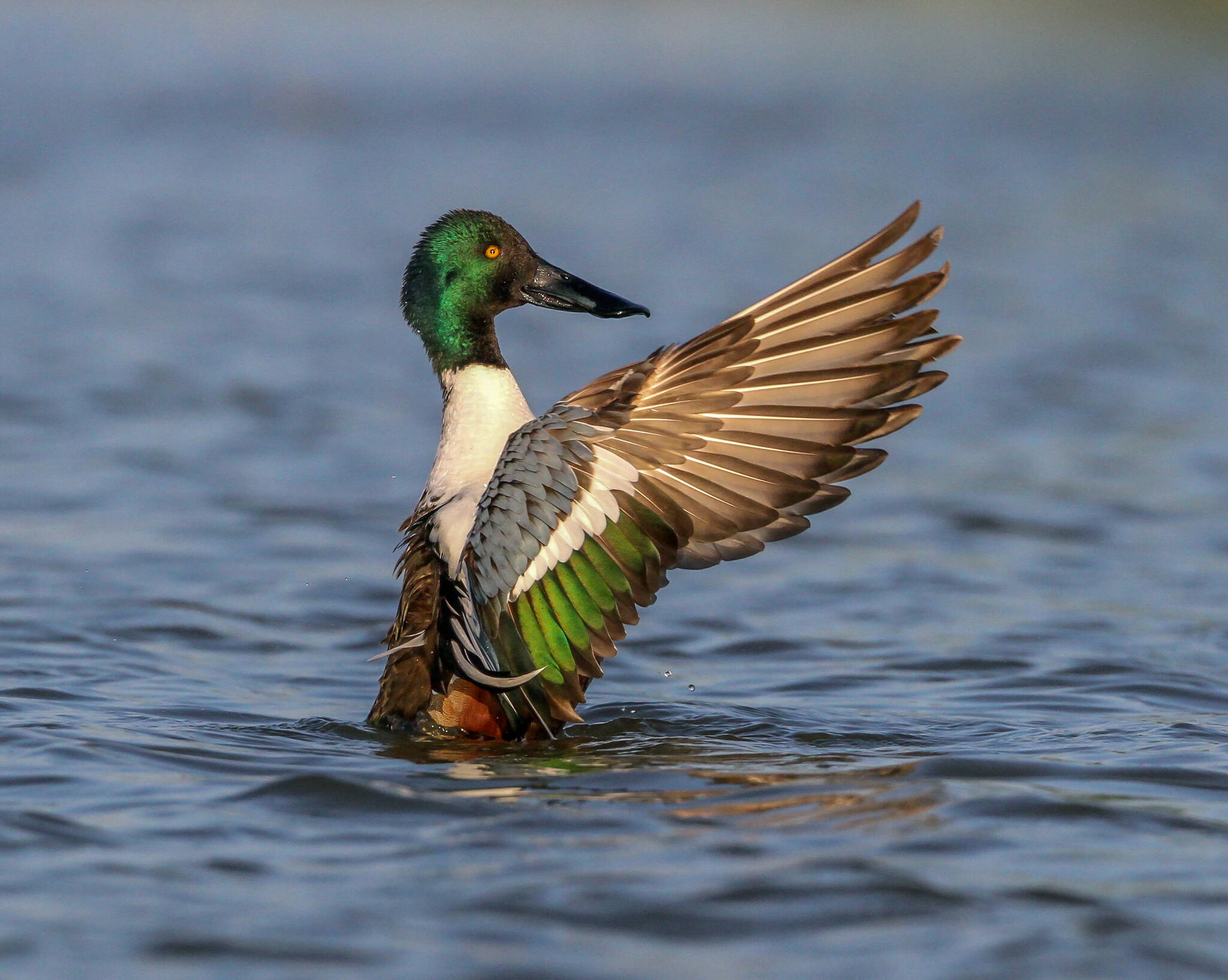
A male northern shoveler duck. (U.S. Fish and Wildlife Service photo)
Male VGs are thought to guard their mates from the attentions of other males more intensely than defending a nest site itself. The nest is composed of plant fibers with a topping of feathers. Both male and female build the nest, but she does most of the work. Females also do the incubation of eggs and most of the tending of the chicks. Clutch size is usually four to six eggs. Incubation takes about 15 days and starts with the laying of the first egg of a clutch, so hatching is not synchronous. Chicks stay in the nest about 24 days.
Another bird that caught my attention this spring is the northern shoveler, which typically arrives later than the other ducks. It’s one of the dabbling ducks (including mallards, widgeon, etc.), so-called because they commonly forage from the water surface as they swim; they are capable of short dives too. The dabblers are distinguished from the diving ducks (bufflehead, goldeneye, etc.), which are very able divers. The legs of the divers are placed behind the center of gravity, which facilitates diving and underwater swimming, at the price of awkward walking on land. Dabblers have the legs placed under the center of gravity, and they can walk more or less comfortably on land.
There are four species of shovelers: our northern species that ranges over North America and Eurasia plus three more elsewhere. As other dabblers often do, they sometimes grub around in the mud if the water is shallow. Dabblers commonly filter-feed, taking in water at the front of the bill and passing it out on the sides and back. The edge of the bill bears a row of fine keratin plates that filter out food particles. As the water passes through the filter, the plates catch small invertebrates and sometimes seeds; the tongue sweeps the prey from the plates and back down the throat. But shovelers are specialized for filter-feeding, and the morphology of the bill is so distinctive that they are sometimes classified in a different genus from the rest of the dabblers. The bill is unusually broad and has longer filtering plates than other dabblers. In addition to capturing prey, the plates may also reject unwanted particles of debris that are discarded at the back of the bill. Groups of shovelers and even single individuals sometimes swim in tight circles, creating a vortex that brings up more prey from deeper waters.
Northern shovelers like to nest in grassy areas near water, although they place the nest at some distance from the water. The showy males are very territorial, defending their nesting area against intruders. Females do all the nesting-work: choosing the nest site (while accompanied by the male), building the nest, incubating the eggs, guarding the precocial chicks. The nest is a simple scrape lined with some plant fibers and feathers. The average clutch size is about 10 eggs. Although some incubation occurs during egg-laying, all the eggs hatch on about the same day. The downy, precocial chicks leave the nest immediately and become fully feathered and potentially independent in a few weeks. They stay with the mother at least for that time, and the family may forage together for a while longer.
• Mary F. Willson is a retired professor of ecology. “On The Trails” appears every Wednesday in the Juneau Empire.
