
On a gray morning in early September, with no cruise ships in town(!), I wandered up Basin Road and the first part of the Perseverance Trail with a friend. Just ahead of us was a woman walking her dog and on the railing of the first bridge stood a raven, talking loudly and clearly expectant. We soon figured out that the raven was experienced with dog walkers and knew they usually had doggie treats in a pocket. But no luck, in this case; no treats were forthcoming, despite its persistent attentions.
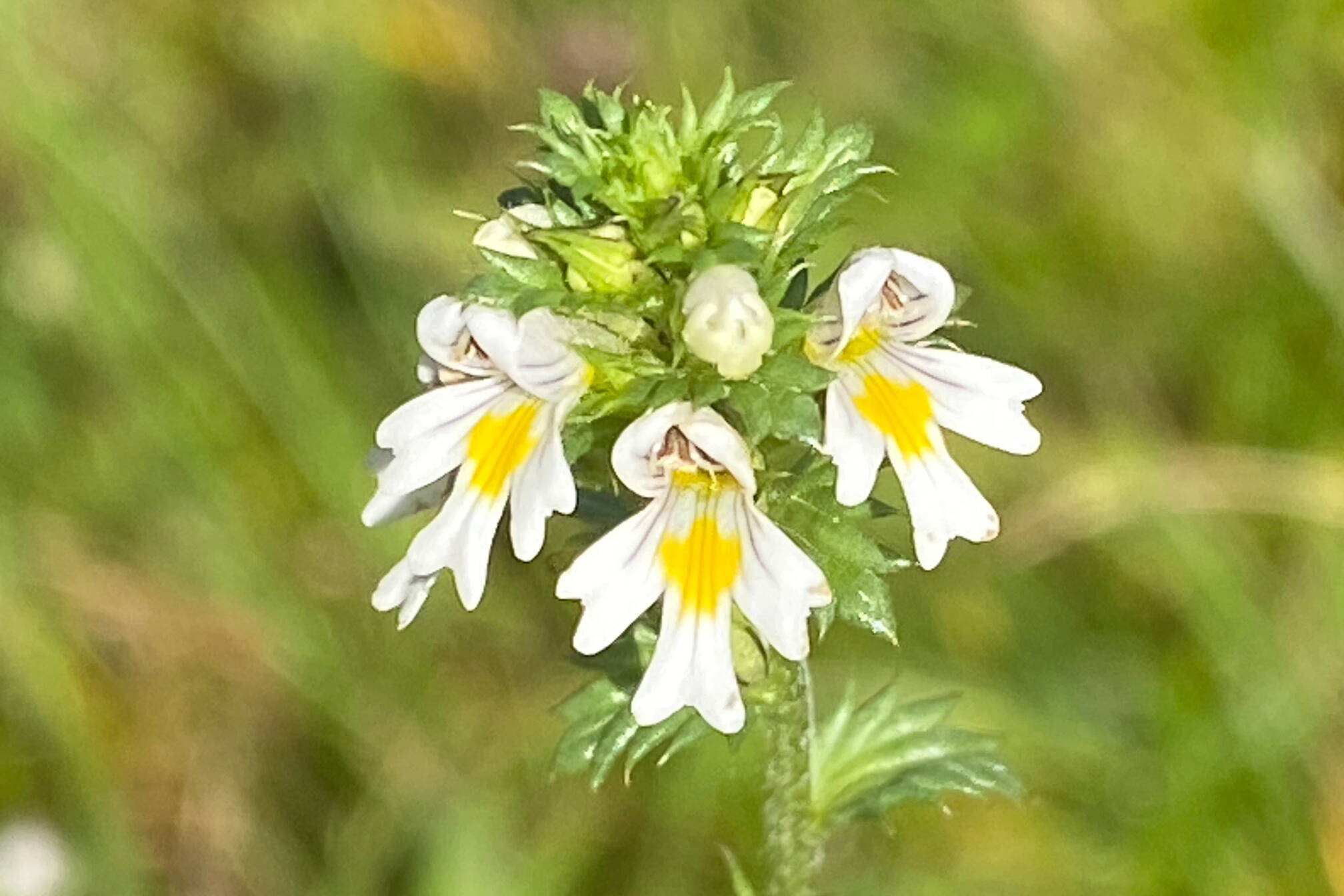
Perky little eyebrights were common on the side of the trail. They seem to have a long flowering season, presenting their little white flowers over many weeks. This plant is a hemi-parasite, having its own green leaves and photosynthesis, but also stealing from various other plants by attaching to their roots. We seldom see visiting insects on these flowers and they may commonly self-pollinate. I’ve just learned that we have both a native species and a Eurasian invasive, and I suspect that it is the invasive species on the trailside.
Red-osier dogwood shrubs had ripe fruits, typically white but sometimes with a bluish tinge. We found just one inflorescence still in flower, the multiple white flowers in prime condition. However, it seemed that pollination and fruit set had been poor, as all the fruit clusters bore just a few fruits and most of the flower stems had not developed a fruit. The fruits of this shrub are interesting because they are relatively high in lipids (about 25%), considerably more than most other fleshy fruits (e.g. blueberry, salmonberry, etc.), and they are correspondingly lower in sugars (about 15%). These dogwood fruits are usually popular with birds.
Another very common flower along the trail was a purple-flowered daisy (Erigeron peregrinus). It looks like an aster, but can be distinguished by inspection of the involucre that supports the multi-flowered flowering head; asters have more layers of tightly packed bracts there. This plant is unusual because our daisy has flat, colorful ray florets surrounding the central disc florets, but many other members of that genus typically have very narrow, bristle-like ray florets. In general, it seems that the flowers of most species of Erigeron attract a variety of visiting insects, but they may often be capable of self-pollination (details lacking for E. peregrinus).
Here and there along the trail, we found jewelweed plants starting to produce capsules but still flowering. I’ve long wondered about the floral structures of this plant, and I think I finally may understand it. To put it in perspective, consider that individual flowers of many plants commonly have several green bracts (called sepals) surrounding the bases of the petals; they protect the buds before the flower opens. In some flowers, those sepals have been co-opted to look like (and presumably function) as petals, making an attractive display. Fireweed is one example; between the broad, pink petals there is usually a narrow, dark pink structure — that’s a sepal. A more impressive example is provided by irises — the broad, colorful upright and drooping structures that make what we improperly call the flower are actually sepals; the true petals are small and inconspicuous.
Jewelweed or touch-me-not (Impatiens noli-tangere) has a more complex arrangement. Bumblebees are initially attracted to its yellow-petaled flower. As a bee crawls in, its back brushes over the flower’s sex organs, potentially picking up or depositing pollen. But the bee isn’t finished with its visit — behind the array of petals is a tubular yellow structure with a skinny little hooked tail at the end. This is a converted sepal bearing a nectar spur, where a bee can get the payoff for its visit. It has been suggested that only small bees or long-tongued species can reach the nectar. The nectar-bearing sepal’s bright color adds to the floral display; two small, ordinary sepals appear at the base of the flower. (This plant can also produce very small self-pollinating flowers that do not open; they appear mostly on plants growing in low light conditions.)
This structural floral arrangement, with converted, nectar-bearing sepals, seems to be quite unusual. The genus Impatiens contains many species and only some have this arrangement. But I have, so far, been unable to track down any specifics about how it may have evolved.
• Mary F. Willson is a retired professor of ecology. “On The Trails” appears every Wednesday in the Juneau Empire.
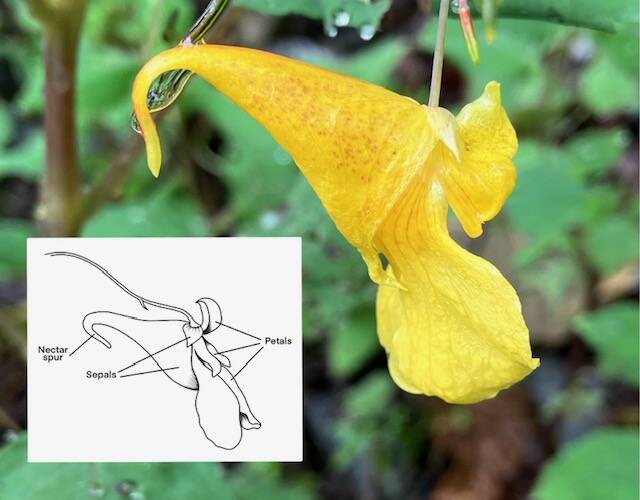
The floral display of jewelweed features petals and a large nectar-bearing sepal. The diagram identifies the structures. (Photo by Mary F. Willson, diagram by KM Hocker)
