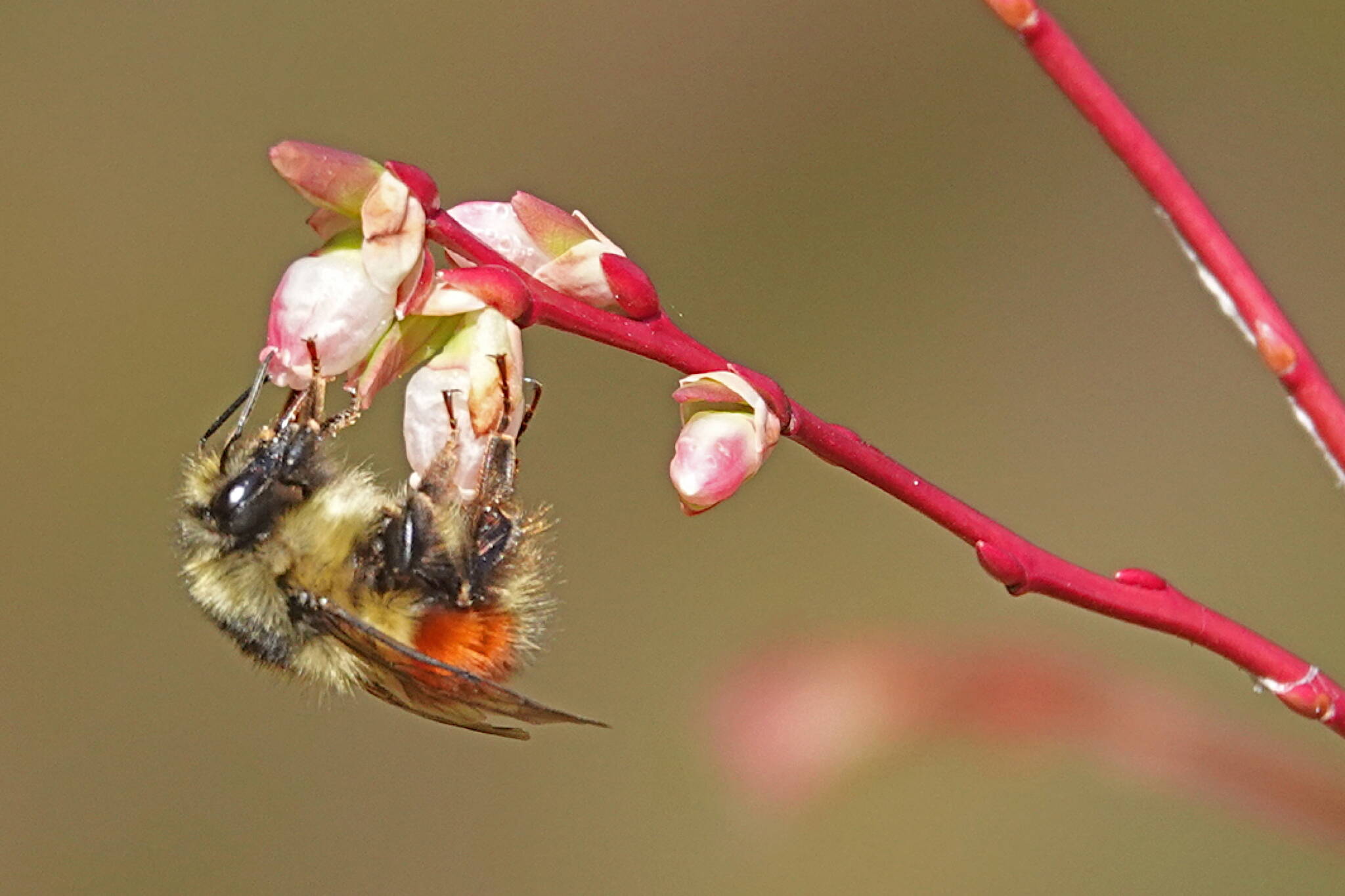
A queen bumblebee visits a blueberry flower. (Photo by Bob Armstrong)

A queen bumblebee visits a blueberry flower. (Photo by Bob Armstrong)

On The Trails: Spring flowers and their pollinators

Spring flowers have co-evolved with insect pollinators for a long time. The flowers require pollen delivery to set seed. To entice insects to visit and deliver the pollen, they produce food rewards (nectar and pollen). When conditions are right, the insects get fed and the flowers get pollinated. But spring, with its highly variable weather conditions, is always a chancy time for pollination. If something goes awry for either party in a pollination partnership, it can have serious effects on both partners. So, for example, in some years a late freeze might damage blueberry flowers. This could hinder pollination and deprive pollinating insects of food, leading to poor blueberry crops and — perhaps — low reproductive success for the pollinators.

Plants and pollinators rely on environmental signals to time their life cycles and activity patterns. Some species may use day length as the principal trigger, while others use temperature. Some may use both, or other environmental factors. These signals trigger genetically determined responses, such as emergence by insects and blooming by plants. In some cases, the response to the trigger may include evaluation of body condition and the internal resources available. That is reported to happen for bumblebees and is likely to happen for plants as well.
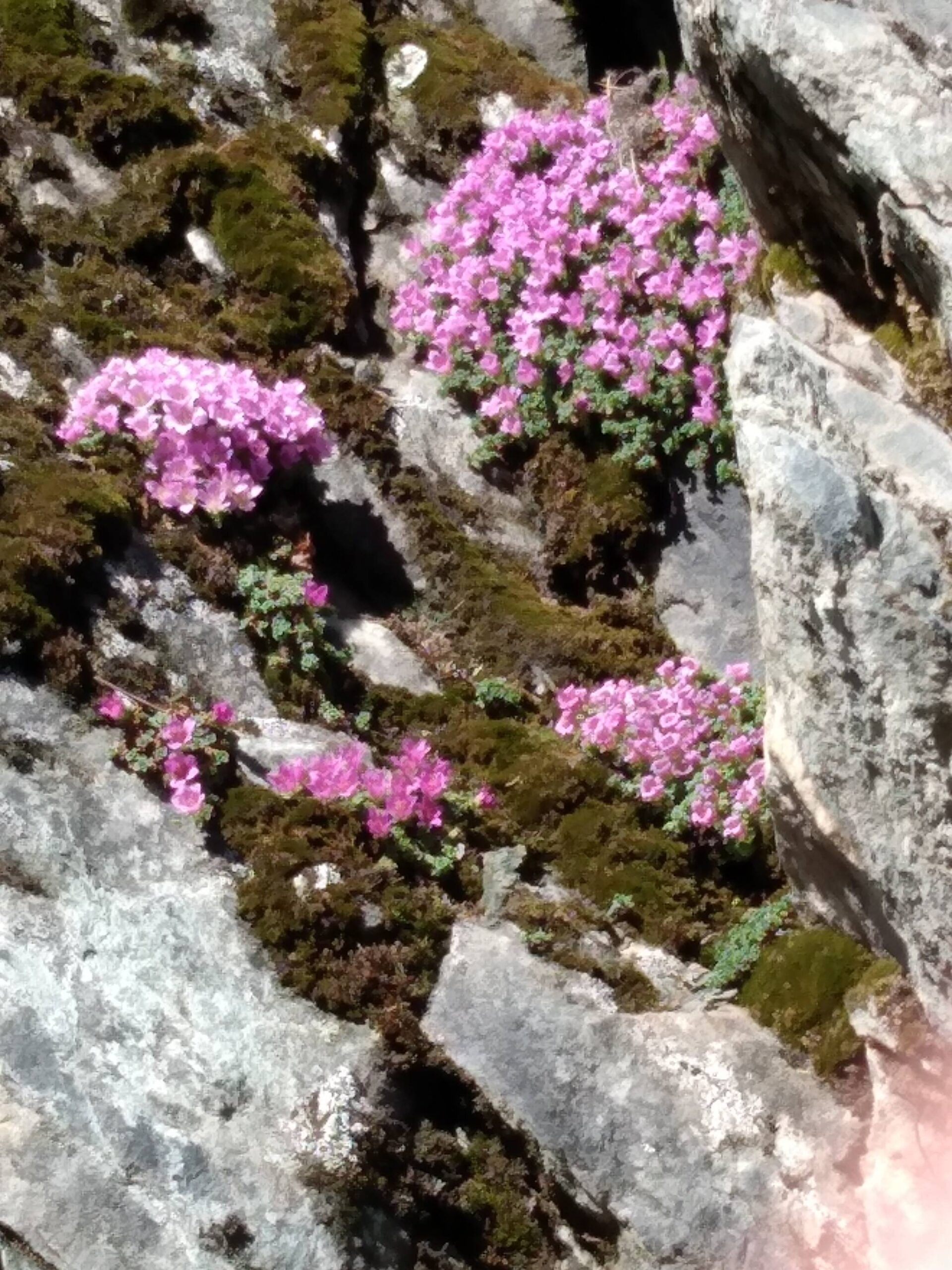
A purple mountain saxifrage is often pollinated by bees. (Photo by Martina Kallenberger)

A purple mountain saxifrage is often pollinated by bees. (Photo by Martina Kallenberger)

Day length is very predictable, temperature much less so. The globally warming climate means that a temperature-responsive species in a pollination partnership may shift its timing, but one that is responsive to day length does not. Similarly, temperature-responsive species may have different settings for their responses and therefore respond differently to climate warming. These changes can have serious consequences. If temperature changes induce the flowers to bloom too early (or too late) for their pollinators, or if the insects come out before (or after) the flowers are available, some species will fail to reproduce and will die out. The co-evolved system will break down.

The risks are especially great for flowers that depend mainly on a single kind of insect, as many of our species do. For instance, bees are probably the main pollinators of blueberry flowers, although various flies may visit too. In the absence of bees, the other visitors are likely to be insufficient to achieve good pollination. It could be a similar story for flowers that depend chiefly on certain beetles or flies.

In our area, the situation is complicated by our notorious local variations in microclimate. Conditions differ with elevation, exposure to insolation, proximity to the ocean, the proximity of garden flowers as alternative foods, and so on. So what might happen in one part of a population might differ from that in another and we might observe differences in pollination success and insect abundance. In a few cases, the local populations might be so separated from each other that they can evolve local adaptations, but in most cases, there is likely to be gene flow among the populations, reducing that possibility. A further complication is that even if pollination and insect diets are good, climate change might alter the conditions for plant growth and insect nesting, which are essential for the interactions to continue.

To make specific predictions about the likely fates of our local species in response to climate warming requires specific information about the environmental triggers to which each species responds. That information is not available now.

• Mary F. Willson is a retired professor of ecology. “On The Trails” appears every Wednesday in the Juneau Empire.

More in Sports

Senior Juneau-Douglas High School: Yadaa.at Kalé hockey players were recognized at the Treadwell Arena on Friday, Jan. 23, 2026 before the Crimson Bears faced the Homer High School Mariners. Head coach Matt Boline and assistant coaches Mike Bovitz, Luke Adams, Jason Kohlase and Dave Kovach honored 11 seniors. (Chloe Anderson / Juneau Empire)
JDHS celebrates hockey team’s senior night with sweeping victory over Homer

The Crimson Bears saw an 8-2 victory over the Mariners Friday night.

Photo by Ned Rozell
Golds and greens of aspens and birches adorn a hillside above the Angel Creek drainage east of Fairbanks.
Alaska Science Forum: The season of senescence is upon us

Trees and other plants are simply shedding what no longer suits them

Things you won’t find camping in Southeast Alaska. (Jeff Lund/Juneau Empire)
I Went to the Woods: Sodium and serenity

The terrain of interior Alaska is captivating in a way that Southeast isn’t

An albacore tuna is hooked on a bait pole on Oct. 9, 2012, in waters off Oregon. Tuna are normally found along the U.S. West Coast but occasionally stray into Alaska waters if temperatures are high enough. Sport anglers catch them with gear similar to that used to hook salmon. (Photo provided by the National Oceanic and Atmospheric Administration/West Coast Fisheries Management and Marine Life Protection)
Brief tuna bounty in Southeast Alaska spurs excitement about new fishing opportunity

Waters off Sitka were warm enough to lure fish from the south, and local anglers took advantage of conditions to harvest species that make rare appearances in Alaska

Isaac Updike breaks the tape at the Portland Track Festival. (Photo by Amanda Gehrich/pdxtrack)
Updike concludes historic season in steeplechase heats at World Championships

Representing Team USA, the 33-year-old from Ketchikan raced commendably in his second world championships

A whale breaches near Point Retreat on July 19. (Chloe Anderson/Juneau Empire)
Weekly Wonder: The whys of whale breaching

Why whales do the things they do remain largely a mystery to us land-bound mammals

Renee Boozer, Carlos Boozer Jr. and Carlos Boozer Sr. attend the enshrinement ceremony at the Naismith Basketball Hall of Fame in Sprinfield, Massachusetts, on Saturday, Sept. 6, 2025. As a member of the 2008 U.S. men's Olympic team, Boozer Jr. is a member of the 2025 class. (Photo provided by Carlos Boozer Sr.)
Boozer Jr. inducted into Naismith Hall of Fame with ‘Redeem Team’

Boozer Jr. is a 1999 graduate of Juneau-Douglas: Yadaa.at Kale

Photo by Martin Truffer
The 18,008-foot Mount St. Elias rises above Malaspina Glacier and Sitkagi Lagoon (water body center left) in 2021.
Alaska Science Forum: The long fade of Alaska’s largest glacier

SITKAGI BLUFFS — While paddling a glacial lake complete with icebergs and… Continue reading

Photo by Jeff Lund/Juneau Empire
The point of fishing is to catch fish, but there are other things to see and do while out on a trip.
I Went to the Woods: Fish of the summer

I was amped to be out on the polished ocean and was game for the necessary work of jigging

A female brown bear and her cub are pictured near Pack Creek on Admiralty Island on July 19, 2024. (Chloe Anderson for the Juneau Empire)
Bears: Beloved fuzzy Juneau residents — Part 2

Humor me for a moment and picture yourself next to a brown bear

Isaac Updike of Ketchikan finished 16th at the World Championships track and field meet in Budapest, Hungary, on Tuesday. (Alaska Sports Report)
Ketchikan steeplechaser makes Team USA for worlds

Worlds are from Sept. 13 to 21, with steeplechase prelims starting on the first day

Old growth habitat is as impressive as it is spectacular. (Photo by Jeff Lund/Juneau Empire)
I Went to the Woods: The right investments

Engaged participation in restoration and meaningful investment in recreation can make the future of Southeast special