
February ground to a halt and March slowly geared up. Days were getting longer, but the tedious pseudo-spring weather prevailed — no longer really winter but not really spring. All the ponds in the Valley were still frozen and thin films of new ice often formed over puddles, just to be gone in a few hours. Buds on some shrubs were getting plump but avian activity was hard to find. We become impatient.
Then, just before the Ides of March, things were changing a bit. A friend reported a flock of snow buntings in the wetland meadows. Strollers on the dike trail remarked on seeing a robin. And then, I spotted my very own bunch of robins, perched high in a cottonwood. Five of ‘em — just black, robin-shaped forms; it took a little work to find the right place to see some color. They were real, not just imaginary. The very next day, a walk with a friend produced several songs from invisible juncos somewhere in the canopy. And a few days later, a group of robins were searching, largely in vain, for edibles on the frozen ground along the dike; all of these robins were males, with black heads. Females usually arrive a little later than the males, as is the case for many migrant songbirds.
Mid-March, and the ponds were still ice-covered, the ground frozen. But I found a felt-leaf willow with newly emerged catkins, almost ready for visits by bumblebees. Felt-leafs are typically the first willow to show signs of spring vigor and they can be very important food sources for early bees. I wondered if some garden crocuses might also be starting to bloom, so I drove out to the Arboretum to see. Indeed, the crocuses there were getting started — a few were open, with more on the way. But no bees yet.
However, as we looked in vain for bees, we heard a tinny series of taps, then another series — aha! There’s a sapsucker nearby. We spotted him near the top of a power pole, where he was letting the world know he was back for the season. He poked around a bit in a clump of moss and then resumed his advertising. Maybe he liked the tinny sounds of that metal canister on the pole.
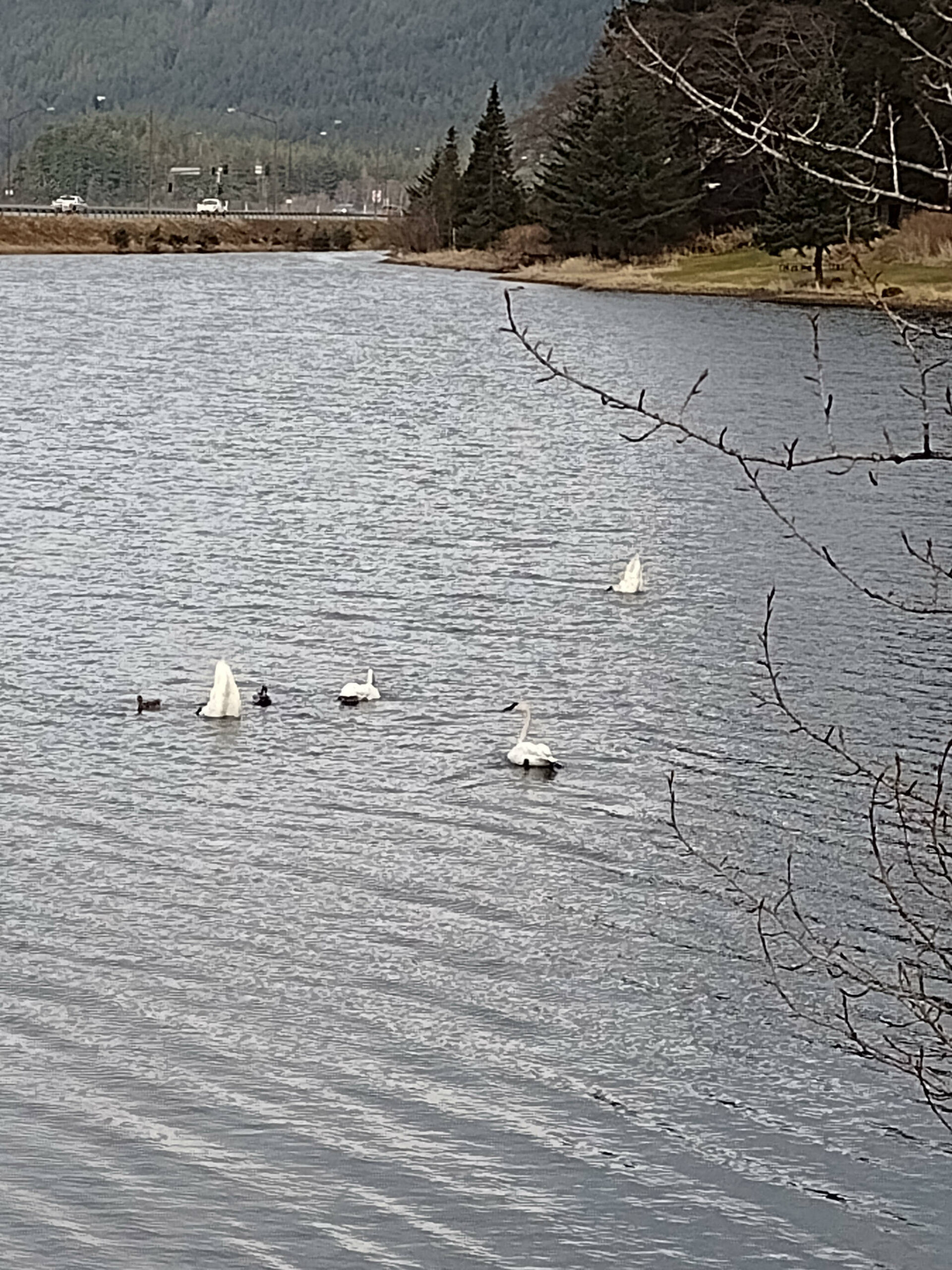
Swans stopped to forage at Twin Lakes on their way north. (Photo by SP Stanway)
Another sign of spring was enjoyed by some folks who reported swans on Twin Lakes — early migrants on their way north to nesting grounds. They may have moved on in a day or two; when I looked there was ice over the ponds again and no swans visible. But a couple of days later, swans were back on the lake again. They came and went for a while, foraging on the weeds in the pond and going some other local place else periodically.
We then had to tolerate a series of snow squalls that left an inch or more of white stuff on the ground. But it disappeared quickly. Another walk in a cold breeze on the dike trail found a robin and two ravens that were very busy at the side of the trail. As we watched from about 50 yards away, both ravens were assiduously plucking old, brown grass blades, discarding one selection and then gathering another. One of them accumulated a huge bundle that nearly covered its face. We hoped they’d fly to a tree where they probably had a sturdy bowl of sticks and twigs awaiting some lining material. But no…they both flew out to a log in the meadow and spent a considerable time sorting through their collections. Was this just a practice run? Or could those clever birds have noted our watchfulness and decided to look like they were just frazzing around, while not showing us where a nest might be?
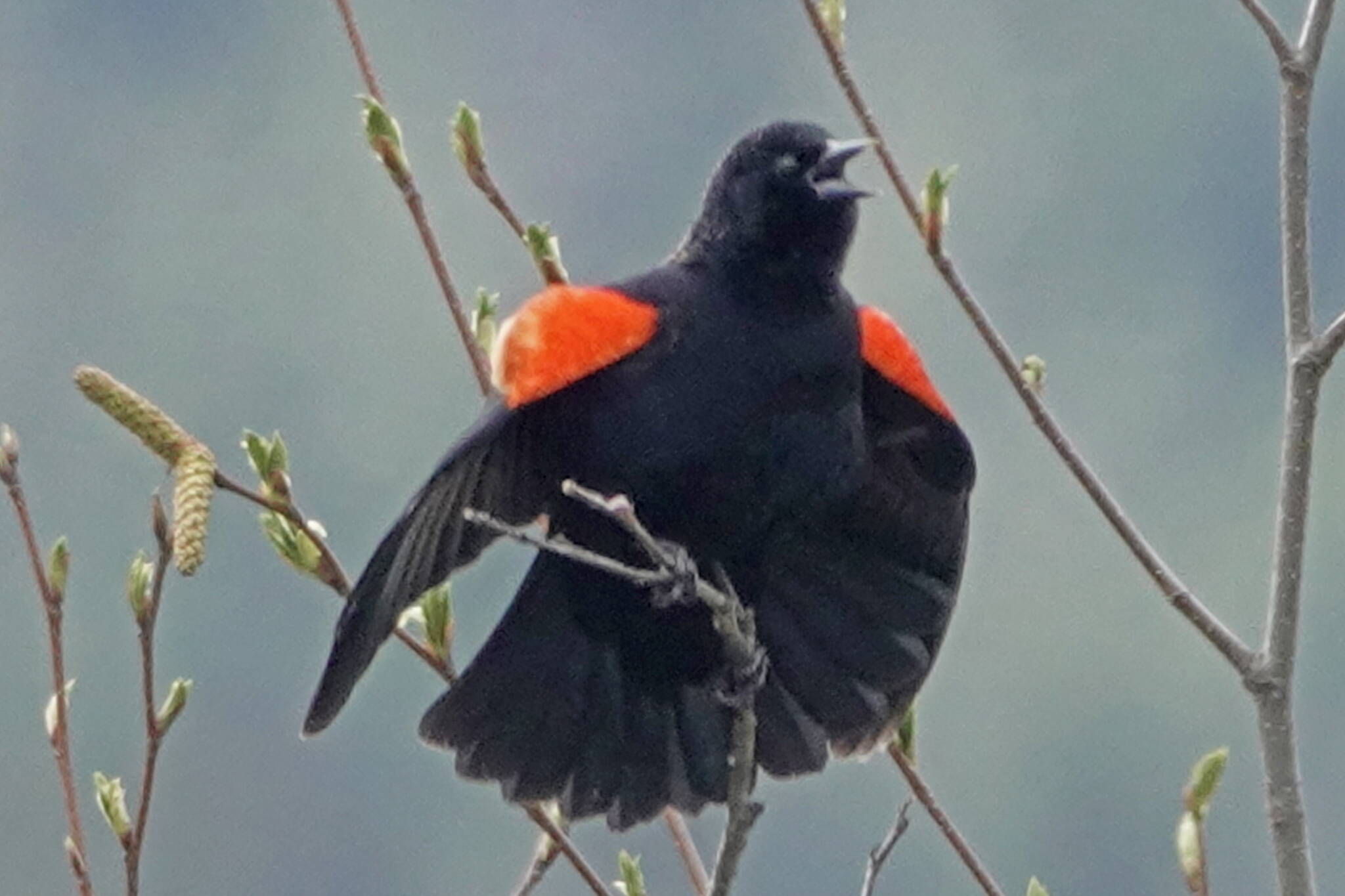
Then, on a typical pseudospring day, heavy rain alternating with sunshine and with scattered raindrops, near a friend’s house on Mountainside, I heard a familiar call, in fact a loud chorus. Could it be blackbirds? I saw several brown birds, too big for sparrows, deep in the brush. Maybe females? And in the treetops, a whole gang of dark birds, with tails too long to be starlings. After a little while, I finally saw a flash of red and yellow epaulets (so-called, although it’s the elbow not the shoulder). Yes! Red-winged blackbirds for sure, trilling as if they were really excited about something. I was told that they come there to feed on birdseed that someone makes available. The ponds are still frozen, so they’ll have to wait to get settled.
The spring equinox is just past, and spring things are starting to happen!
• Mary F. Willson is a retired professor of ecology. “On The Trails” appears every Wednesday in the Juneau Empire.
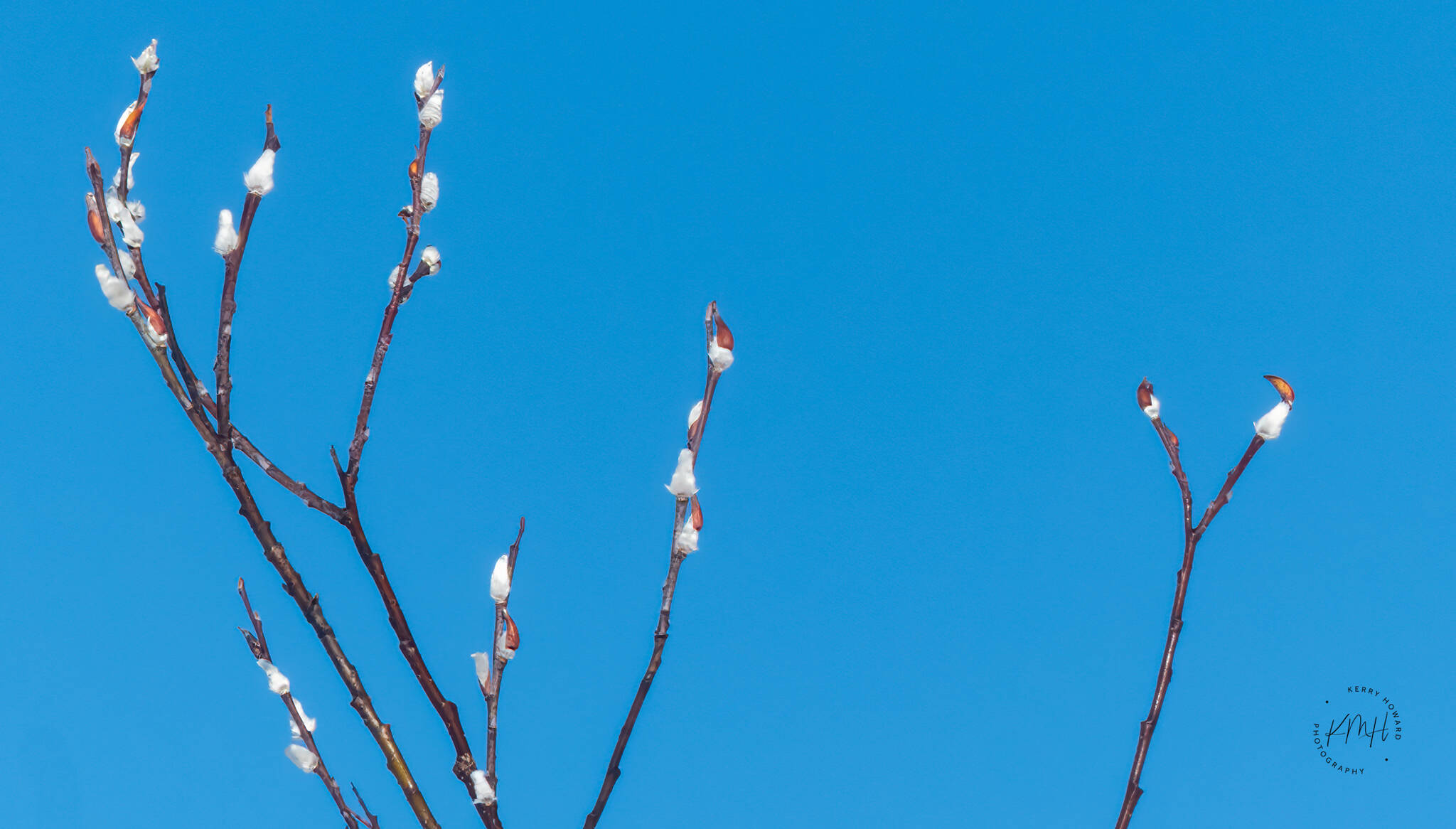
Feltleaf willow catkins are the earliest “pussywillows” to appear in spring. (Photo by Kerry Howard)
