
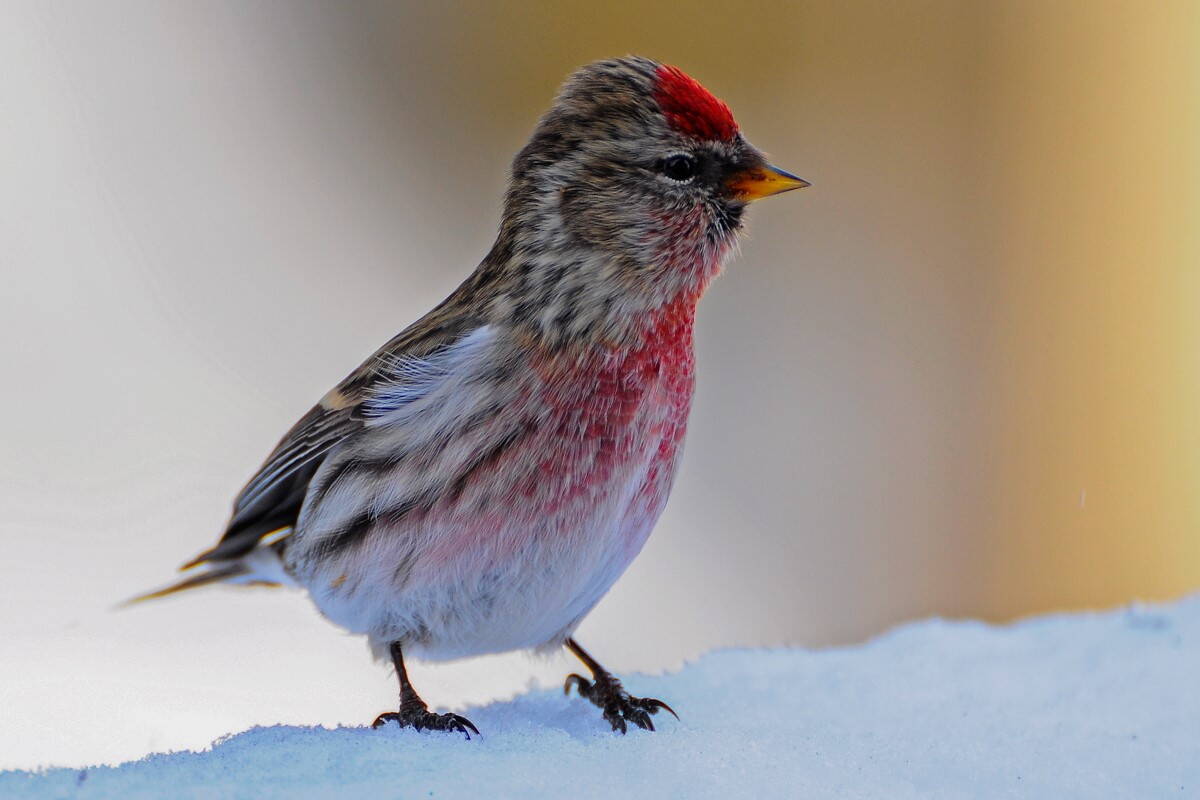
January brought us two massive snowfalls, piling up about six feet deep, and pretty much shutting down the whole city for a couple of days. The plows stacked up huge berms that afflicted visibility at intersections, as well as access to driveways, trailheads and mailboxes. Many of us just stayed home, shoveling decks and roofs, waiting to be plowed out. Then came a warm spell, and lots of snow melted, big trucks carted off some of the berms to a snow-dump, and at the end of the month, more snow fell.
That month also saw a huge influx of redpolls, flocking hither and yon, from Douglas to places out the road. My seed feeders had 30 or more in regular attendance, and they were noted all around town, visiting feeders and scavenging fallen alder seeds. White-winged crossbills were here too, seen and heard in many places.
One day as I drove from the Valley toward downtown, I saw an unusual aggregation of eagles in the wet, grassy meadow between Lemon Creek and Vanderbilt…There must have been 30 or 40 of them, down in the grass and perched on stumps. There was a good high tide just then, and I wondered if the tide had brought some tasty little prey into the wet meadow. I’m told that DIPAC released its annual crop of young chum salmon earlier than usual, so there might have been tiny salmon fry in there, but would eagles go for such small prey? The next day, on a low tide, there were still over a dozen eagles down in that meadow. That’s all in addition to the usual lineup of eagles in the tops of conifers next to the dump.
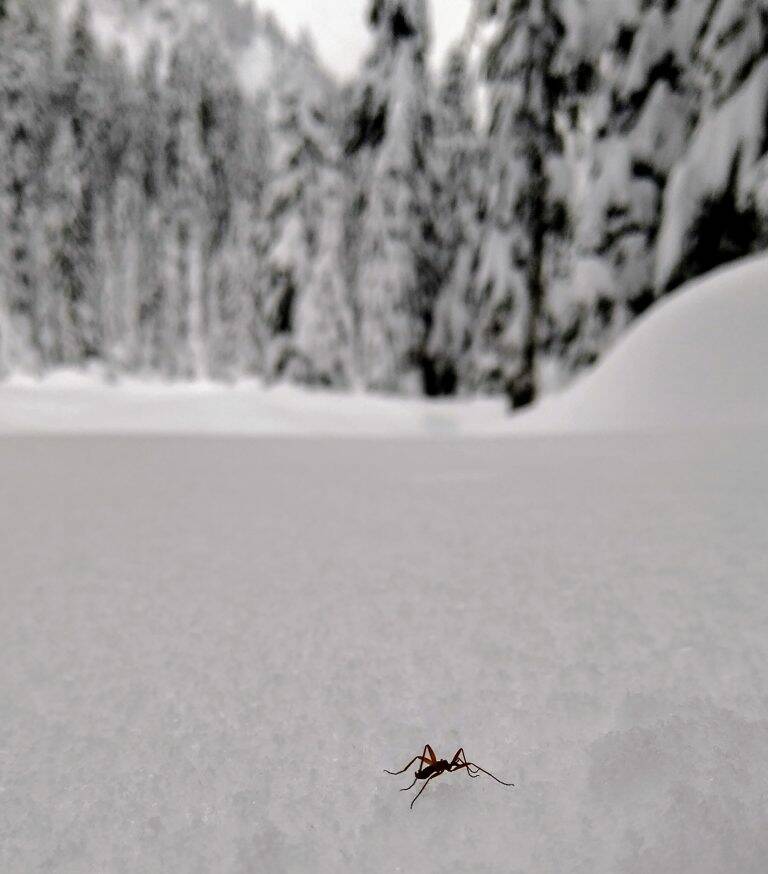
A snow fly wanders on fresh snowfall near the Mt. Baker region in Washington state. (University of Washington photo)
Then a friend called my attention to a recently published article about a strange little crane fly. They are not the usual sort of crane fly, but have been classified in a separate subfamily and, indeed, are sometimes assigned to a different but closely related taxonomic family. There are over 30 species of these, known as snow flies (genus Chionea), distributed in the northern hemisphere. They are wingless, unlike most crane flies, and adults are typically seen walking on the snow in winter. That seems to be the mating season, when they wander over the snow looking for mates. Why would they use that season? They are not feeding then, but predators are probably fewer than in warmer times. The females are presumed to lay their eggs down under the snow in the debris and leaf litter, but that part of the life cycle has not been reported, apparently.
But winter can be dangerous in other ways. Most insects (including typical crane flies) become paralyzed when temperatures drop below freezing, and there is also the risk of their body fluids freezing, which is typically lethal. But snow flies are able to remain active at temperatures down to minus seven or more degrees centigrade, well below the temperatures at which other crane flies become paralyzed. But below that limit, they freeze to death due to internal ice formation. Before reaching that limit, they are “supercooled,” their small volumes of fluids remaining liquid because they contain no particles that serve as nuclei for ice crystals to form. That’s a feature found in many small insects, most of which are inactivated at lower temperatures, but somehow snow flies can maintain normal locomotor activity right down to the lethal freezing point. That may allow them to seek shelter in snow burrows at times and continue mate-searching for longer periods.
They have another unusual feature too. If a leg starts to freeze, they can self-amputate it before the freezing spreads fatally to the rest of the body. Detaching a leg takes only two or three seconds, sometimes less; when successful, detachment happens before the fast-moving wave of ice reaches the site of amputation. In experimental situations, snow flies that self-amputated a leg survived at lower temperatures and for longer times.
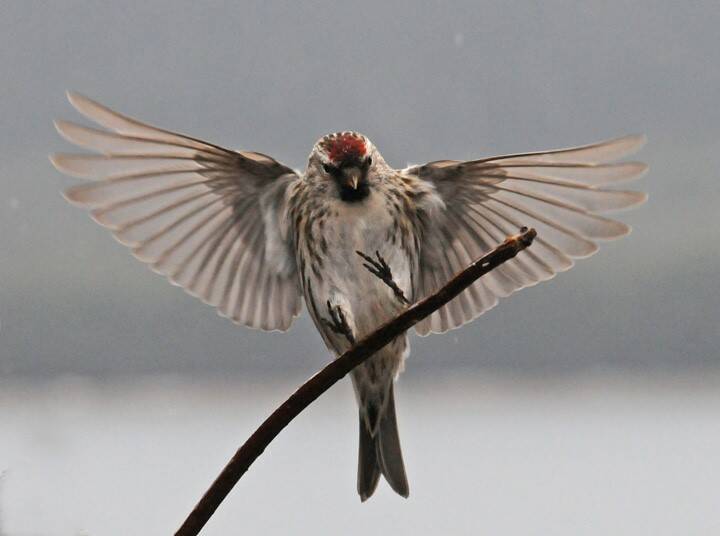
A redpoll comes in to land at a feeding station in Juneau. (Photo by Bob Armstrong)
What happens if more than one leg is amputated? Apparently, wild-roaming snow flies have been observed with only three legs left, but I suspect that even fewer legs could be just as lethal as freezing. And if walking is impaired for flies with only three or four legs, it seems likely that mating opportunities would be reduced. So self-amputation might work best when it doesn’t go too far…
Self-amputation is well-known in typical craneflies, as well as some other insects and some spiders and their relatives, but in those species, it occurs when a leg becomes stuck somewhere or is grabbed by a predator. Snow flies’ ability to cut off a leg when it starts to freeze appears to be unique.
Snow flies have not yet been recorded for Alaska, but there are records from just over the border in Canada. So it would be surprising if they are not here. Local natural history buffs that are active in winter might be on the lookout for them — and put the record on iNaturalist or send a specimen to a museum.
Thanks to Derek Sikes UAF and JJ (Vollenweider) Page NOAA for helpful consultations.
• Mary F. Willson is a retired professor of ecology. “On The Trails” appears every Wednesday in the Juneau Empire.
