
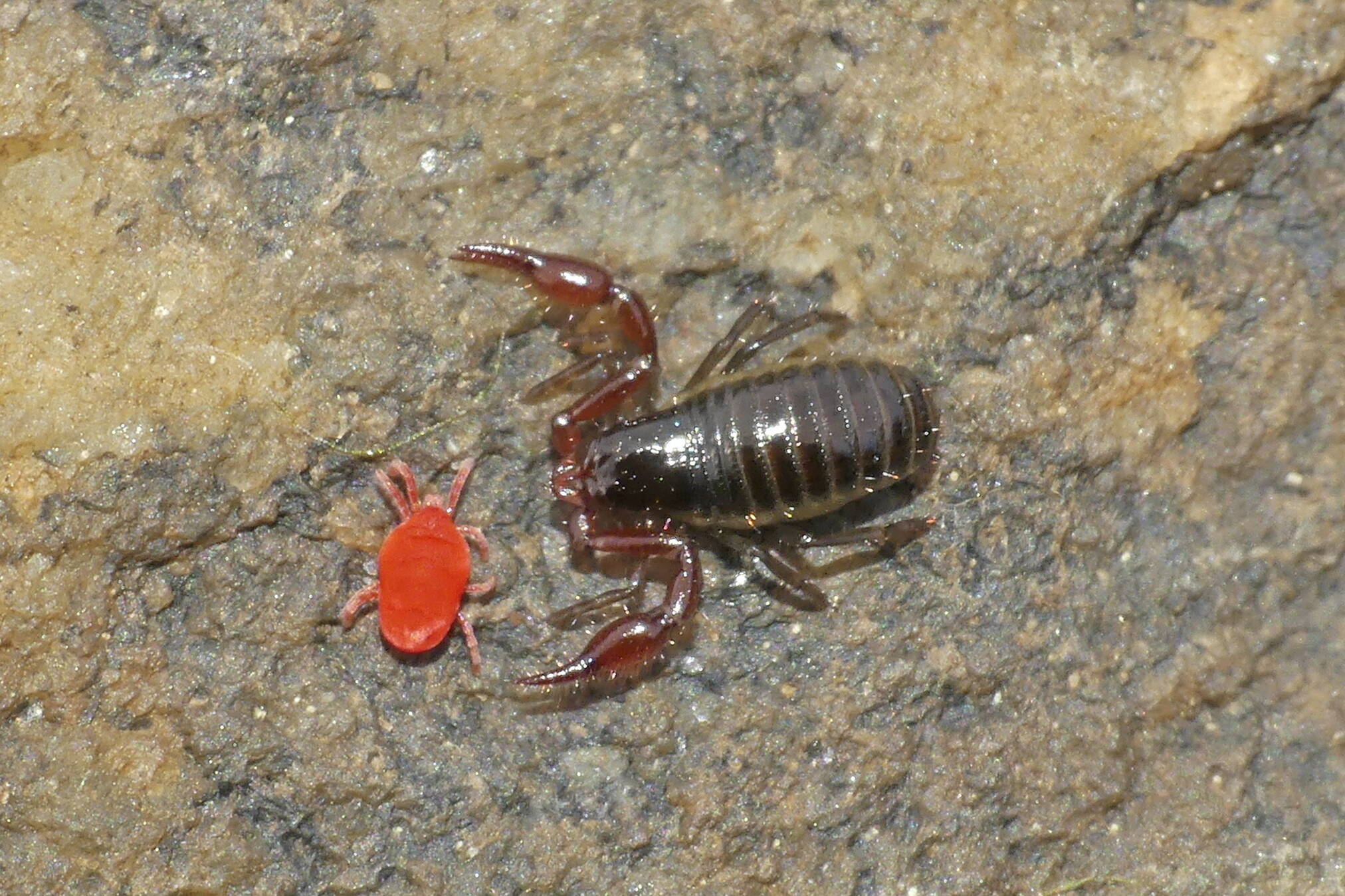
Just before the spring equinox, a friend and I went out on the Fish Creek Trail one morning on a low tide. We saw five or six kinds of ducks and heard some corvid-like squawking from invisible birds in the conifers at the point that the Merlin app said were magpies. The object of this little trip, however, was the intertidal zone: just where cobbles give way gradually to sand. There, scattered rocks are slightly embedded and often surrounded by bits of rockweed.
The first rocks my friend gently turned over yielded our prize: pseudoscorpions. They clung to the underside of the rock; more may have still been down on the sand, undetectable. Pseudoscorpions are small relatives of spiders, mites, and true scorpions, classified as Arachnids. They comprise a very old group of invertebrates — they have been around for almost 400 million years. There are over 3,000 species of them, found all over the world in many kinds of habitats, including human habitations. The species that occurs here is Halobisium occidentale, which ranges from Alaska south to California, chiefly in intertidal zones, but also in some inland places (according to the distribution map).
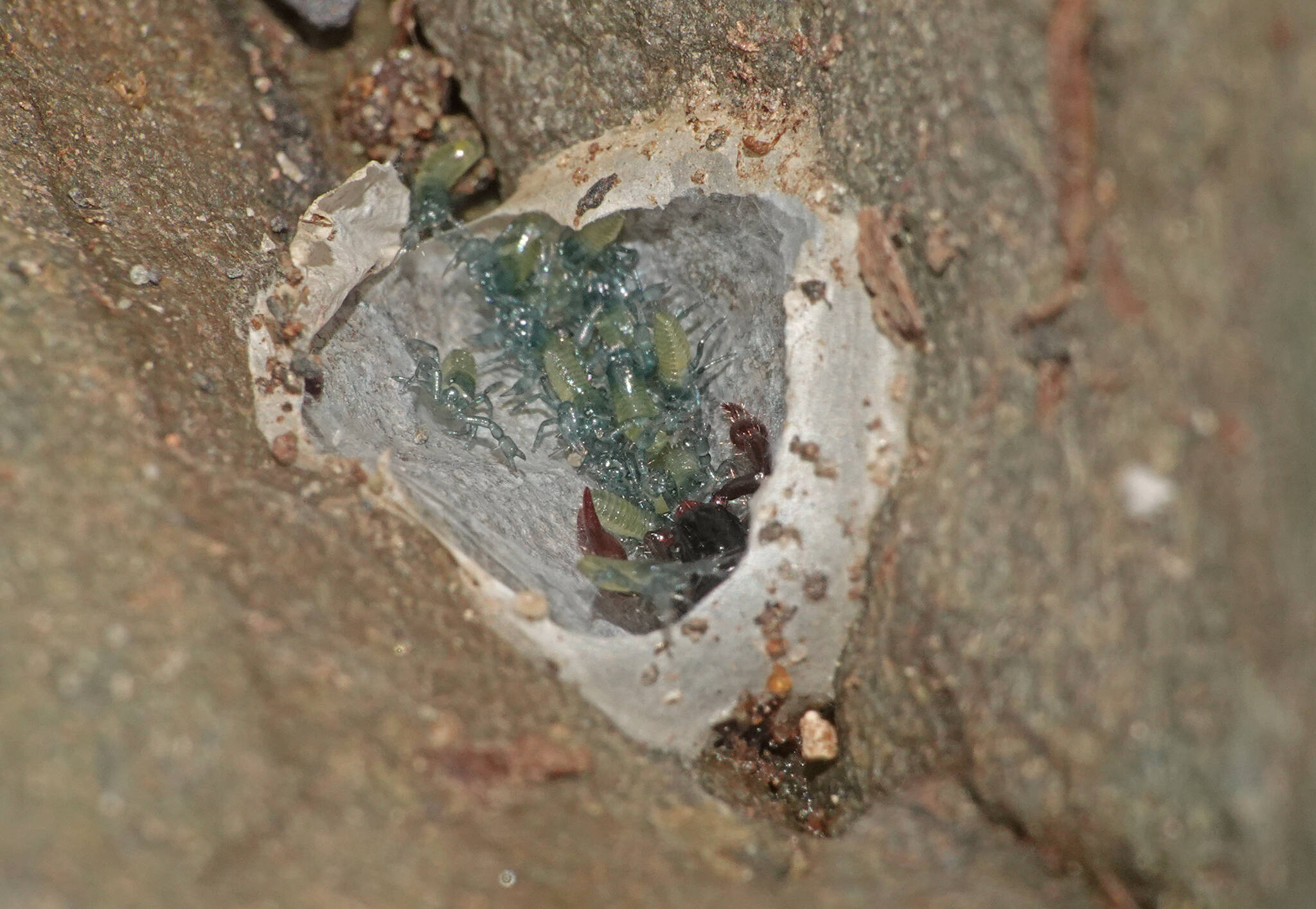
A female pseudoscorpion guards her young in a cocoon. (Photo by Bob Armstrong)
Pseudoscorpions resemble true scorpions (hence their name), but they lack the long tail with a stinger at the end. And they are very small, mostly less than a centimeter in length. At the front end of the body, they have a pair of pedipalps that bear pincers used in prey capture. In many species, those pincers produce venom that helps subdue prey. Humans don’t have to worry about being bitten by those pincers — they are too small. But the pincers work nicely for the capture of springtails, mites, and other small invertebrates. Pseudoscorpions breathe air, using a network of tubules called tracheae that reach from spiracles on the outside to the internal parts. I am guessing that our species emerges from under the rocks when the tide is out, to forage among the rockweed fronds, debris, and so on. Their known predators are mainly spiders and harvestmen (daddy-long-legs).
The life cycle often takes several years to complete. A male makes a packet of sperm and entices a female to it, in some species using an elaborate mating dance. (Regrettably, no info for our local species). She takes up the packet and puts it in a brood pouch on her abdomen; the sperm reach her eggs and she carries a pouch full of a dozen or more fertilized eggs on her abdomen for about three weeks. When the young hatch, they may ride on the female’s back for some time. They grow and molt three times during the next several years, changing in size but not much in appearance. Some species build tiny silken igloos for shelter during the molting process. Then they become fully adult — sexually mature, ready to mate. Adults may live two or three years.
Under the intertidal rocks, they make cocoons, often with a silken lining, which are shelters used for resting and molting, for females protecting their broods, and for overwintering places. Pseudoscorpions can hold their breath for many hours and even days, while they are sheltering in their cocoons. Activity may be reduced in winter.
Thanks to Bob Armstrong for photos and helpful consultation.
• Mary F. Willson is a retired professor of ecology. “On The Trails” appears every Wednesday in the Juneau Empire.
