
I went on the Audubon cruise to Berners Bay in May, on a drizzly, breezy day. On the outbound trip, we enjoyed some of the usual sightings: oyster catchers on a reef, marbled murrelets, pigeon guillemots, lots of scoters, gulls including Bonaparte’s gull, some seals and sea lions, and so on. Of course we stopped at Benjamin Island to view the sea lion haulout, crowded with (mostly) females and juveniles. In between sightings, I had a bit of fun watching the raindrops run down the front window — almost never in a straight line. The course of a drop was usually full of little zigzags, sometimes capturing another drop on the way, other times for no obvious reason.
Several rivers feed into Berners Bay. Years ago, my field crew and I studied the eulachon (a.k.a. hooligan) spawning run there. Eulachon are extremely rich in fats and predators thronged in huge numbers to feast at the spring migration into the rivers. The size of the spawning run varies from year to year, and sometimes spawners may try new rivers. So the predators need to be on the look-out for changes. Most eulachon die after spawning, as salmon usually do too.
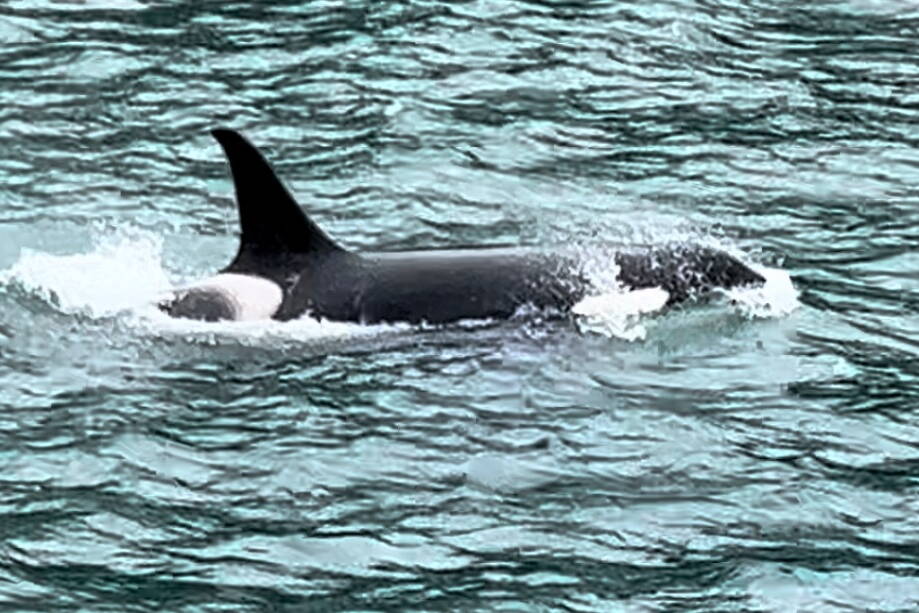
On the way back, things got even more very pleasing. There were humpback whales breaching repeatedly just ahead of us and more of them cruising quietly close to shore. Our boat was escorted by a pod of orcas, spread out on both sides of us. I have no idea how many there were, because each of them came up for air on its own schedule. We were all going in the same direction, so they were with us (or we were with them?) for some time. We assumed that these were the fish-eating type of orca, not the mammal-eaters, because they were spaced so far apart. A Dall’s porpoise came alongside the boat and, as they often do, swam in our wake, possibly sheltering from the orcas, just in case. Captain Dan did a fine job making sure that our boat behaved circumspectly and politely as we “swam” with the orcas.
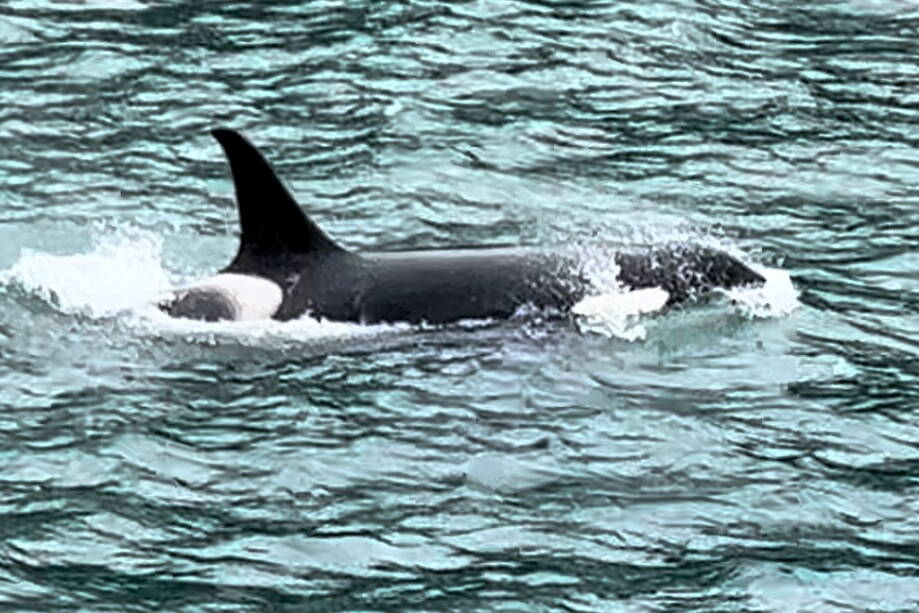
An orca swims beside a boat near Berners Bay on May 12. (Photo by Eric Jorgensen)
A walk with a friend on the Outer Point Trail was also productive, in its own way. A little flock of red-breasted mergansers cruised by, diving occasionally. One of them was in good male plumage and the other six seemed to be females — but no, at least one of them was a male, just molting into his mature plumage. We got good looks at Townsend’s warblers and hermit thrushes and heard them singing — the hermits doing lots of vocal variations.
Just above the beach, there is an old root-wad that supports a profusion of young trees. We’ve all seen nurse logs with some little hemlocks getting started on them. This “nurse” held a real thicket of small trees: there were at least 40 little spruces of various sizes and maybe about 10 hemlocks. A great start for them, but the competition among them must be fierce and few will survive.
Yellow-rumped warblers have seemed to be everywhere lately, foraging in small flocks. When not inspecting the new leaves on the shrubs, they zip out over ponds and go flycatching. Most of these will move on to their nesting grounds, but some will stay. To my surprise, some yellow-rumps even visited my suet feeder.
On my home pond, mallards were progressing thorough the usual demographic pattern: early in the season, numerous males and females congregated, feeding and getting acquainted. Then the females almost disappeared as they began tending eggs. So now, the pond is occupied mostly by males, as many as 10 or 12 of them, hanging out together quite amicably.
Occasionally a female arrives and is immediately claimed by a male who is now very hostile to his former buddies (they will be buddies again, after she leaves). The pair keeps company with each other for some time, feeding and resting side by side. Such a female has clearly lost her first clutch and is in process of replacing it; it is not clear how she decides which male to accept.
Mallard nests are very vulnerable and it’s not uncommon for whole clutches to be lost to dogs or ravens or mink or whatever. If these replacement clutches are successful, there will be some late broods of little ducks. But for now, the first successful broods of ducklings are beginning to appear.
Just as I came home one day, my neighbor came over and directed my attention to some movement in the brush. Presently, a female mallard emerged, followed by a tight string of eight or nine tiny ducklings. All of them ran quickly across the road and we hoped they’d soon find another pond for relative safety.
• Mary F. Willson is a retired professor of ecology. “On The Trails” appears every Wednesday in the Juneau Empire.

A humpback whale breaches right ahead of a boat north of Juneau on May 12. (Photo by Bob Armstrong)
