
I like to live where there are seasonal changes in weather and natural history activity, but sometimes those changes, including the most recent conditions, just create boredom and wistfulness. The days are getting very short, of course, and they have also been mostly gray and drippy. Furthermore, recent walks haven’t turned up much of natural-history interest (although there were a few friendly dogs to greet). For instance, one walk on the dike trail yielded only one lady bufflehead, and a few days later there was a single bemused-looking song sparrow just standing in the trail for long minutes. Nothing to disturb the mental torpor.
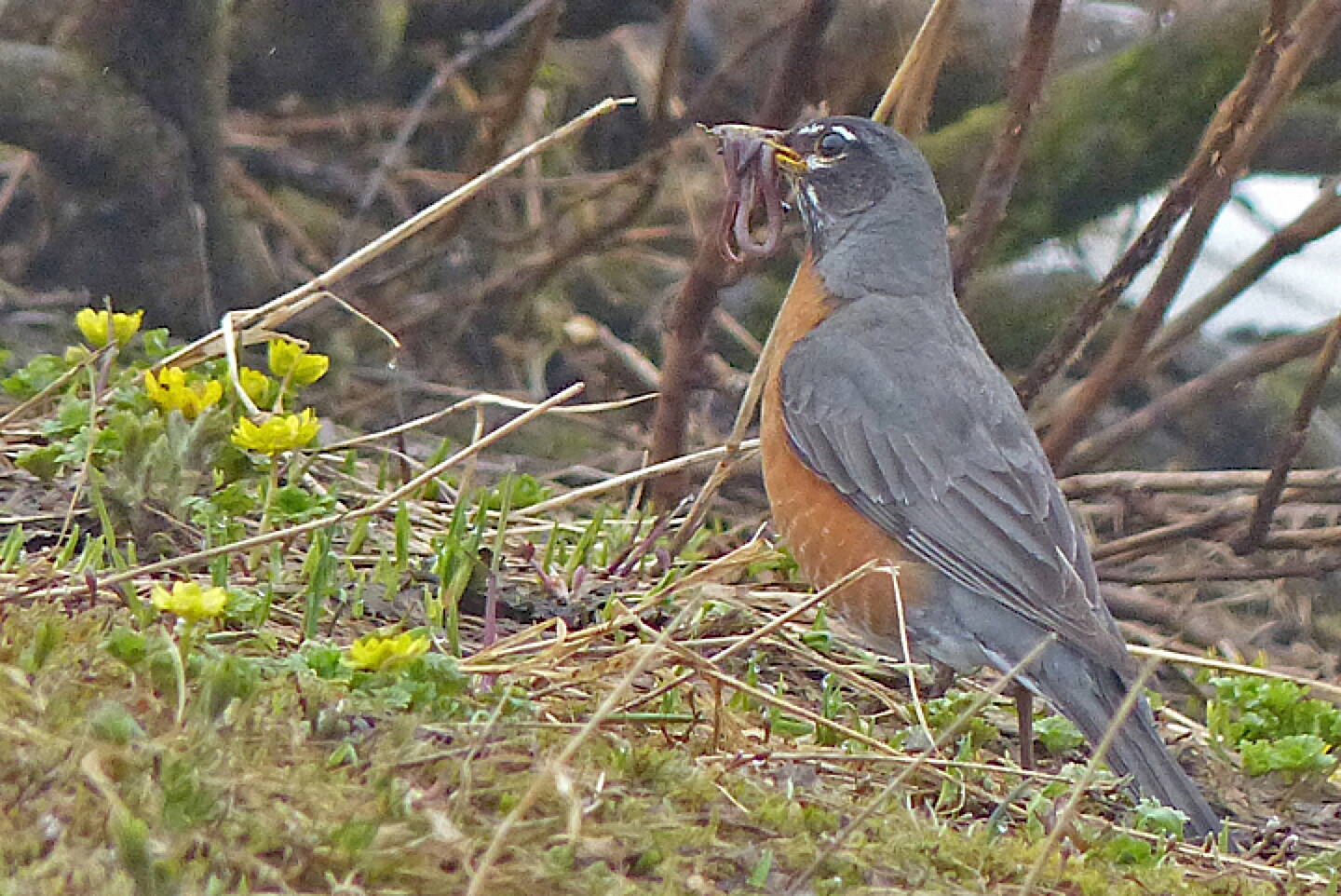
I needed something more cheerful to write about, and an image of a robin popped into the vacant space in my head. Out of season, yes, and often disregarded as just commonplace and ho-hum, but robins are remarkably successful at co-existing with lots of humans on the landscape. Part of that success is probably related to their favored nesting habitats, where trees and shrubs occur next to grassy areas, which is often a feature of human-occupied areas. Their short song is cheery; it almost says “cheer-up.”
So here’s a bit about robins: American robins are thrushes, classified in the taxonomic family that includes (in North America) varied thrushes, hermit thrushes, Swainson’s thrushes, bluebirds, and solitaires. It’s a cosmopolitan family with about 175 species. The European robin is not classified in this family. However, the red breast of that much smaller species is probably why European settlers called our red-breasted thrush a robin, despite the lack of any other similarity. For present purposes, I will use the word “robin” to refer just to the American robin.
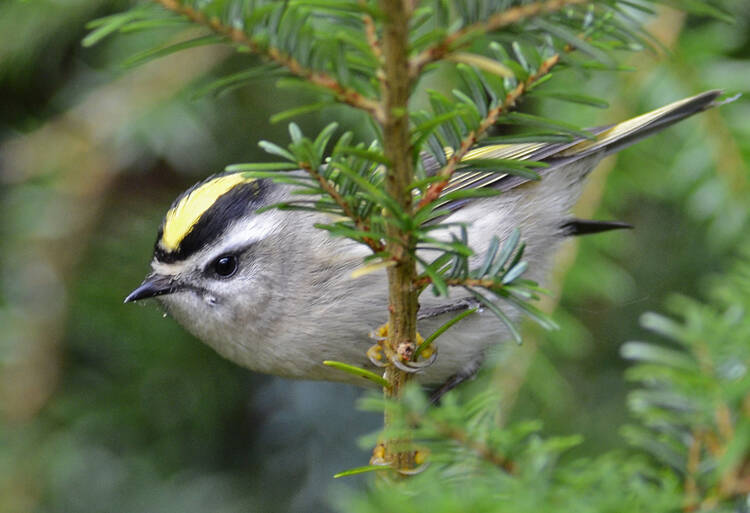
A female golden-crowned kinglet searches for insects in confer foliage. (Photo by Mark Schwann)
Robins eat a varied diet that includes insects, worms, and fruits. They nab bugs off foliage and tear up moss carpets looking for whatever might be there. But they are best known as worm-eaters. We see them as they tug long worms out of the soil, sometimes engaging in extended tugs-of-war with a tenacious worm, or carrying a fat gobbet of worm to feed some chicks. How do they find earthworms? Sometimes it’s easy…worms can be driven to the surface by excessive soil moisture, for example, where they can be picked up whenever the bird sees them. More often, robins have to detect worms hidden in the soil. Their run-and-stop mode of hunting gives them opportunity to check out possible worm locations at every stop. They can do this visually, looking for tiny movements of the soil, and they can also do it acoustically, listening for worms rubbing and pushing soil particles. There is also a possibility that they locate worms by detecting soil vibrations, but this remains to be well-documented.
Robins are important agents of seed dispersal, particularly in late summer and fall, when many fruit-bearing plants ripen their crops. Elderberry, blueberry, salmonberry, crowberry, and other small fruits are swallowed, the pulp digested, and the small seeds excreted somewhere away from the parent plants. Sometimes robins raid a cherry tree in someone’s garden, swallowing the fruit but regurgitating the big seed, probably not as far from the parent as the smaller seeds. Experiments have commonly found that individual robins often vary in their preferences for fruit colors and other fruit traits.
Nests can be placed anywhere from the ground to a treetop or the top of a stump or a roof, but they are commonly saddled on a tree branch several meters above the ground. Females pick the site and do the construction, gathering grasses and stems and lots of mud. The outside layer is made of dry grass and small twigs and maybe moss, then comes a layer of mud, and a lining is usually made of fine, dead grasses. The use of so much mud is interesting and not common; our other local thrushes don’t do that, but some Eurasian species may do so. I have to ask why some do and some don’t…
There are usually three or four eggs in a clutch, incubated by the female for 10 to 12 days, and they do not all hatch on the same day. Lots of nests fail, often because of egg predation by jays or squirrels and other small mammals, among others, and re-nesting then occurs. Females also brood very young chicks, and both parents feed chicks. Eggs are various shades of bright blue, and the vividness of the blue on an eggshell is reported to influence the parental attentiveness of the male when he comes to feed the first-hatched chicks when they are still very young. Researchers have wondered why that would be so, but the Why still lacks definitive answers.
Chicks fledge when they are about 13 days old, but they can’t fly well nor fend for themselves and parents continue to feed them for about two weeks. Second broods are common, females starting a second clutch before the first brood is independent, and males taking over the care of fledglings. Robins become sexually mature in their second year after hatching. They seldom live longer than a few years but occasionally survive for over 10 years.
Robins nest all across North America and most of the breeding population of Canada and Alaska migrates south for the winter, chiefly to southern parts of the continent. Southeast Alaska is recorded as having year-round robins, but moving flocks may raid a berry patch in someone’s garden and we often see what I think are migrating flocks along our beaches. Occasionally, robins stray to the Caribbean islands and even to Iceland and Europe.
Despite their sensitivity to DDT and other pesticides, which can be concentrated in their earthworm prey, robin populations seem to be doing quite well. Cheering news!
Some days later, I tried the dike trail again, and again on a drippy, gray, breezy day. But this time, I found a flock of buffleheads, a big flock of juncos, a small flock of chickadees, and — lo and behold — two golden-crowned kinglets foraging right next to the ground, pecking at very small bugs, far away from their usual haunts in the tree crowns. Nothing wildly unusual, but a major improvement over those previous visits.
• Mary F. Willson is a retired professor of ecology. “On The Trails” appears every Wednesday in the Juneau Empire.
