
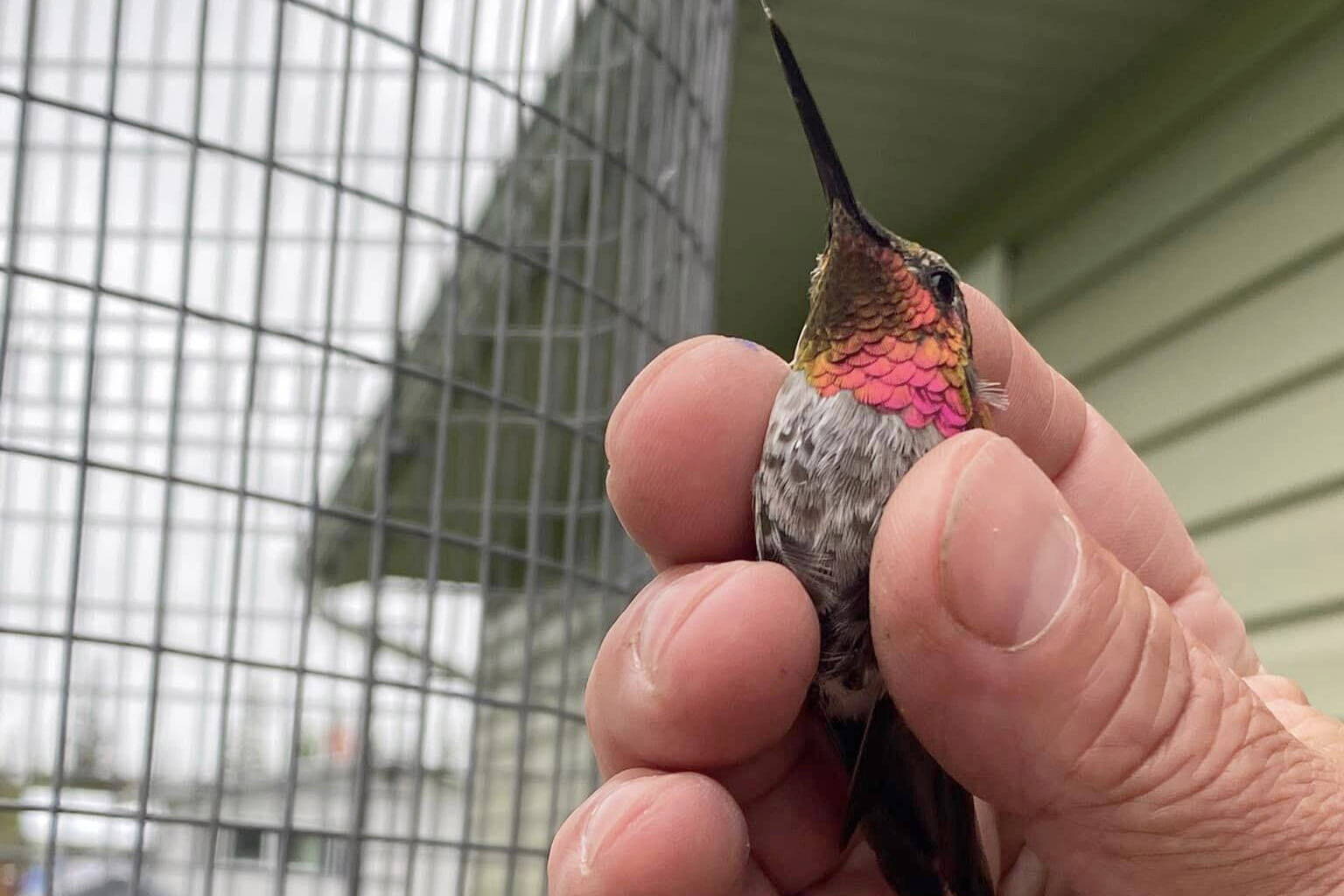
Nectar is a rich, sugary food source used by plants to attract pollinators, and many animals exploit that resource, including lots of birds. The sugary contents of hummingbird feeders even draw opportunists, including finches and woodpeckers, that generally do not visit flowers. And many kinds of birds take an occasional sip of nectar, as part of a mixed diet.
There are three large avian families that focus on nectar feeding (note: the exact number of species in these taxonomic families varies among taxonomists). The birds in these families have digestive systems that can easily deal with the form of sugar (sucrose) in nectar, but it seems that occasional nectar-feeders do not usually have the right enzymes to break down sucrose very well. Nectarivores often eat insects too, to get some much-needed protein, and sometimes fruit.
The family best known to us is that of the hummingbirds, which are related to swifts and are only very distantly related to the other two families, which are passerines or songbirds.
Hummingbirds (Trochilidae) inhabit North and South America. There are over 350 species, ranging in size from the tiny bee-hummingbird of Cuba, weighing about two grams (the smallest warm-blooded vertebrate known), to the giant hummingbird of the Andes, weighing about 20 grams or a bit more. Hummingbirds are known for their ability to hover for extended times, out in the open air while waiting for access to a feeder or right in front of a flower while the bill probes into the flower for nectar. Their tongues are deeply grooved, with little flaps and fine fringes (called lamellae) along the sides of the tongue tip. They were long thought to work by capillary action, the fluids moving up the tongue grooves by intermolecular forces.
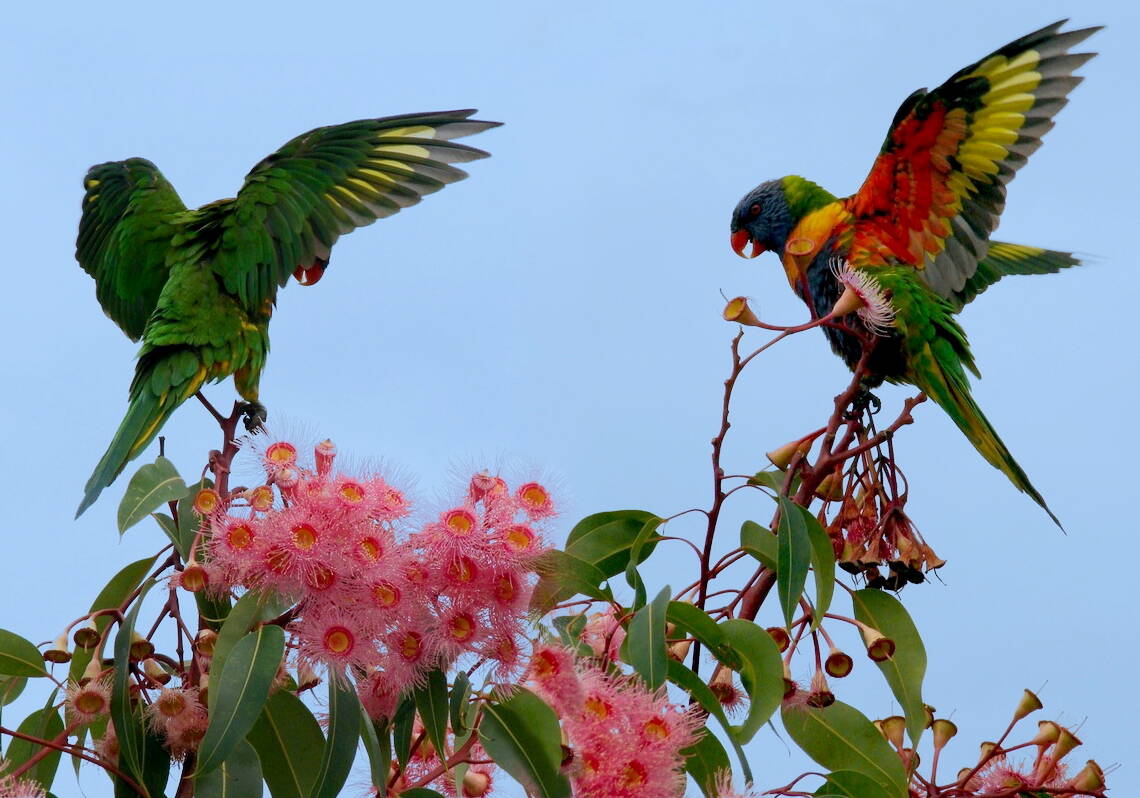
Rainbow lorikeets in Brisbane, Australia. (Photo by Tatiana Gerus, republished under a Creative Commons license)
More recently, research has shown that this is not likely to be correct. Instead, when the tongue is extended into the fluid, the flaps and lamellae unfurl and capture fluid; as the tongue is withdrawn, the fluid is somehow off-loaded by as-yet-undescribed means. Because hummers often repeatedly extend and retract their tongues while feeding, one suggestion is that tongue-extension (compressing the lamellae) through a tightly closed bill tip might push the fluid back up through the bill.
In short, the act of drawing up nectar may not be just a result of passive intermolecular forces but instead involve some muscular activity, with the flicking of the tongue. The physics of all this gets complex and the details remain to be worked out.
There are so many species of hummers that it is not surprising to find a variety of foraging patterns: some repeatedly visit a sequence of flowers in a set pattern called trap-lining; some defend a patch of flowers as a temporary territory. And there are a variety of bill shapes and sizes, often closely correlated with the size and shape of the flowers the birds visit: for example, the sword-billed hummingbird of the high Andes has a bill longer than its body length, so long it cannot preen its feathers with the bill but has to use its feet; it forages on flowers with very long corollas. Others have rather short, very curved bills that fit into certain kinds of flowers. In addition, some hummers have unusually sharp, serrated bills that seem to be used for fighting other hummers and may not be quite so good for feeding.
Another family (Nectariniidae) includes the sunbirds and their relatives called spider hunters; they live in Africa, southern Asia, Indonesia, and even reach northern Australia. There are over 140 species. Unlike the hummingbirds, they usually perch when feeding from flowers. Tongues commonly tubular or deeply grooved, with a brushy tip. The feeding mechanisms seem to be different from those of hummers, possibly involving capillary action and perhaps suction.
The third family with lots of nectar-feeders is known as honey-eaters (Meliphagidae) — a bit of a misnomer, because they don’t eat honey, they eat nectar (from which honey is made by bees). There are over 180 species, living in Australia, New Guinea, New Zealand, and some Pacific islands. They seldom hover, but perch and cling when nectar-feeding. Many have brush-tipped tongues. Feeding mechanics are reported to be similar to those of hummers, with rapid tongue flicks squeezing nectar up to the throat.
Several other lineages have regular nectar feeders. For example: Bananaquits live in Central and South America, with many subspecies reflecting local variation. Sugarbirds (two species) live in southern Africa, specializing on flowers of Protea. And there’s even a parrot, the rainbow lorikeet of Australia, that uses the tiny papillae on the tongue tip to harvest eucalyptus nectar; the bill sometimes crushes the flowers to make nectar more accessible. There are other, closely related lorikeets, that are likely to share these traits.
Some special issues are associated with nectar feeding: Nectar is mostly water, so a diet with lots of nectar means that lots of water must be excreted. Furthermore, nectar of some plants contains toxins, which can expose nectar feeders to those toxins. Some birds may simply avoid toxic nectars, but at least some sunbirds are reported to detoxify nectar containing the toxin nicotine, which occurs in the nectar of tobacco plants, flushing out the residues with the excess water. Clearly, more research on toxin tolerance in other nectarivores would be useful.
• Mary F. Willson is a retired professor of ecology. “On The Trails” appears every Wednesday in the Juneau Empire.
