

The sun came out! So it was a day for me and a friend to head to the Boy Scout Camp Trail, dodging rain puddles here and there. A tree swallow cavorted over the river, making long, graceful swoops. We heard Townsend’s warblers and an orange-crowned warbler, in addition to the more usual robins and varied thrushes. A pair of geese lounged along the bank, probably one of the resident pairs, but in the big meadow, many dozens more (possibly still migrating) were foraging busily. That meadow had been seriously worked over by geese that left their tracks, scats, and small digs where goose bills had grubbed up roots.
The flower season is coming here, just somewhat later here than close to town. Skunk cabbage, salmonberry, and some currants are going strong. On this walk, we also saw one chocolate lily in bloom, one lupine shoot just one open flower, and a single baneberry. Buttercups were everywhere, with their festive yellow; marsh marigolds had buds ready to burst. Shooting stars dotted the open areas, and there were patches of little blue violets and the big purple Alaska violets. Little star flowers and strawberry flowers added whites to the scene, and nagoons provided their dark pink hues. Twisted-stalk stems still held closed buds. I noted that the big Viburnum bush that resides at the edge of the meadow looked unwell, with several dead branches.
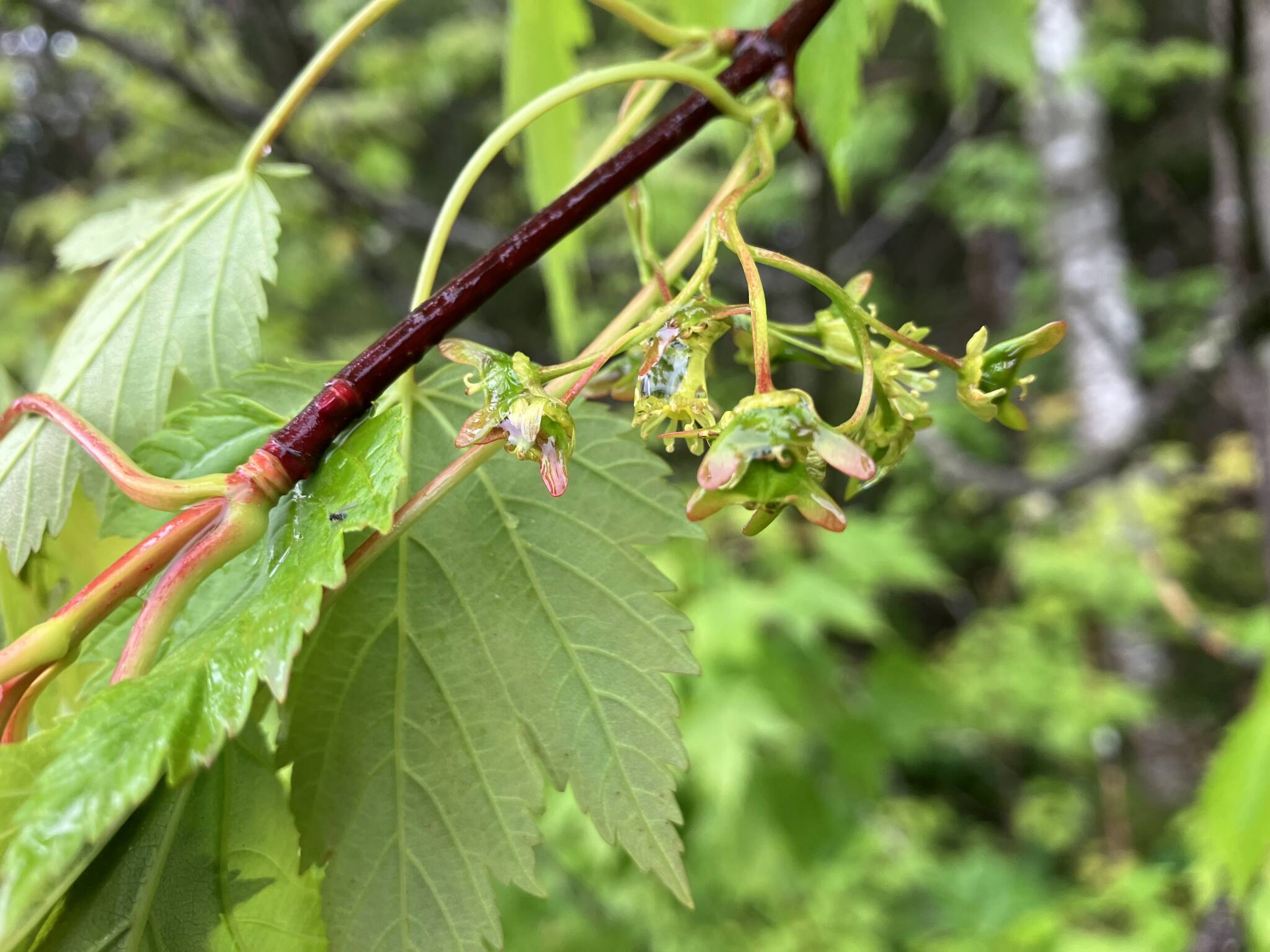
Young maple samaras are developing. (Photo by Mary F. Willson)
A big beach log provided a handy perch for a snack and a chance to meet a couple of friendly canines and their owners. Then back over the grassy rise to the meadow edge again.
And there we heard crows raising a ruckus — great distress, from the sound of it. Two crows were clearly protesting something, and I finally located the cause up in a spruce tree: A raven was ripping their nest to shreds, dropping bits of fluffy nest lining and fine nest material. There probably had been eggs or tiny chicks in the nest and they’d made a good snack for the raven. The crows yelled some more, dove at the raven, and flew off.
A stroll with a friend along the beaches of North Douglas, I noticed a little maple tree, whose leaves were three-lobed and sharply pointed. This is known here as Douglas maple, a species that ranges southward through the Rocky Mountains and the coast ranges, where it bears several other names. It is NOT vine maple, although sometimes called that; vine maple is a distinct species that does not occur as far north as Juneau. There are over 130 species of maple, mostly in Asia, and over a dozen species in North America, just one of which reaches Juneau.
These Douglas maples were flowering, bearing small clusters of flowers on fairly long stems. I’d never before inspected maple flowers and this was my chance to do so. Douglas maples are usually dioecious (having male and female flowers on separate individuals), but a few individuals may bear both male and female flowers. The flowers we inspected had no stamens and were female, with two tiny, thin projections in the middle of a greenish cuplike flower; those two little projections were, I think, the tips of wings developing on the seeds; they would grow bigger and the attached seeds would fill.
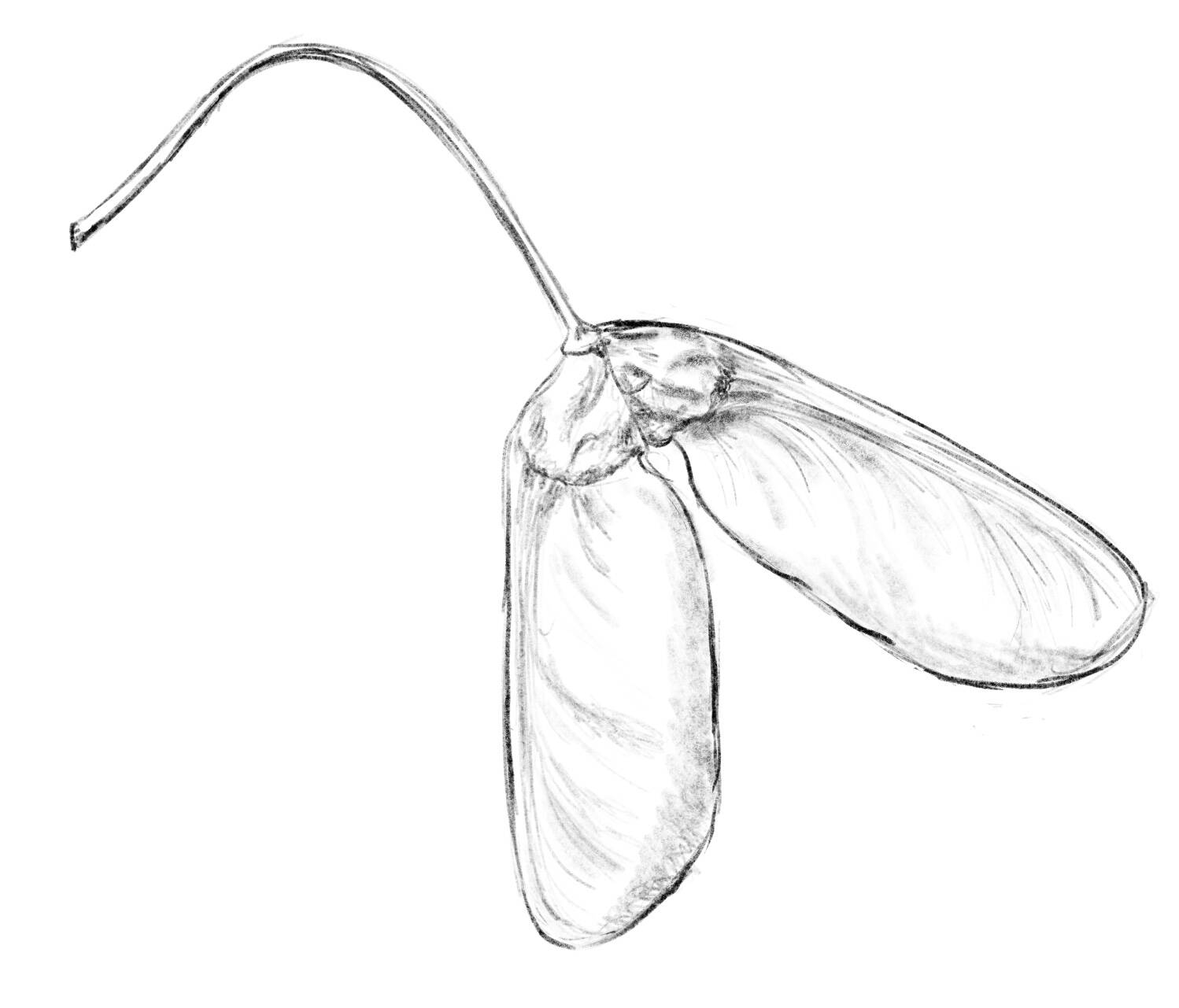
A sketch shows how two samaras will separate and the wings will help them disperse on the wind. (Illustration by K.M. Hocker)
Female maple flowers have two fused ovaries, each of which can hold one seed. The seed is surrounded by dry maternal tissue, so technically the unit is a fruit; the wing develops from maternal tissue. Two of those fruits are joined together, each with wing extended. At maturity, they separate to go twirling off in a breeze.
Each of the winged maple fruits is called a “samara,” a collective term for fruits with wings. Some other North American species bear samaras too. Ash trees have wind-dispersed samaras that are somewhat more symmetrical than those of maples. A little membranous wing of maternal tissue surrounds elm seeds, with various modifications in different species, and it is said that the word “samara” may derive from an old Celtic word for elm “seeds.” Each type of samara has its own aerodynamic characteristics. An asymmetrical wing has a leading edge that creates rotation, which somehow increases lift and the length of time the fruit can be airborne. (Note that the wind-dispersed seeds of conifers are not samaras, because they are not covered with maternal tissue and are not fruits.)
Finally, just for fun, here are some interesting and unusual things that I saw at my feeders one afternoon. On the suet block, a male hairy woodpecker hammered away on one side, while a yellow-rumped warbler picked at the other side. A female hairy woodpecker gobbled up peanut butter, then then clamped her feet on the underside of the hummingbird feeder and reached up around the red plastic flowers so she could slurp up lots of nectar. Fun!
• Mary F. Willson is a retired professor of ecology. “On The Trails” appears every Wednesday in the Juneau Empire.
