
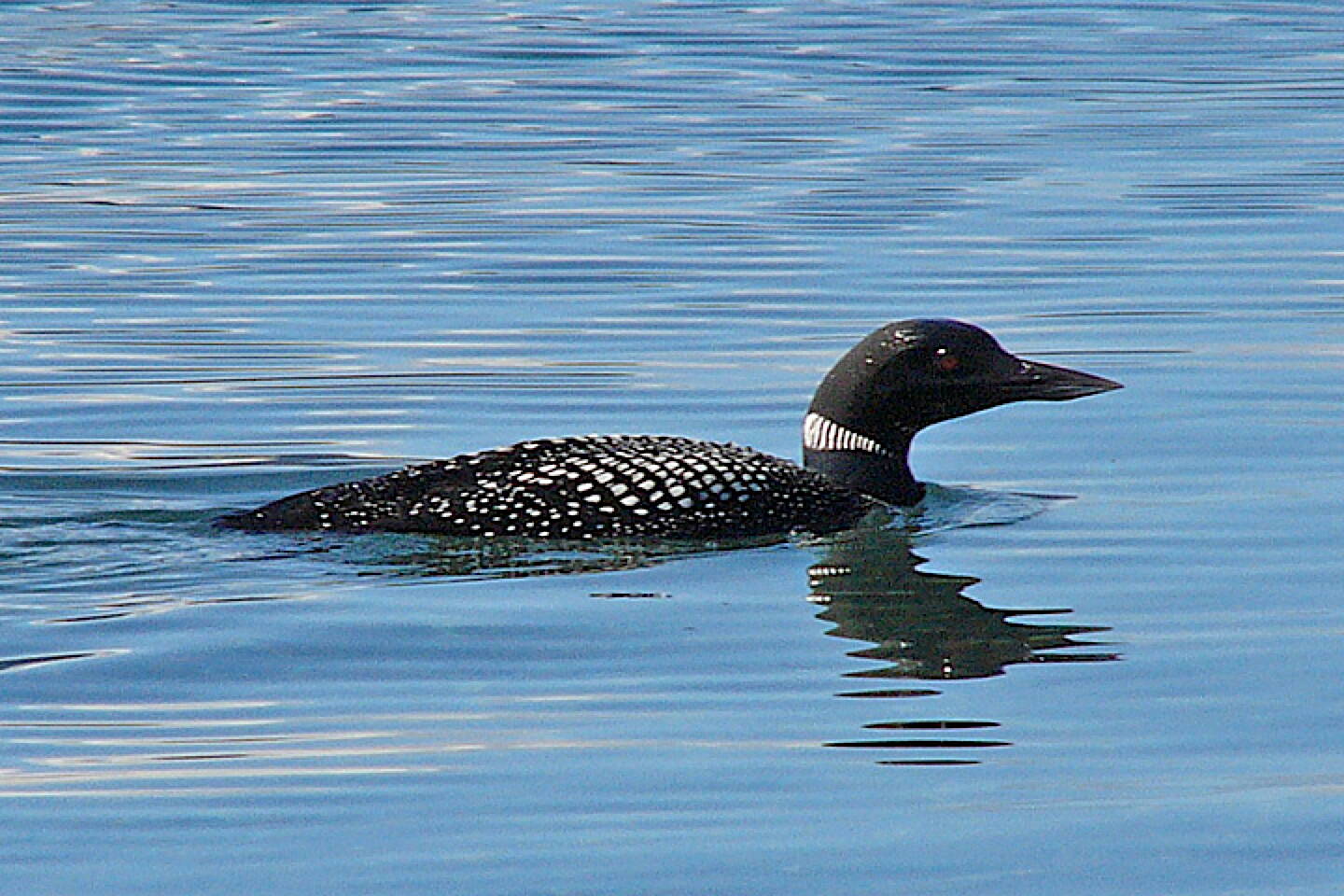
One misty day in mid-December, a friend and I walked the little Fish Creek Trail. At the side of the pond, a small gray bird was bobbing up and down on a gray rock — a dipper! A bit later, we saw it again, fossicking in the stream in the meadow. That was a treat. Then, as we walked the berm where the trail is flanked by prickery roses, we spotted two loons in the bay. I think they were common loons, an adult in winter plumage and a slightly paler one, perhaps a big juvenile.
Loons have been a favorite bird for years. As a kid growing up in Wisconsin, I often saw them and heard them on the northern lakes. Sometimes we’d see an adult with a chick or two riding on its back or tucked almost invisibly under a wing. Fun! Common loons were one of the first birds I learned to identify — along with red-headed woodpeckers and robins.
When I moved to Alaska, a few decades ago, I learned that there are five species of loon, all of them found in Alaska. Loons were long thought to be related to grebes, but genetic studies have revealed that they are more closely related to penguins and albatrosses.
Loons are built for swimming and diving. The big, webbed feet are set far back on the body, with much of the upper leg held within the body cavity. This arrangement is not good for walking on land because the center of mass is not directly over the feet. So if they need to move on land, they often slide on their bellies while pushing with the feet. In addition to the unusual leg arrangement, they have high wing-loading — small wing area but heavy bodies. They need a long, running takeoff to get airborne, up to 200 meters, unless there is a headwind.
Loons eat mostly fish, especially those that have a cylindrical shape and erratic swimming patterns. They also eat crabs and crayfish. Although they can dive to 60 meters and more, most dives are in shallow water. They can decrease their buoyancy by compressing air from among their feathers and letting air out of their air sacs. The roof of the mouth and tongue have sharp, rear-pointing little teeth that aid in slippery prey retention, and both upper and lower bills are moveable, aiding manipulation of wiggly fish. They commonly ingest their prey underwater and do not regurgitate undigested material. A gizzard has stones, collected on purpose by each bird, and that organ grinds up the hard-to-digest parts.
Common loons (Gavia immer) breed primarily in forested areas across northern North America and into Greenland, wintering along the coasts. They are common in Alaska, occurring in good densities on the Kenai and Alaska Peninsulas. They breed on all sorts of clear freshwater lakes and ponds, typically putting the nest close to the shore. Males usually arrive first on the lakes, soon joined by females; if a pair was successful in the previous year, they are likely to pair up again on the same lake and may even use the same nest. But if a nest failed, new partners are sought. As experienced males set up their territories, they or their mates may be evicted by “floaters,” which are younger adult birds that spend several years exploring before they settle down. Although they may get adult plumage as early as their second year, they often don’t breed until they are five years old (or more!), and some live for over 30 years. The evicted birds may try to settle elsewhere. Territorial battles between males can be fierce and sometimes lethal.
Although the males seem to choose the nest site, both members of a pair build a nest. Nests are usually placed near the shoreline of a lake or pond, with an open view of the water. A nest is usually just an oval of plant material with a depression in the middle. The birds may add material during incubation, which is done by both male and female. They don’t have the normal kind of featherless brood patch on the ventral surface that’s found in many birds. Instead, they have a highly vascularized area on the lower abdomen covered by soft feathers. Eggs are incubated for about four weeks between this area and the feet. The usual clutch size is two eggs. Because the eggs are not laid on the same day, one chick hatches before the other one and sometimes chases the young sibling away, so it is not fed and dies.
Newly-hatched chicks can swim almost immediately and even make shallow dives. By the end of the first week, they can begin to chase fish. They are guarded closely by one parent while the other parent dives for prey, which (especially for young chicks) may include invertebrates as well as fish. By the time the chicks are about eight weeks old, they can catch about 50% of their own food and by about 12 weeks they can catch most of their own food and even begin to fly. Then they become independent and the parents leave them. Juveniles sometimes go to another lake and join up with juveniles of other families. Predation is a major source of mortality for chicks, especially by eagles but also by intruding “floaters” and sometimes snapping turtles and big fish. Other serious sources of mortality on eggs and chicks come from human disturbance and motorboat wakes, and during the nesting season all ages are threatened by pollution of lakes.
• Mary F. Willson is a retired professor of ecology. “On The Trails” appears every Wednesday in the Juneau Empire.
