
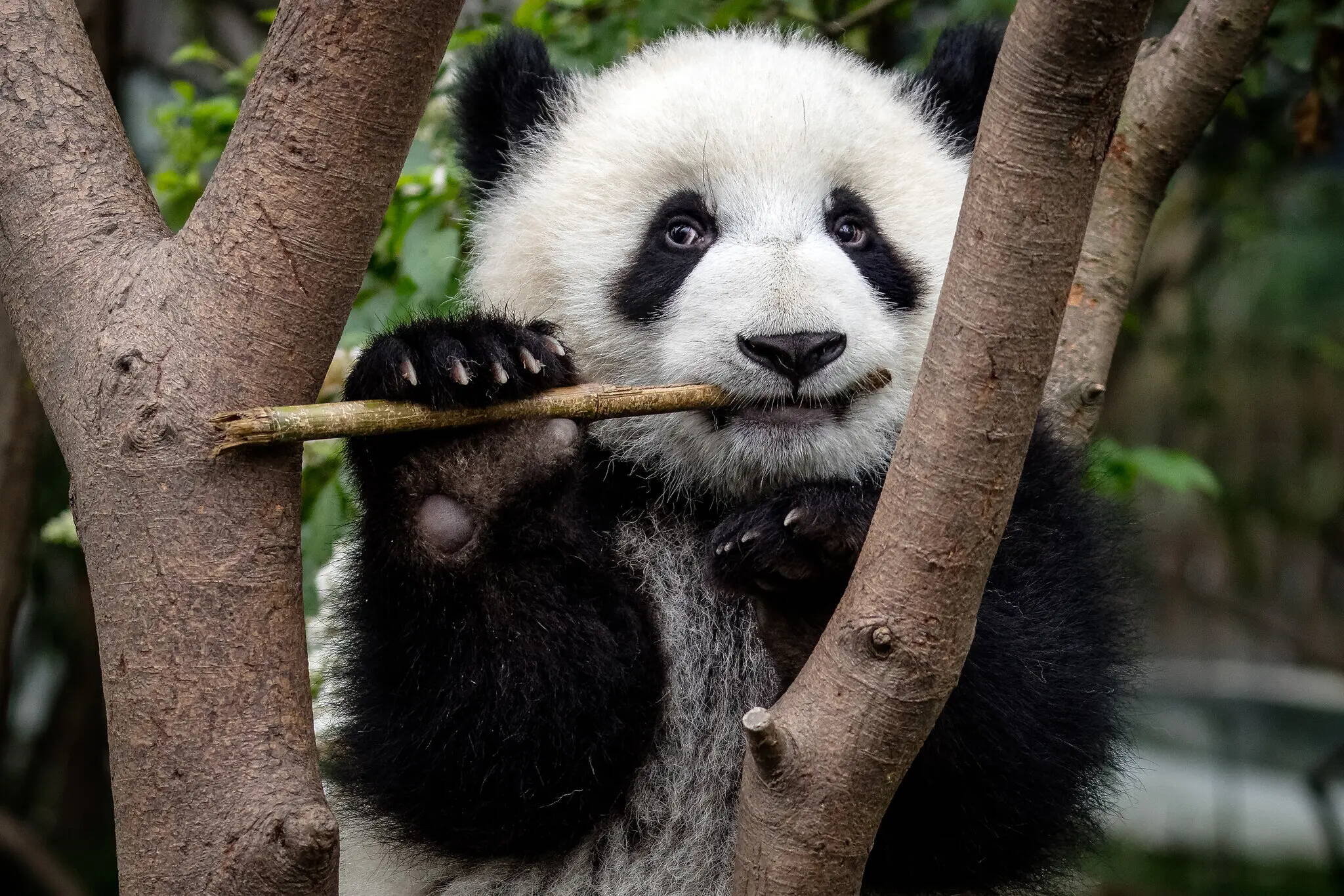
At the Chengdu Research Base of Giant Panda Breeding in China, a giant panda held a bamboo snack with the help of a thumblike digit. (Sharon Fisher / The New York Times)

At the Chengdu Research Base of Giant Panda Breeding in China, a giant panda held a bamboo snack with the help of a thumblike digit. (Sharon Fisher / The New York Times)

On the Trails: Little bones

We’re all familiar with the major bones of a human body, although many folks don’t know their official names. Far less well-known are some small bones, most of which are really tiny, roughly the size of a sesame seed. They are therefore called sesamoid bones, and they form within tendons that connect muscles to bones; most of them do not articulate directly with other bones.

Humans sometimes have dozens of these little bones, especially at the joints in hands and feet, although the number of them varies with genetics and usage. Like other bones, they ossify gradually, as we grow. Most of these little bones are tiny, but slightly bigger ones (a centimeter or so) are associated with our big toes and thumbs, and the biggest of all is the knee-cap or patella.

The patella develops within the tendon that runs from the quadriceps muscle of the thigh (thighbone = femur) to the shinbone (tibia); that muscle is involved in extending or straightening the leg. The patella protects the joint between femur and tibia and, like other sesamoid bones, it is thought to provide some mechanical advantage or leverage to the muscles that move the jointed appendage.

Other animals have sesamoid bones too, of various sizes. They occur in most lizards and in bird feet, legs, and wings. Mammals usually have patellas and other smaller sesamoid bones. Interestingly, patellas have disappeared in some mammalian lineages (e.g. Monotremes—the echidnas and platypus); they have come and gone in a few other lineages too.

In some cases, in the course of evolution, a sesamoid bone has enlarged and acquired a new function. According to most classifications, pandas are bears, but they occupy a separate evolutionary lineage within that group. Giant pandas are the well-known black and white bamboo-eaters of China, popularized as children’s toys. They have developed a special sesamoid bone of the wrist, associated with the arm bone called the radius, so it’s called a radial sesamoid bone. It’s an addition to the normal five toes that bears usually have, and, unlike human thumbs, is not fully opposable. Nevertheless, it functions like a thumb and enables a panda to hold a bamboo stalk so it can strip off bamboo leaves and eat them, along with new shoots. The panda’s “thumb” has a pad beneath it, like the other hand bones do, and there is a groove between the pads, where the critter holds the stalk. Most of their diet is bamboo, and they eat a lot of it.

Red pandas of the eastern Himalayas are also highly herbivorous, eating lots of bamboo, although they snack on fruits and bugs and other things too. They also have a radial sesamoid bone that aids in manipulating bamboo stalks as well as helping them climb small branches. They are not very closely related to giant pandas, and their enlarged radial sesamoid bone has evolved independently.

Moles are burrowers and they too have a large radial sesamoid bone that’s like the panda’s thumb. In the case of moles, it increases the size of the front foot, probably for better digging of the burrows. Peruvian cotton rats are reported to have an enlarged radial sesamoid bone that may assist them in grasping small branches and twigs, as they may sometimes climb in search of food, but this needs further documentation, because they apparently live mostly in arid, grassy areas.

I’ve also read that elephants can develop a so-called sixth toe, which may increase stability. It develops in a cartilaginous and fatty lump behind the other, forward-pointing toes and points towards the back of the foot, ossifying as the critter ages. Elephants actually walk on tiptoe, although that is not evident externally, so the “sixth toe” provides another sturdy point of ground contact. It may have originated when elephant ancestors walked more on land and became very large.

Although this topic may seem rather arcane for Juneau natural history, I hope readers will think of it broadly in terms of what unusual twists can sometimes occur in the course of evolution.

• Mary F. Willson is a retired professor of ecology. “On The Trails” appears every Wednesday in the Juneau Empire.

More in Sports

The Juneau-Douglas High School: Yadaa.at Kalé Crimson Bears won fourth place during the Division II Hockey State championships in Palmer last weekend. Photo courtesy of Rapi Sotoa
Juneau takes home fourth place during high school state hockey tournament

The Crimson Bears also received the Sportsmanship Award last weekend.

Senior Juneau-Douglas High School: Yadaa.at Kalé hockey players were recognized at the Treadwell Arena on Friday, Jan. 23, 2026 before the Crimson Bears faced the Homer High School Mariners. Head coach Matt Boline and assistant coaches Mike Bovitz, Luke Adams, Jason Kohlase and Dave Kovach honored 11 seniors. (Chloe Anderson / Juneau Empire)
JDHS celebrates hockey team’s senior night with sweeping victory over Homer

The Crimson Bears saw an 8-2 victory over the Mariners Friday night.

Photo by Ned Rozell
Golds and greens of aspens and birches adorn a hillside above the Angel Creek drainage east of Fairbanks.
Alaska Science Forum: The season of senescence is upon us

Trees and other plants are simply shedding what no longer suits them

Things you won’t find camping in Southeast Alaska. (Jeff Lund/Juneau Empire)
I Went to the Woods: Sodium and serenity

The terrain of interior Alaska is captivating in a way that Southeast isn’t

An albacore tuna is hooked on a bait pole on Oct. 9, 2012, in waters off Oregon. Tuna are normally found along the U.S. West Coast but occasionally stray into Alaska waters if temperatures are high enough. Sport anglers catch them with gear similar to that used to hook salmon. (Photo provided by the National Oceanic and Atmospheric Administration/West Coast Fisheries Management and Marine Life Protection)
Brief tuna bounty in Southeast Alaska spurs excitement about new fishing opportunity

Waters off Sitka were warm enough to lure fish from the south, and local anglers took advantage of conditions to harvest species that make rare appearances in Alaska

Isaac Updike breaks the tape at the Portland Track Festival. (Photo by Amanda Gehrich/pdxtrack)
Updike concludes historic season in steeplechase heats at World Championships

Representing Team USA, the 33-year-old from Ketchikan raced commendably in his second world championships

A whale breaches near Point Retreat on July 19. (Chloe Anderson/Juneau Empire)
Weekly Wonder: The whys of whale breaching

Why whales do the things they do remain largely a mystery to us land-bound mammals

Renee Boozer, Carlos Boozer Jr. and Carlos Boozer Sr. attend the enshrinement ceremony at the Naismith Basketball Hall of Fame in Sprinfield, Massachusetts, on Saturday, Sept. 6, 2025. As a member of the 2008 U.S. men's Olympic team, Boozer Jr. is a member of the 2025 class. (Photo provided by Carlos Boozer Sr.)
Boozer Jr. inducted into Naismith Hall of Fame with ‘Redeem Team’

Boozer Jr. is a 1999 graduate of Juneau-Douglas: Yadaa.at Kale

Photo by Martin Truffer
The 18,008-foot Mount St. Elias rises above Malaspina Glacier and Sitkagi Lagoon (water body center left) in 2021.
Alaska Science Forum: The long fade of Alaska’s largest glacier

SITKAGI BLUFFS — While paddling a glacial lake complete with icebergs and… Continue reading

Photo by Jeff Lund/Juneau Empire
The point of fishing is to catch fish, but there are other things to see and do while out on a trip.
I Went to the Woods: Fish of the summer

I was amped to be out on the polished ocean and was game for the necessary work of jigging

A female brown bear and her cub are pictured near Pack Creek on Admiralty Island on July 19, 2024. (Chloe Anderson for the Juneau Empire)
Bears: Beloved fuzzy Juneau residents — Part 2

Humor me for a moment and picture yourself next to a brown bear

Isaac Updike of Ketchikan finished 16th at the World Championships track and field meet in Budapest, Hungary, on Tuesday. (Alaska Sports Report)
Ketchikan steeplechaser makes Team USA for worlds

Worlds are from Sept. 13 to 21, with steeplechase prelims starting on the first day