

A bit of exploration of the rocky intertidal zone near Shaman Island yielded lots of big sea stars (mostly five-armed), little green sea urchins, and tiny snails (periwinkles or margarites? I’m never sure about telling the difference).
The best finds were discovered by lifting flat rocks to see who had found shelter there (and then very carefully replacing the rocks to their original position). There was a wee Dungeness crab, with a carapace no more than a centimeter wide, a miniscule hermit crab carrying its periwinkle shell only three millimeters wide, and a big hermit crab altogether lacking a shell — with no large empty shells readily available. Agitated pricklebacks and gunnels wriggled and flopped about, not liking our disturbance. These little fish are not blennies or eels, although they are often mistakenly called that by local folks. We found several empty cases left by tusk worms — small polychaete worms that adroitly build their cases by cementing together lots of fine sand grains.
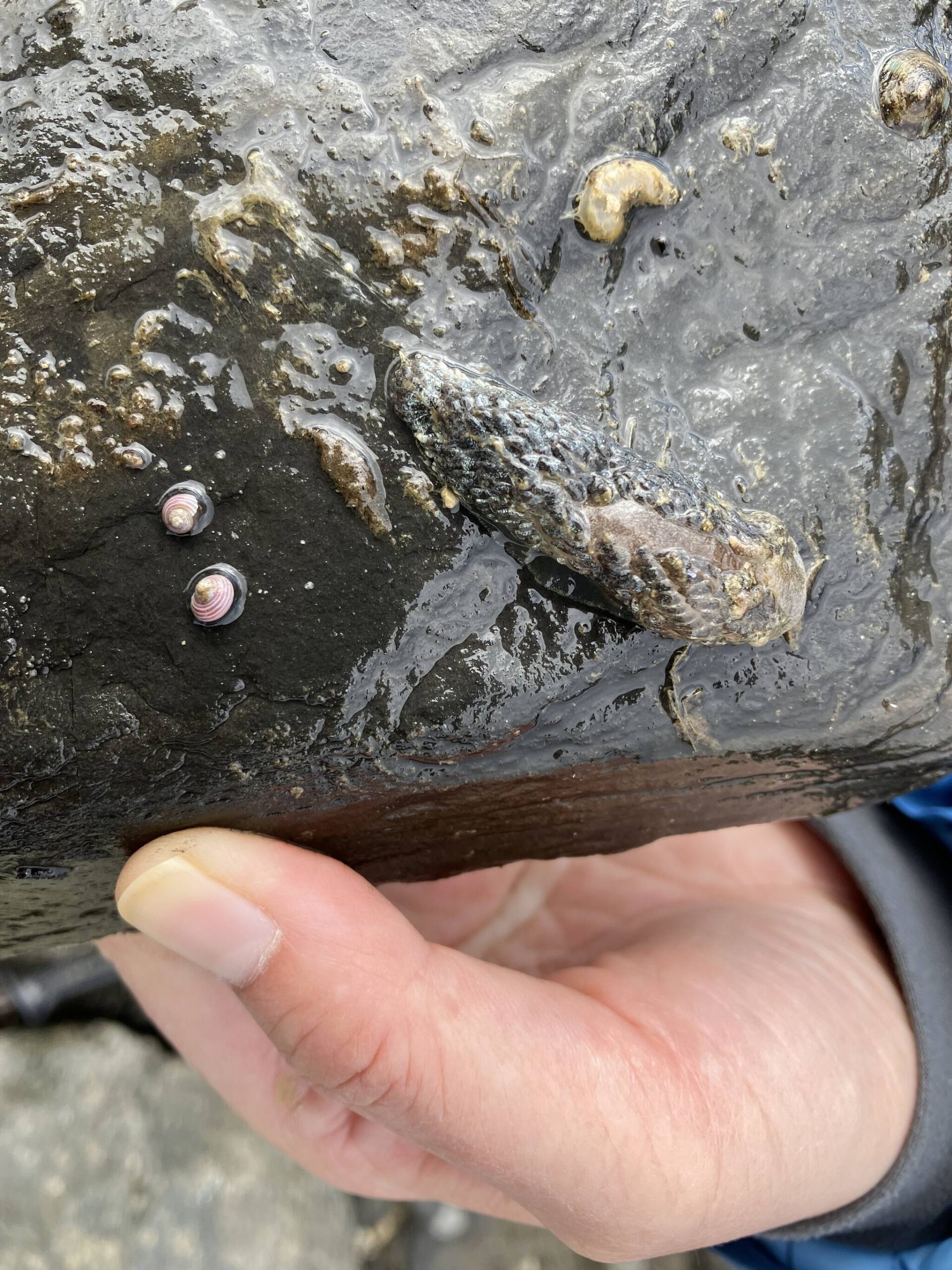
Shag rug sea slugs hide under the rocks and lay their eggs there. (Photo by Mary F. Willson)
There were two sea slugs (shellless molluscs known as nudibranchs) under the rocks, one of them near a coil of their newly laid eggs. They are called shag rug sea slugs, which bear numerous projections (cerata) along their backs, except for a long bare patch behind the head. Those cerata are used in respiration, but in these sea slugs they have other functions too. The usual prey of shag rug sea slugs are anemones, which defend themselves with stinging cells (nematocysts). Although shag rugs can partially deactivate the discharge of stinging cells by spreading mucus over the base of the anemone before biting off chunks, if the sea slug then ingests undischarged nematocysts, it may store them in the dorsal cerata for possible use in their own defense. In addition, some anemones harbor symbiotic photosynthetic unicellular green algae and dinoflagellates, and a foraging sea slug may store those in the cerata too, where they can continue photosynthesis for several days, generating carbohydrates, perhaps for an ‘after-dinner treat’? Very versatile, those cerata!
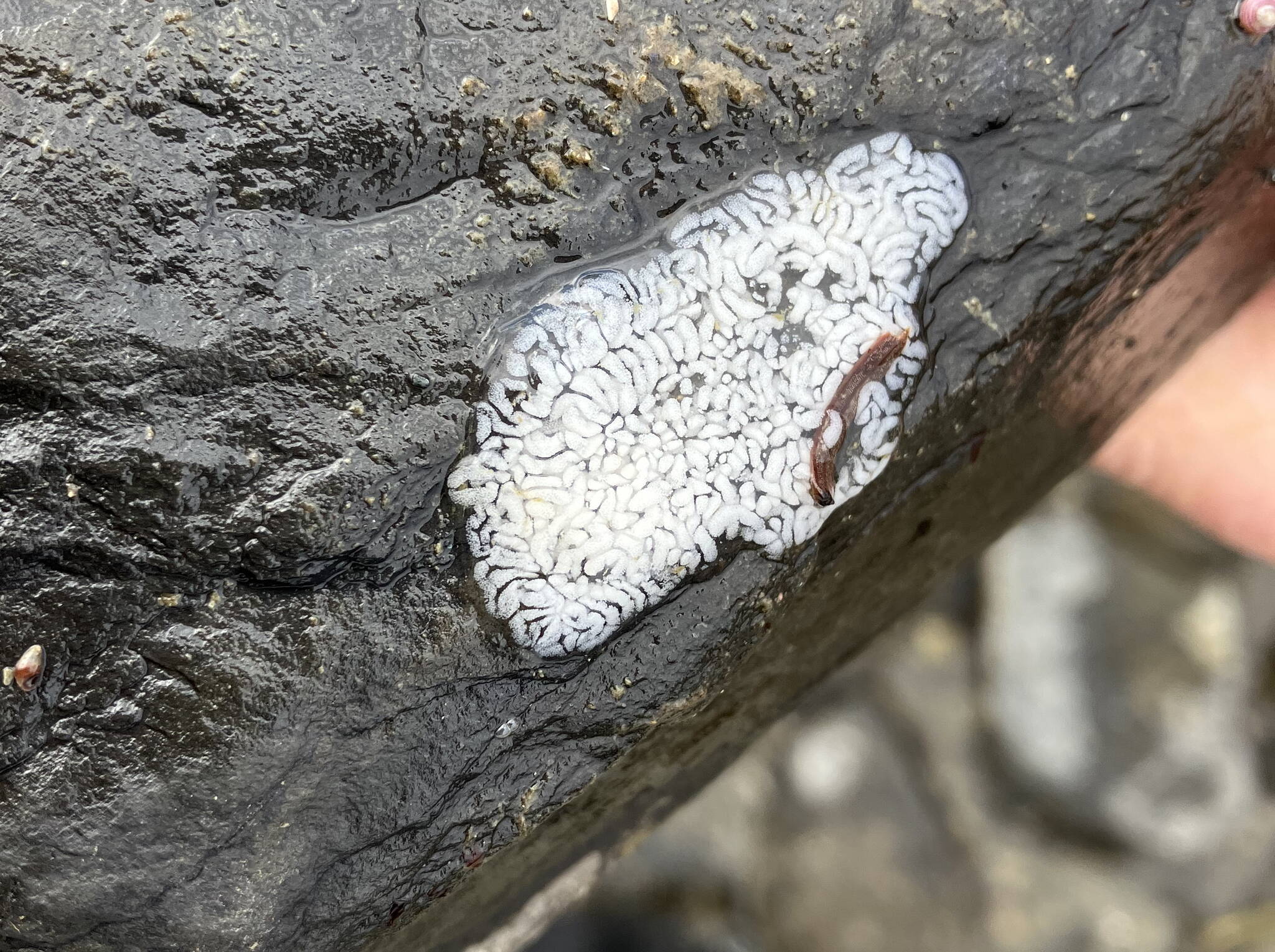
Eggs from shag rug sea slugs. (Photo by Mary F. Willson)
A brown alga known as rockweed often attaches to intertidal rocks, sometimes forming large mats. Lots of critters find shelter and food there. Mussels attach to the algal fronds and are eaten by ducks and maybe gulls too. Periwinkles graze on microalgae on the rockweed surface and on the rockweed itself. However, their grazing on rockweed induces defensive chemicals that deter further feeding there, so the grazers have to shift their attentions to un-grazed fronds that have fewer defenses; that keeps them moving around. There are isopods (crustaceans) that specialize on rockweed habitats, probably eating detritus. Amazingly, there is a ground beetle that seeks out such moist habitats; both larvae and adults eat snails! The isopods and the beetles have been observed in local rockweed beds. There must be amphipods, springtails, flies, and who knows what else tucked into those algal fronds, providing more prey for visitors to the algal beds. Mallards, goldeneyes, and buffleheads have been seen poking about in rockweed mats, looking for edibles in there. Other ducks may do so too, not to mention fish that could weave in and out of the fronds at high water levels.
Another intertidal habitat consists of sand with scattered rocks, often embedded, and clumps of rockweed. That seems to be a good place for pseudoscorpions (which I had not encountered before). There are thousands of species, but we seem to have just one. They are very small (usually less than one cm long) relatives of spiders that have strong pincers for capturing springtails and mites; the pincers contain venom that helps subdue the prey. Although they run around searching for prey, they also find refuge under those scattered rocks, where they make little round shelters.
The walk to the intertidal zone offers another kind of fun. At this time of year, you may hear Pacific wrens singing, sapsuckers drumming, and ruby-crowned kinglets singing. Recently, at Pt. Louisa, I saw a flock of white-winged crossbills carefully inspecting spruce cones on the ground, as if hoping for some retained seeds. The trees normally shed their cones when the seeds have gone, so I wonder just how many seeds are likely to found in discarded cones.
Thanks to the helpful folks at NOAA, Derek Sikes (UAF) and local naturalist Bob Armstrong for helpful consultations.
• Mary F. Willson is a retired professor of ecology. “On the Trails” appears every Wednesday in the Juneau Empire.
