
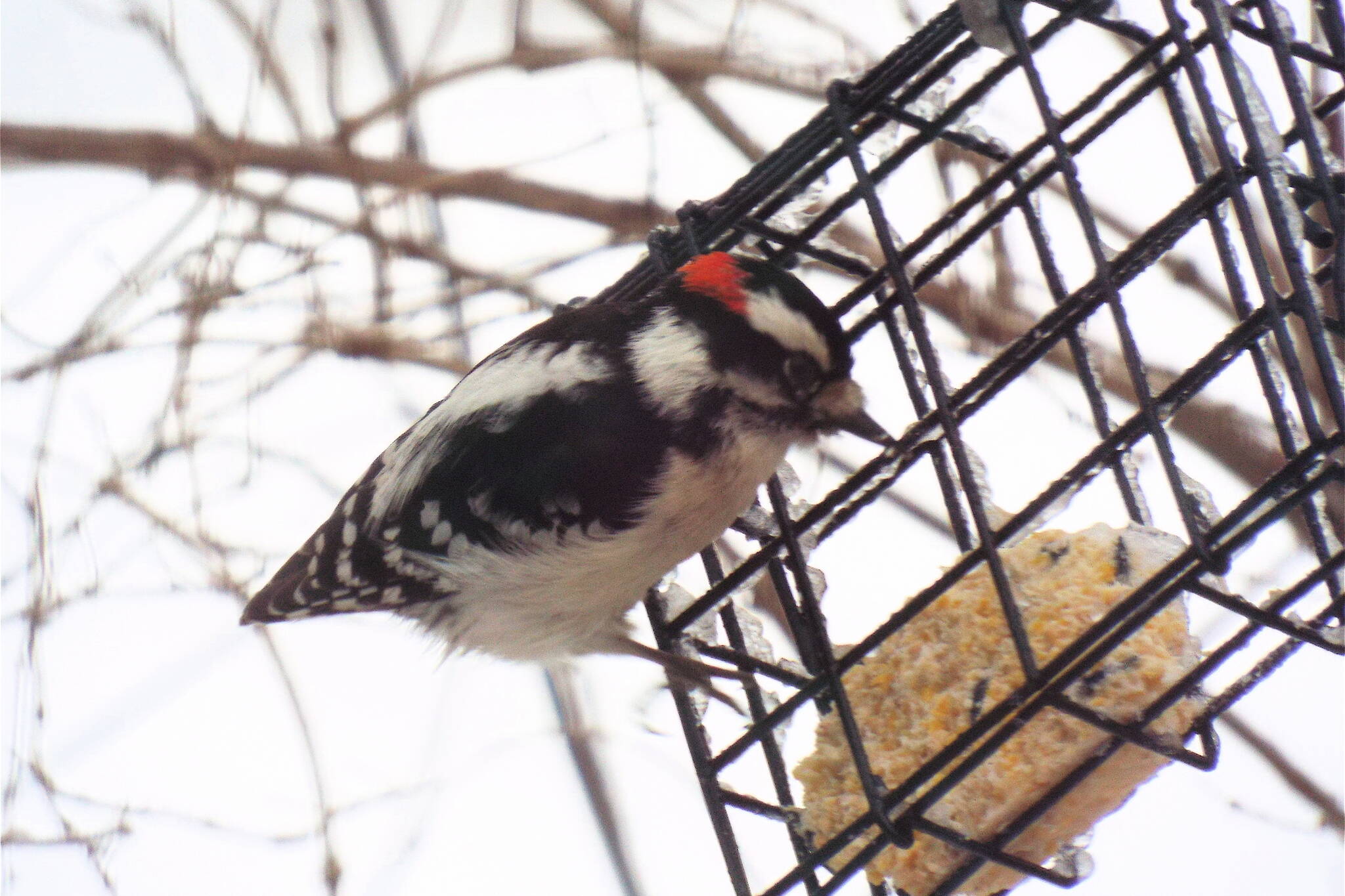
A male downy woodpecker pecks at a suet block with its small bill. (Photo by Steve Willson)

On the Trails: Hairy and downy woodpeckers

A male hairy woodpecker is a regular visitor to my peanut butter feeders, also sampling from the suet from time to time. In a previous year, a male brought a juvenile with him almost every day — perhaps the same male; limited data show that some individuals can live as long as 15 years. Male hairies are attentive parents, participating in all phases of nesting and chick rearing.

Hairy woodpeckers get their name from long filamentous feathers on their white backs. However, I’ve found no information on possible uses of those special feathers for display. Downy woodpeckers are named for the patch of soft, down feathers on the lower back. Males have a red patch on the back of the head, sometimes divided into two parts by a narrow, vertical black band. The red patch can be used in courtship displays.

Hairy woodpeckers are readily distinguished visually from the similar-looking and closely related downy woodpeckers by size. Hairies average just over nine inches long and downies average just under seven inches long (males and females are typically similar in size), being slightly larger in the northern part of their range. The bill on hairies is relatively longer and stouter too. The outer tail feathers of hairies are usually white, unmarked with black, while downies have small black marks along the edges of those feathers.
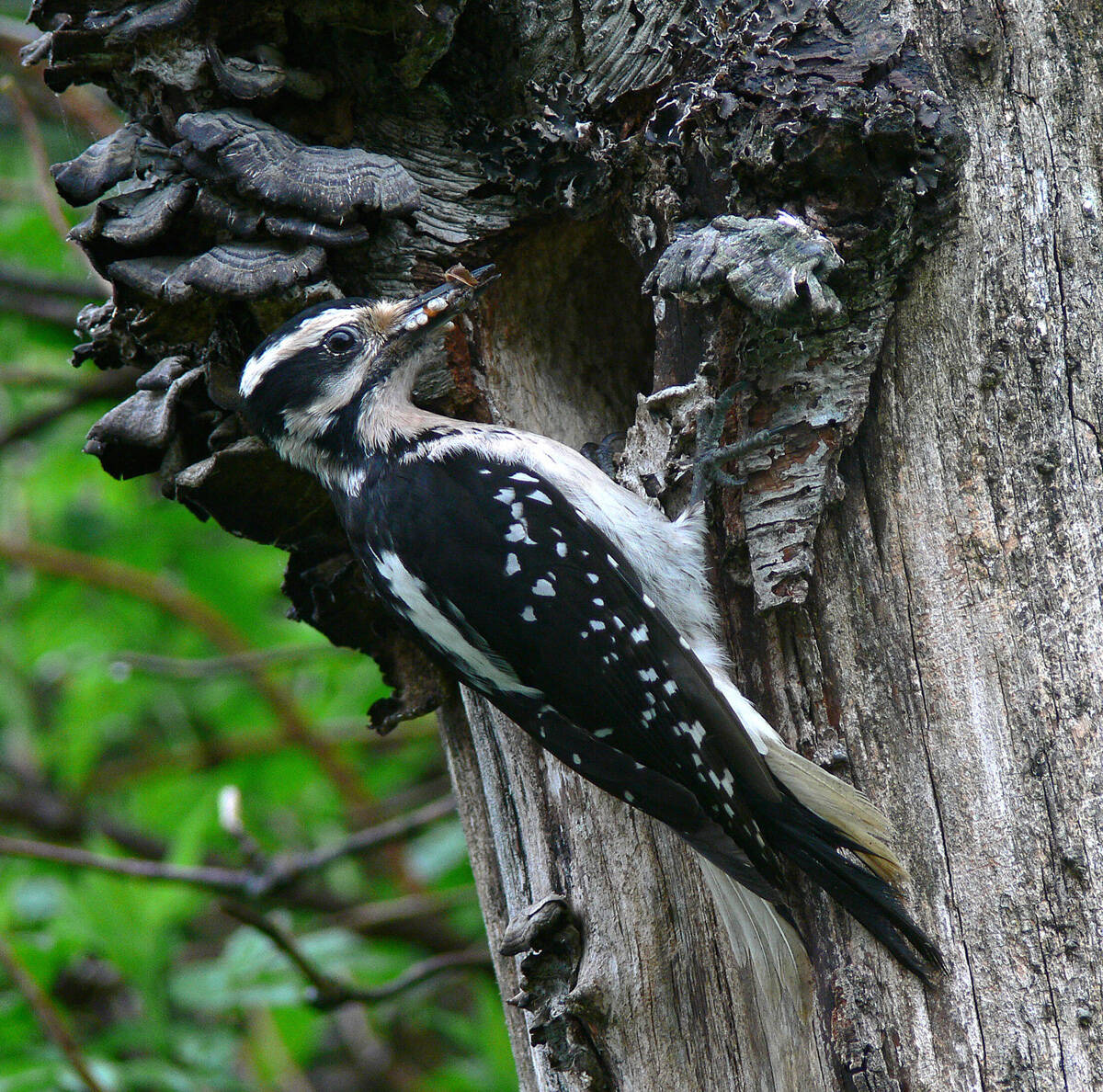
A female hairy woodpecker attends her nest. (Photo by Bob Armstrong)

Both species range widely over North America, south of the far north Arctic zone; some populations of hairies also occur in Central America. They are considered to have year-round resident populations. Neither species is regularly migratory, but some seasonal movements of some individuals seem to occur sometimes in some areas, either locally or occasionally long-distance dispersing of young adults.

In general, hairies live in forested areas, both deciduous and coniferous, but there is regional variation in the types of forest preferred. Downies prefer deciduous forest or mixed forest with lots of deciduous trees. Hairies commonly forage on tree trunks and branches, downies use tree trunks too, but they are more likely to forage on small branches, vines, sturdy vegetation stems, and goldenrod galls. Downies glean the surface, probe into crevices, and excavate small holes. In addition to gleaning the surface, hairies often flake off loose bits of bark; wood-boring larvae are detected by tapping a branch. If one is located, the bird may excavate a hole to pursue the prey under the bark. Both eat a variety of arthropods, as well as some fruit and sometimes seeds, occasionally sipping sap from sapsucker wells. In some regions, males and females of both species often choose different foraging substrates.

Breeding behavior of hairies and downies is similar. Both male and female excavate the nest cavity, commonly in a large tree or snag with heart-rot fungus. Eggs are laid one per day. Clutch size varies, but typically averages four or five eggs. Incubation, by both parents, lasts roughly 12 days and starts with the last egg, so hatching is usually synchronous. If, however, one egg hatches a bit late, that chick is at a competitive disadvantage with its siblings, and it often dies. Both parents brood the chicks, the male usually at night, and both parents feed the chicks. The parents consume the fecal sacs of very young chicks and carry away those of older chicks (at least for downies, males do most of this).

The nestling period for downies is shorter than for hairies: downies stay in the nest around three weeks while hairies stay for around four weeks. Fledglings stay with their parents and are fed by them for three or more weeks. Juveniles mature in one year and are generally ready to breed a year after hatching.

• Mary F. Willson is a retired professor of ecology. “On The Trails” appears every Wednesday in the Juneau Empire.

More in Sports

Senior Juneau-Douglas High School: Yadaa.at Kalé hockey players were recognized at the Treadwell Arena on Friday, Jan. 23, 2026 before the Crimson Bears faced the Homer High School Mariners. Head coach Matt Boline and assistant coaches Mike Bovitz, Luke Adams, Jason Kohlase and Dave Kovach honored 11 seniors. (Chloe Anderson / Juneau Empire)
JDHS celebrates hockey team’s senior night with sweeping victory over Homer

The Crimson Bears saw an 8-2 victory over the Mariners Friday night.

Photo by Ned Rozell
Golds and greens of aspens and birches adorn a hillside above the Angel Creek drainage east of Fairbanks.
Alaska Science Forum: The season of senescence is upon us

Trees and other plants are simply shedding what no longer suits them

Things you won’t find camping in Southeast Alaska. (Jeff Lund/Juneau Empire)
I Went to the Woods: Sodium and serenity

The terrain of interior Alaska is captivating in a way that Southeast isn’t

An albacore tuna is hooked on a bait pole on Oct. 9, 2012, in waters off Oregon. Tuna are normally found along the U.S. West Coast but occasionally stray into Alaska waters if temperatures are high enough. Sport anglers catch them with gear similar to that used to hook salmon. (Photo provided by the National Oceanic and Atmospheric Administration/West Coast Fisheries Management and Marine Life Protection)
Brief tuna bounty in Southeast Alaska spurs excitement about new fishing opportunity

Waters off Sitka were warm enough to lure fish from the south, and local anglers took advantage of conditions to harvest species that make rare appearances in Alaska

Isaac Updike breaks the tape at the Portland Track Festival. (Photo by Amanda Gehrich/pdxtrack)
Updike concludes historic season in steeplechase heats at World Championships

Representing Team USA, the 33-year-old from Ketchikan raced commendably in his second world championships

A whale breaches near Point Retreat on July 19. (Chloe Anderson/Juneau Empire)
Weekly Wonder: The whys of whale breaching

Why whales do the things they do remain largely a mystery to us land-bound mammals

Renee Boozer, Carlos Boozer Jr. and Carlos Boozer Sr. attend the enshrinement ceremony at the Naismith Basketball Hall of Fame in Sprinfield, Massachusetts, on Saturday, Sept. 6, 2025. As a member of the 2008 U.S. men's Olympic team, Boozer Jr. is a member of the 2025 class. (Photo provided by Carlos Boozer Sr.)
Boozer Jr. inducted into Naismith Hall of Fame with ‘Redeem Team’

Boozer Jr. is a 1999 graduate of Juneau-Douglas: Yadaa.at Kale

Photo by Martin Truffer
The 18,008-foot Mount St. Elias rises above Malaspina Glacier and Sitkagi Lagoon (water body center left) in 2021.
Alaska Science Forum: The long fade of Alaska’s largest glacier

SITKAGI BLUFFS — While paddling a glacial lake complete with icebergs and… Continue reading

Photo by Jeff Lund/Juneau Empire
The point of fishing is to catch fish, but there are other things to see and do while out on a trip.
I Went to the Woods: Fish of the summer

I was amped to be out on the polished ocean and was game for the necessary work of jigging

A female brown bear and her cub are pictured near Pack Creek on Admiralty Island on July 19, 2024. (Chloe Anderson for the Juneau Empire)
Bears: Beloved fuzzy Juneau residents — Part 2

Humor me for a moment and picture yourself next to a brown bear

Isaac Updike of Ketchikan finished 16th at the World Championships track and field meet in Budapest, Hungary, on Tuesday. (Alaska Sports Report)
Ketchikan steeplechaser makes Team USA for worlds

Worlds are from Sept. 13 to 21, with steeplechase prelims starting on the first day

Old growth habitat is as impressive as it is spectacular. (Photo by Jeff Lund/Juneau Empire)
I Went to the Woods: The right investments

Engaged participation in restoration and meaningful investment in recreation can make the future of Southeast special