
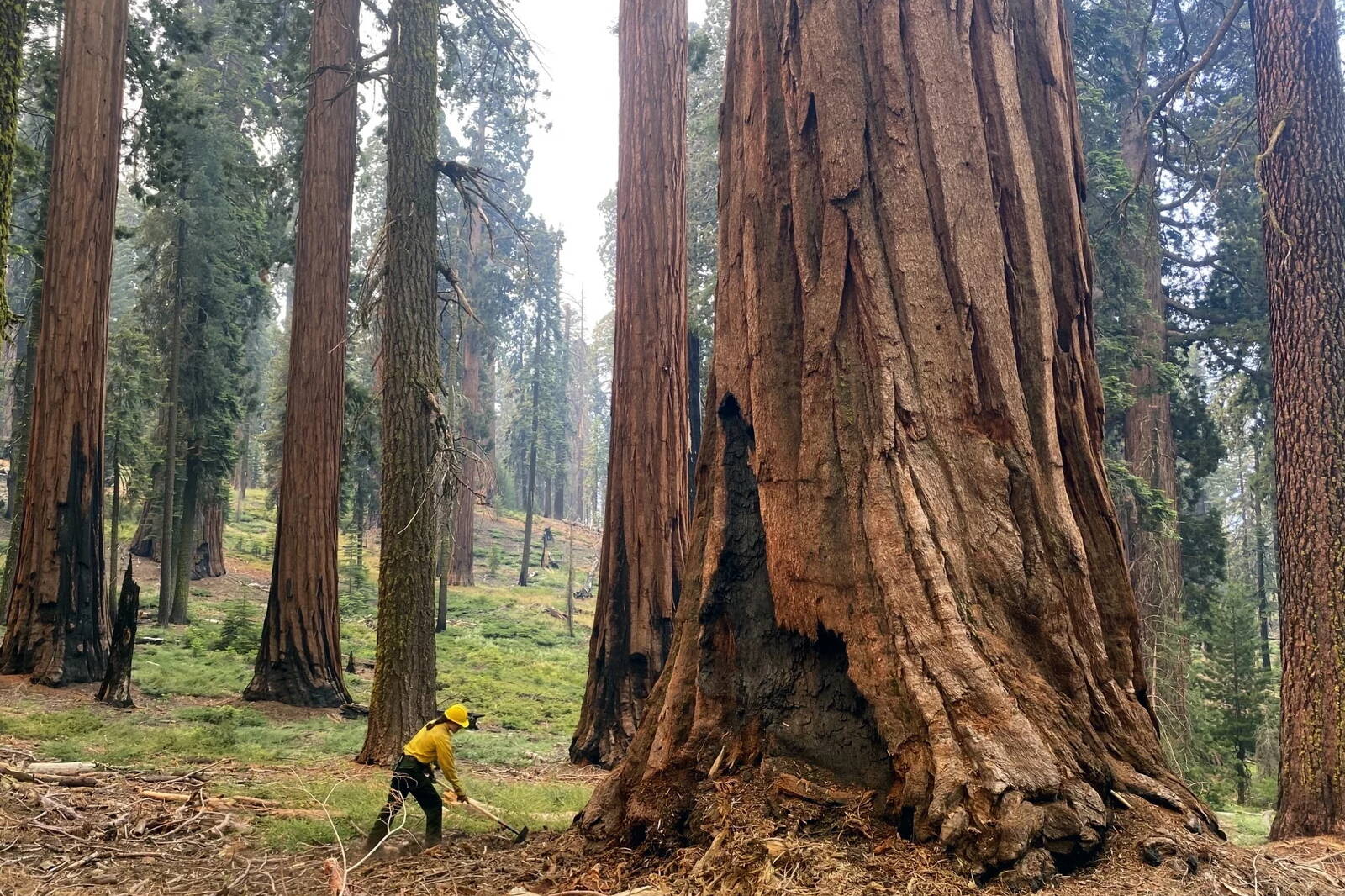
In areas subject to fairly frequent wildfires, especially surface fires, we find many plants that have evolved resistance to burning, even taking advantage of the cleared ground for seed germination.
One of the most famous of these is the coastal redwood (Sequoia sempervirens). This species is known for achieving notable heights, well over 300 feet, immense girths (to almost 30 feet), and long life (almost 2,000 years in some cases). It grows in the rain-drenched coast of California and far southwestern Oregon, but has shallow root systems. The roots cannot supply enough water for such a large bulk and the trees are dependent on coastal fogs for water, which is taken up through leaves and bark.
Redwoods resist burning with very thick bark (over a foot thick near the base) and little burnable resin in the wood. And they have thick lignotubers in the soil near the base of the trunk that are somewhat protected by soil and bark; these can produce new shoots, doing so especially when the main trunk is damaged. Although they resist burning by surface fires, redwoods sometimes experience seemingly catastrophic fires that burn the entire crown, killing the needles, and blackening the trunks. One such fire occurred in 2020, not far from Santa Cruz, torching a stand of big trees.
But the trees are not dead. Within five months of the burn, stored carbon was being mobilized into new sprouts from under the bark; some of that carbon had been stored for almost 60 years. But it wasn’t just the carbon that was old…some of the sprouts were coming from buds that had formed hundreds of years ago — up to a thousand or so years! Lots of trees store some buds underneath the bark, and they can sprout from a felled tree for a few years, but the age of these redwood sprouts is phenomenal — although quite in keeping with the trees’ longevity. Of course, it remains to be seen if those new, green sprouts will be sufficient to provide enough photosynthates to keep the trees in a living state.
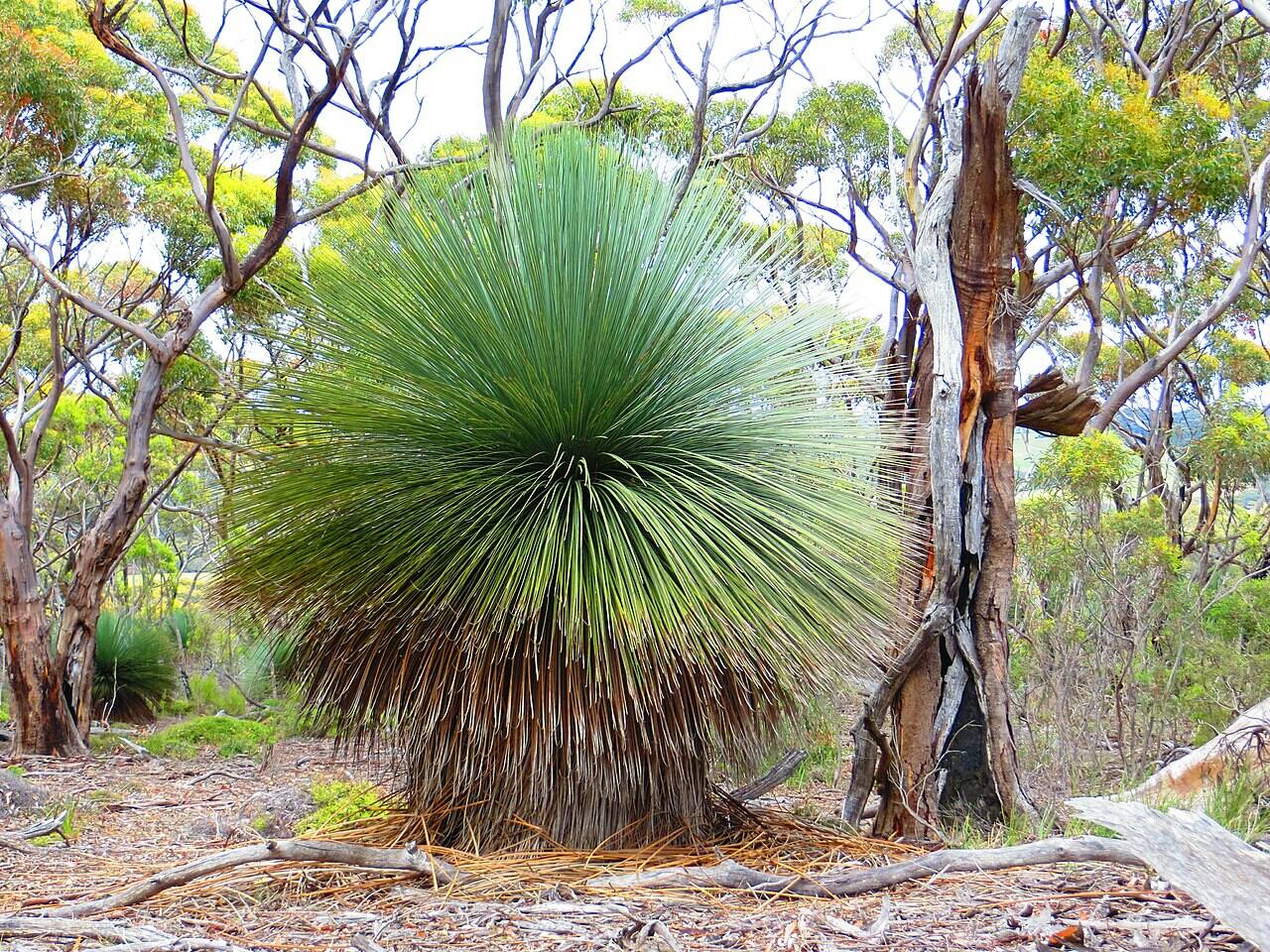
A Kangaroo Island grass tree at Cape Cassini in South Australia. (Republished under a Creative Commons Attribution-Share Alike 4.0 International license)
A wildfire can also clear the groundcover, removing possible competition for seedlings and sometimes making a fertile bed of ashes for seed germination. Hundreds of tree species in many evolutionary lineages take advantage of that by having mature, seed-bearing cones that remain closed, sometimes for years, not releasing seeds until the heat of a surface fire rises up and melts the resins that hold the cone shut. In effect, they have an above-ground seedbank. Such cones are called “serotinous” (meaning “late-opening”) and they are characteristic of trees in dry forests all around the world, from China and South Africa to Australia and North America, where surface fires are relatively common.
Examples of North American species with serotinous cones include Monterey pine, jack pine, some lodgepole pines, and the giant sequoia (Sequoiadendron giganteum). The giant sequoia is in the same taxonomic family as the coastal redwood, but its fire adaptations are somewhat different. The very thick bark is fire-resistant and new sprouts can emerge from the trunk if branches are damaged. Lignotubers and stump sprouts may occur in young individuals. However, the cones are serotinous, releasing seeds after a surface fire. In addition to clearing understory vegetation that would impair seedling growth, low-level fires also prevent buildup of flammable vegetation that might burn sufficiently high and hot to damage the crowns of the sequoias.
Interestingly, researchers are finding that, even without a surface fire, intense solar heat sometimes opens serotinous cones, releasing seeds into a crowded, cluttered environment where seedlings would encounter intense competition. So we can infer that climate warming is likely to interfere with the evolved adaptation of serotinous cones and perhaps have serious effects on the tree populations.
Australia is well-known for its bush fires and many of its trees are fire-adapted. Some have thick bark, some have serotinous cones, some have lignotubers, and so on. In addition, there’s an unusual group of about 30 species called “grass trees.” Growing on nutrient-poor soils, they have mycorrhizal associates that increase the trees’ supply of water and nutrients. The main stem of some species is often mostly underground, but others make a perceptible trunk. Around the top of the stem, there is a dense ring of tough, grass-like leaves that are reported to make a hard, protective fire barrier. Flowers are borne on a long, upright spike above the leaves. Some of these species actually require a fire to initiate flowering, so they don’t even begin the process of making seeds until the ground is cleared around the parent plant. That’s considerably ahead of the usual schedule for serotinous cones, with their seeds ready to go. But why do those grass trees use fire to start the flowering process? I wonder what the pollination success and seed set might be, compared to flowers that don’t bloom in response to fire.
• Mary F. Willson is a retired professor of ecology. “On The Trails” appears every Wednesday in the Juneau Empire.
